
9 Hard Leetcode Problems to Challenge yourself in 2022

Introduction
If you are trying to get into FAANG companies, then there are probably 3–5 technical rounds where you would be asked to solve different problems using Algorithms and Data Structures.
The last few posts in the series were focused on Easy and Medium difficulty Leetcode problems that are prevalently asked in Software Engineer Interviews. The following set of problems are also asked in FAANG interviews, these are tagged as Hard.
I am not asking you to go and grind through all 1300 problems over there to become the best problem solver these companies look for. Instead, I have garnered a list of questions that get you started with this.
I consider this list to be the first step in getting the job you deserve. Leetcode: https://leetcode.com/explore/
Now, let’s go to the list
1) Count of Smaller Numbers After Self
You are given an integer array nums and you have to return a new counts array. The counts array has the property where counts[i] is the number of smaller elements to the right of nums[i].
Input: nums = [5,2,6,1]
Output: [2,1,1,0]
Explanation:
To the right of 5 there are 2 smaller elements (2 and 1).
To the right of 2 there is only 1 smaller element (1).
To the right of 6 there is 1 smaller element (1).
To the right of 1 there is 0 smaller element.
2) Median of Two Sorted Arrays
Given two sorted arrays nums1 and nums2 of size m and n respectively, return the median of the two sorted arrays.
Input: nums1 = [1,3], nums2 = [2]
Output: 2.00000
Explanation: merged array = [1,2,3] and median is 2.3) First Missing Positive
Given an unsorted integer array nums, return the smallest missing positive integer.
Input: nums = [1,2,0]
Output: 3Input: nums = [3,4,-1,1]
Output: 24) Trapping Rain Water
Given n non-negative integers representing an elevation map where the width of each bar is 1, compute how much water it can trap after raining.
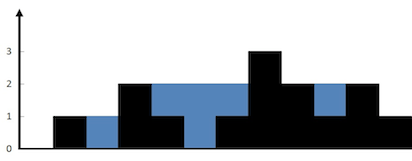
Input: height = [0,1,0,2,1,0,1,3,2,1,2,1]
Output: 6
Explanation: The above elevation map (black section) is represented by array [0,1,0,2,1,0,1,3,2,1,2,1]. In this case, 6 units of rain water (blue section) are being trapped.5) Word Ladder
A transformation sequence from word beginWord to word endWord using a dictionary wordList is a sequence of words beginWord -> s1 -> s2 -> ... -> sk such that:
- Every adjacent pair of words differs by a single letter.
- Every
sifor1 <= i <= kis inwordList. Note thatbeginWorddoes not need to be inwordList. sk == endWord
Given two words, beginWord and endWord, and a dictionary wordList, return the number of words in the shortest transformation sequence from beginWord to endWord, or 0 if no such sequence exists.
Input: beginWord = "hit", endWord = "cog", wordList = ["hot","dot","dog","lot","log","cog"]
Output: 5
Explanation: One shortest transformation sequence is "hit" -> "hot" -> "dot" -> "dog" -> cog", which is 5 words long.6) Find Minimum in Rotated Sorted Array II
Suppose an array of length n sorted in ascending order is rotated between 1 and n times. For example, the array nums = [0,1,4,4,5,6,7] might become:
[4,5,6,7,0,1,4]if it was rotated4times.[0,1,4,4,5,6,7]if it was rotated7times.
Notice that rotating an array [a[0], a[1], a[2], ..., a[n-1]] 1 time results in the array [a[n-1], a[0], a[1], a[2], ..., a[n-2]].
Given the sorted rotated array nums that may contain duplicates, return the minimum element of this array.
You must decrease the overall operation steps as much as possible.
Input: nums = [1,3,5]
Output: 1Input: nums = [2,2,2,0,1]
Output: 07) Closest Binary Search Tree Value II
Given the root of a binary search tree, a target value, and an integer k, return the k values in the BST that are closest to the target. You may return the answer in any order.
You are guaranteed to have only one unique set of k values in the BST that are closest to the target.

Input: root = [4,2,5,1,3], target = 3.714286, k = 2
Output: [4,3]
Input: root = [1], target = 0.000000, k = 1
Output: [1]8) Integer to English Words
Convert a non-negative integer num to its English words representation.
Input: num = 123
Output: "One Hundred Twenty Three"
Input: num = 12345
Output: "Twelve Thousand Three Hundred Forty Five"9) Find Median from Data Stream
The median is the middle value in an ordered integer list. If the size of the list is even, there is no middle value and the median is the mean of the two middle values.
- For example, for
arr = [2,3,4], the median is3. - For example, for
arr = [2,3], the median is(2 + 3) / 2 = 2.5.
Implement the MedianFinder class:
MedianFinder()initializes theMedianFinderobject.void addNum(int num)adds the integernumfrom the data stream to the data structure.double findMedian()returns the median of all elements so far. Answers within10-5of the actual answer will be accepted.
End of the Line
Thank you for reading the article. Good luck with your Programming Interview! Next post coming soon
Support us in bringing more articles to you by becoming a member.


