
How to Stop Feeling Overwhelmed

Ever felt like a stampede was coming?
1. Acknowledge what is happening
I have led an overwhelming life. Born in 1963, my twin sister and I were placed into a Catholic orphanage in Penang, Malaya, because our parents could not afford to care for us.
When we were 15 months old, a Doctor and his wife whom had moved to Australia from England, heard about us. They brought us out to Perth, Western Australia. At age 3, we were formally adopted.
Besides identity confusion, racism, and sexism, and loss of relationships, the youngest 5 in my adoptive family were abused as children, by several males in the family.
At times, I have been so frightened, lost and confused, that I have wished for the ground to open up and swallow me or to just disappear.
September 2018 saw me making it to age 55 alive and well, through inner strength and self-support, as well as through my own spirituality and support from others.
I began to feel good about myself, until I started comparing myself to others.
I started to feel overwhelmed by all that is possible, by there being so much to learn or to know; and especially by thinking about others around me who have been achieving a lot more than me, in my own eyes.
My acknowledgement was: I felt daunted or out-done by others.
Acknowledging something is more than knowing that something is happening.
It’s about acceptance, but not necessarily in terms of agreeing with or liking something.
Take a moment to say to yourself “I know that I am feeling that this is too much for me right now and I need to re-focus.” This is acknowledgement.

2. Change your focus
Take a deep breath, close your eyes for a few seconds if you want to, then walk away. If you are at your computer, comparing yourself to others or looking at your expenses or bills, get up and out of that room.
Step away from the trouble. You may have been arguing with your spouse or someone else, or he / she may not be listening to you, and you acknowledge that you feel angry, vexed, frustrated, and worried or upset.
Now is the time to think about and concentrate on something different, that doesn’t involve or include the source of what overwhelmed you.
Stretch, or give the dog a bath, or water the garden, wash the floor, or even walk slowly to the letter box and check for letters. If you’re at work, go get a glass of water or walk to the lifts or around the office for a minute.
Do this while consciously emptying your mind of any distressful feelings.
This is literally called “turning the corner.” Psychologists say that when you turn around or get up and turn around or walk away from something, you are opening up to new opportunities.
Consider that we live in space-time or the 4th dimension with solid objects in coordinate space, which gives the effect of linear time. When you move the mass, which is you, you are changing things in time, because movement through space connects moments.
A moment in “time” is really an experience that is connected to every other moment over all “time”, and a change of focus is like pulling levers or pressing switches, that makes new connections, which can lead to new ways or to right actions.
If you need to have a sleep or a rest to re calibrate a tired body, do that. Even closing your eyes and resting, while in a chair at work, for 2 minutes, can help.
A change of focus re-sets your mind. Use it to clear your mind and begin with a clean slate.
3. Change your thoughts
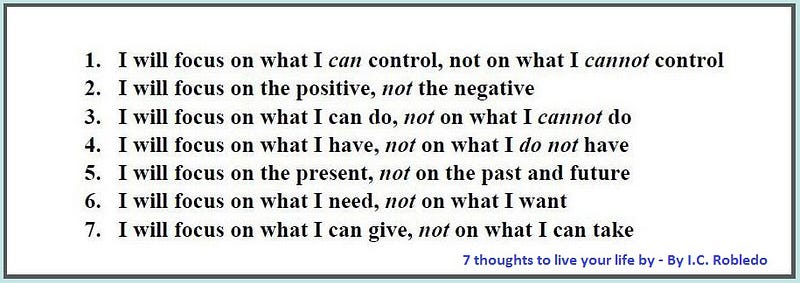
Paying attention to your feelings of overwhelm: distress, discomfort, uncertainty and helplessness, is the first step toward changing your thoughts and moving forward.
Earlier, when issues of self-worth and confidence came up for me, and I started to feel agitated, and thinking that others are better than me, I walked away, in order to wipe the slate clean.
It is important to note that it is the energy that you are recycling. Give yourself the time to unwind and to recharge, by literally moving away from the situation, and “turning the corner.”
The “7 Thoughts to live your life by” as put forward by Isaac Robledo are excellent guidelines for you to now change your thoughts, after owning your feelings, then changing your focus.
You are not ignoring the situation. Rather, you are transforming the energy that is fueling your feelings of being overwhelmed, into energy that will help you get through your situation.
In my case, I realized it was my choice to feel overwhelmed by my own expectations, and realized that it was within my control to change my feelings of being overwhelmed and of not being good enough.
After this initial realization or acceptance (Thought number 1) thoughts under the points 2 to 5 above easily fell into place for me.
Point number 2: There is plenty of evidence around that shows me personally, that I have led a productive Life using my skills and interests to help and inspire others, and that people like me.
Point number 3: I will continue as I am, because I have realized that my worries over “not being able to make the grade” or not being good enough, were based upon “hot air” or false thoughts (presumptions).
Point number 4: What I have in the “Now” is my significant contribution to writing, and my unique experiences, which have been helpful to some people. There is nobody like me, and right at this moment I am loved and I am worthwhile.
Point number 5: I have the power in the here and now to be positive and realistic, which includes controlling what I can control, and what I can do with the resources that I have.
I get it that some thoughts may try to be pervasive or lingering, especially when it comes to money concerns or serious issues, which you really have to do something about.
Perhaps you have an important bill to pay, and it is scary or worrisome because you can’t get around it or ignore it, because you know it has to be paid eventually. You don’t have enough money for it right now.
Here is where Points 5 and 6 come into play.
Isaac Robledo, the proponent of “The 7 thoughts to live by” says that the categories of thoughts are sub-sets in a hierarchy.
You have to think in terms of numbers 1 to 6 before you think in terms of number 7. Your essential needs come first, before you can really help others, to your utmost.
Well, after going through stages 1 and 2 above, you would do well to write down all the possible steps that you can do (following Point number 3), with examples below.
- Ask if you can pay the bill later or by installments
- Borrow from someone you know
- Sell something to raise some funds, even to work colleagues (this latter is something that I do)
- Take money out from your mortgage surplus
- Re-arrange your Budget to pay the bill, and then perhaps later use some funds for what you may have wanted to pay for right now
- Ask someone to split the bill with you
- Offer something to someone, in exchange for payment
- Sell something to a Pawn broker
- Draw from your superannuation

It’s really important to focus on the present (the “here and now”) and on what you need, if money (or some other matter that is very serious or compelling) is involved. “Climb every mountain” one at a time.
This means DON’T WORRY about the future. In the space-time continuum of all dimensions, the future has already happened, and you are right now designing your Life through your thoughts, which includes planning how to manage your activities to meet a goal.
Thoughts such as “Oh my God, what about July’s payment?” (when July is 2 months away) are better re-framed as: “Let’s pay this and get it out of the way, then reassess and plan later for July.”
If you need to repeat Stage 1 (acknowledge your feelings) and Stage 2 (change your focus), before, or among coming up with your options, then do so.
Exercise or stretches may help because this gets the fluids in your body circulating, for your benefit.
Remember, practice makes progress. 💥
More times than not, you will be able to apply the 7 categories of thoughts after releasing your feelings of being overwhelmed and after “setting your face” toward resolving what brought them up.
Then you can (theoretically) go “riding on the horses” (like in Daryl Braithwaite’s song “Horses), rather than giving up altogether on what has overwhelmed you.
Once you are not so easily overwhelmed (yes, feeling less overwhelmed over time does happen), thought number 7, being a focus on what you can give, will come naturally to you in all sorts of ways, and will reinforce your feelings of well-being.
Even if there are times when everything seems against you, remember that you can try to do something, and that every little positive thing counts.
If you are feeling overwhelmed, ask yourself “Is what I am thinking about true?” and “what can I do about this?” after accepting how you are feeling and going for a walk or doing something different.
It’s your choice. Make it a good one.
Thank you for reading!


