
10 Most Important Blockchain Projects For Making Money
Bitcoin will do to banks what email did to the postal industry

Win a Lambo Finance, Cosby Token, and Viagra Token… these are among the worst-performing cryptocurrencies on the market.
There are over 5,000 blockchain projects and more than half of them are complete scams. This makes the task of finding a great crypto project very daunting, to say the least.
However, as I explained to my mom when opening up her first Coinbase account, investing in cryptocurrency isn’t rocket science.
As much as I’d love to find the next Ethereum or Basic Attention Token, why not just invest in Ethereum or Basic Attention Token?
There’s a clear edge that the top blockchain projects have over the rest. So instead of analyzing low-quality projects, let’s take a look at the top 10 most important cryptocurrencies in the blockchain ecosystem.
1. Bitcoin (BTC)
Financial freedom is measured in binary code. Bitcoin
Can there really be any debate as to which cryptocurrency is the most important one? Yes! But we’ll save that for another day…
Bitcoin is the oldest, most respected, most valuable and most popular crypto by far, and no other coin or token even comes close.
The value proposition of Bitcoin is simple: An internet currency that is fully transparent, with no banks in the middle to create trust and is secured by cryptography.
Bitcoin’s never been hacked, it’s bulletproof to inflation, and it's highly decentralized. What more could you ask for?
2. Ethereum (ETH)
Ethereum was the first crypto project to implement smart contracts on a large scale.
Without Ethereum, there would be no DeFi and no NFTs. Almost all advanced applications of blockchain technology have been pioneered by ETH.
They even have a smart contract called a dead man’s switch, which acts as a will and activates when you die. Controversial figure John Mcafee was rumored to have one.
“Whereas most technologies tend to automate workers on the periphery doing menial tasks, blockchains automate away the center. Instead of putting the taxi driver out of a job, blockchain puts Uber out of a job and lets the taxi drivers work with the customer directly. “— Vitalik Buterin, creator of Ethereum
Speaking recently with a friend, I do sometimes wish Vitalik Buterin — and the Ethereum project as a whole— were more normal.
Ethereum needs simple things to grow right now. It needs better marketing, it needs better info for mainstream audiences and as much as I love Vitalik, Ethereum needs a more charismatic spokesperson.
Although I will say Vitalik has tried and is getting better!
Ethereum is my personal favorite cryptocurrency. I could write a steamy love song about it — but we’ll save that for another day too.
3. Ripple (XRP)
Instead of moving away from traditional finance, XRP attempts to use blockchain technology to improve existing monetary systems.
XRP is the cryptocurrency for banks, and therefore, is one of the most controversial coins in the crypto ecosystem.
While other cryptocurrencies usually try to be decentralized, XRP was the first centralized, corporate crypto that gained popularity en masse.
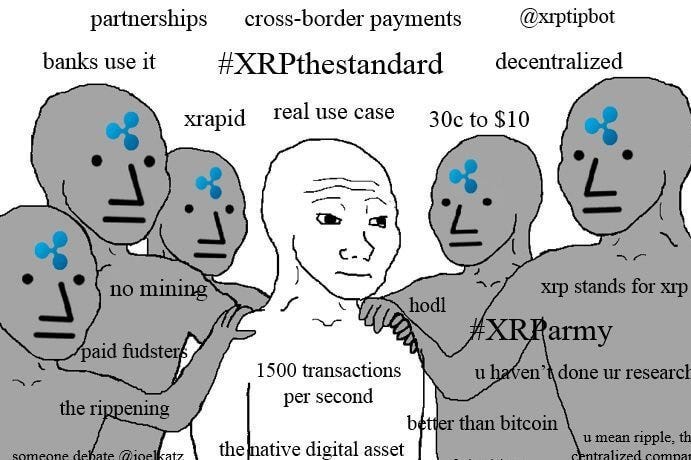
The recent legal troubles of Ripple Labs have caused many people to think that XRP will soon be dead. For now, however, it seems that the worst is over and that Ripple’s price is ready to rip.
Controversies aside, XRP is one of the most technologically advanced coins on the market and remains one of the most influential cryptocurrencies in existence.
4. Cardano (ADA)
I’ll be candid with you guys, by year’s end I’ll either love or hate Cardano.
Launched in 2017 by former Ethereum co-founder Charles Hoskinson, Cardano is the second biggest smart contract platform with a lot to prove.
Cardano is a Lamborghini without any gas in it. It’s pretty to look at, has all these cool features, but doesn’t work for shit.
Cardano has zero projects running on it, and one of them just ended up a scam.
If we don’t have Cardano smart contracts by year's end I’d say Cardano is out of the race — even in the long term. Blockchain projects like Solana, Polkadot and Polygon have threatened Cardano’s second-place position as a smart contract platform.
I’m in no mood to be pollyannaish about Cardano anymore. Let’s pick up the pace IOHK.
5. Chainlink (LINK)
While hundreds of different DeFi tokens have popped up on the scene, Chainlink holds a commanding lead as one of the leaders of decentralized finance.
On a technical level, Chainlink is a decentralized data oracle designed to provide interoperability between blockchain-based networks and external data sources.
DeFi is like a fresh pepperoni pizza and Chainlink is like the pizza cutter. Without the cutter, you can still enjoy the pizza but it’s a lot more sloppy and complicated. You need external help to make the process more efficient.
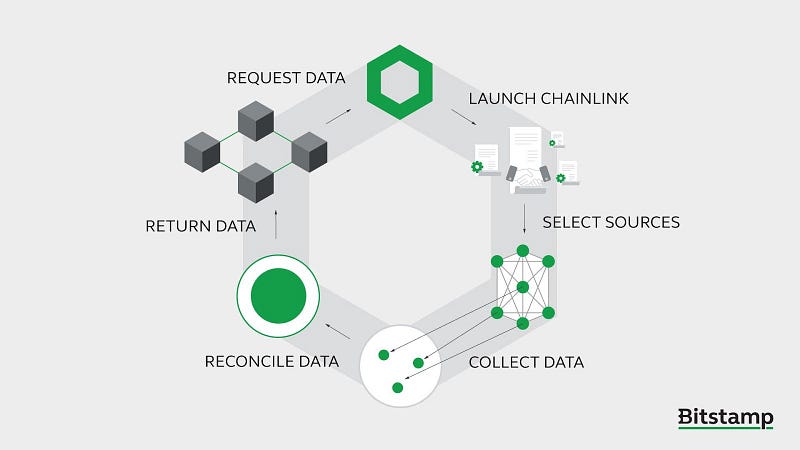
Thanks to Chainlink, decentralized exchanges (DEXes) are able to easily provide the users with accurate prices of external assets.
The possible applications of Chainlink are endless, which is why LINK will continue to be one of the most promising cryptocurrencies on the market.
6. Monero (XMR)
While Monero might not be the largest coin by market capitalization, it is the third-largest coin by the number of active developers, surpassed only by Bitcoin and Ethereum.
Because of that, Monero can be considered one of the most technologically advanced cryptocurrencies.
The main advantage of Monero is its extremely high level of privacy.
“On the Bitcoin blockchain, you can see what wallet address transacted, how many Bitcoin, where it came from, where it’s going,” explained Fred Thiel, former chairman of Ultimaco in an interview with CNBC.
“With Monero, [the blockchain] obfuscates the wallet address, the amount of the transactions, who the counter-party was, which is pretty much exactly what the bad actors want,” he said.
With Monero, nobody knows how many coins you own, where you got them from and what you’re doing with them.
Sure, this has led Monero to be the leading token used by cybercriminals. But it’s high-level of privacy should be celebrated in this age of media surveillance.
No other crypto can provide a similar degree of anonymity, which is why XMR is constantly growing in popularity.
7. Polkadot (DOT)
Polkadot is an open-source blockchain protocol enabling effortless sharing of all types of data between different blockchain networks.
In other words, Polkadot aims to disrupt the current crypto ecosystem by making it much easier for different blockchains to intercommunicate with each other.
This concept is known as interoperability.
Interoperability, or the process of different blockchains working with each other, is a key function of Web 3.0.
In Web 3.0 the internet is open-sourced, permissionless and decentralized.
With Bitcoin anyone becomes their own bank. With Ethereum anyone can own the rights to their own artwork. With Web 3.0 the internet becomes less oligarchical and more democratic.
Code is law, as Polkadot founder and former Ethereum co-founder Gavin Wood put it.
Earlier this year I said I’d take Cardano over Ethereum. By 2022 let's see if that changes.
8. Solana (SOL)
Solana is an innovative blockchain protocol designed to create an efficient and flexible smart contract-oriented environment.
In many aspects, Solana is quite similar to Cardano: It wants to be Ethereum but with much lower fees and transaction times.
It’s hard to say which Ethereum competitor will turn out to be the most successful in the future, but Solana is definitely one of the projects worth paying close attention to.
9. Polygon (MATIC)
“Built by developers, for developers.”
This one line from Polygon’s whitepaper perfectly sums up Ethereum’s number one scaling solution.
Polygon is quite different from Cardano and Solana.
Instead of trying to surpass and replace Ethereum, it aims to supplement it by vastly enhancing the scalability of the main Ethereum chain.
If Polygon manages to successfully implement its idea of providing additional functionality to Ethereum, it has a real chance at becoming a very influential and valuable cryptocurrency.
10. Stellar Lumens (XLM)
Launched by XRP co-founder Jed McCaleb, Stellar is a decentralized network protocol intended to bring fiat currency transfer functionality to blockchain-based ecosystems.
Stellar, like XRP, wants to become the cryptocurrency for the banks.
What Stellar has that XRP doesn’t, is a potentially crippling lawsuit that sees it regulated into hell.
As Todd Kronenberg recently pointed out in an article of mine, central bank digital currencies (CBDCs) could spell the end for stablecoins, XRP and XLM — cryptos invented to directly replace parts of the legacy banking sector.
If this isn’t the case, however, then either XRP or XLM will dominate this sector in the future.
Bottom Line
Diversifying your portfolio is overrated.
It’s better to invest in a handful of projects you believe in rather than spray and pray over thousands of worthless cryptocurrencies or stocks.
Don’t take my word for it. Here’s Peter Thiel —
“I think the real reason people spray and pray in their investing, is that they’re lacking in any conviction, and perhaps because they’re too lazy to really spend the time to try to figure out which companies what companies are ultimately going to work.” — Peter Thiel
Ever since I was a child it was my dream to become a financial advisor. Unfortunately, it never came true. Therefore I am not a financial advisor and you should do your own research and not just listen to random people on the internet. Nothing contained in this publication should be construed as investment advice.
Join 1500+ people on my newsletter for a free copy of my eBook “Mind and Muscle.”


