
What is Data as a Service?
How the new Paradigm will make your Data Strategy Accelerate

Most people are familiar with terms like IaaS (Infrastructure as a Service), PaaS (Platform as a Service) and SaaS (Software as a Service), but what is Data as a Service? Let’s look into it.
Definition and Theoretical Background
Data as a Service is a data management strategy that is using the cloud to enable storage, integration and processing of data over the network connection.
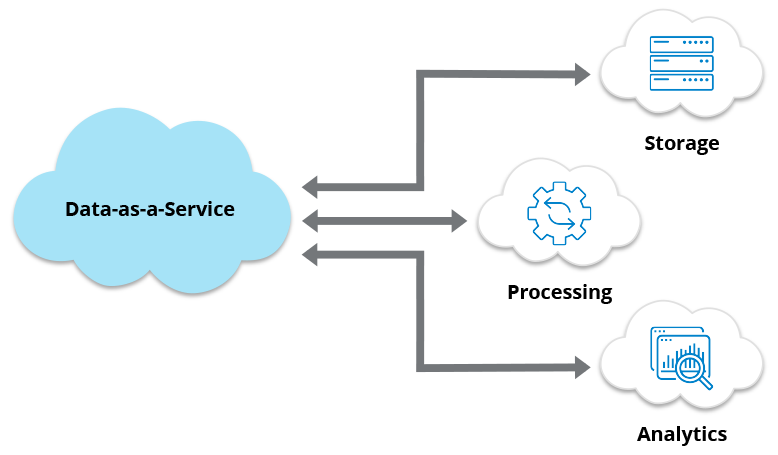
DaaS is similar to SaaS, a cloud computing strategy that delivers applications to users over the network so they don’t have to run them locally on their devices. With SaaS, this eliminates the need to install and manage software locally. Similarly, DaaS outsources most data storage, data integration and data processing operations [2][3].
So to keep it practical, instead of running on self-managed servers via in-house programming and/or software and distributing the data from there, the data from source systems (this can be from OnPrem or already outsourced systems in the cloud) is moved to the cloud via DaaS services and distributed further from there.
Benefits of the new Approach
The advantages compared to on-premises data storage can be [1][2]:
- Reduced setup times because organizations can use DaaS solution can start storing and processing data almost immediately.
- Often cloud infrastructure is less error-prone, so DaaS workloads are less likely to experience downtime and disruption.
- DaaS is more scalable and flexible than the on-premises alternative, as cloud workloads can be allocated more resources instantly.
- DaaS solution makes it easier to optimize data management and processing costs.
- Tools and services on DaaS platforms are automatically managed and updated by the DaaS provider.
- Companies using a DaaS platform do not need staff specialized in setting up and managing data tools.
Challenges and possible Problems of DaaS
Beside the benefits you can have trough DaaS there could be also some challenges with this approach:
- DaaS means that you move data to a cloud infrastructure and transfer data over the network, security risks can arise that would not if the data remained in an on-premises infrastructure behind the firewall. Solutions here can be VPCs, Authentification mechanisms, store data in certain regions and transferring data in encrypted form.
- DaaS platforms may limit the number of tools available for data processing. Users can only work with the tools that are hosted on or compatible with their DaaS platform.
- Transferring large amounts of data to a DaaS platform can take some time in case of limited network bandwidth. So here, your IT department should check if you located in an area with enough bandwidth.
Future of DaaS
Enterprises are increasingly moving to cloud first strategies besides SaaS, DaaS is one of them. With a wide range of industries and both large and small enterprises increasingly focused on the cloud, there is good reason to believe that DaaS will continue to gain traction alongside other cloud services. In any case, it is clear that companies want to focus more and more on value-added activities. This is no different when working with data. If data can be easily and reliably transferred via DaaS, e.g. to SaaS-based Data Lakes and Data Warehouses, without requiring a lot of effort and resources, more can be put into the much more interesting data analysis, for example. Activities that will then really bring added value to a company. In any case, it’s often the case that when you choose a cloud, you get everything from a single source: data interfaces, data integration tools and data analysis software. You can see an example below with the Google Cloud.
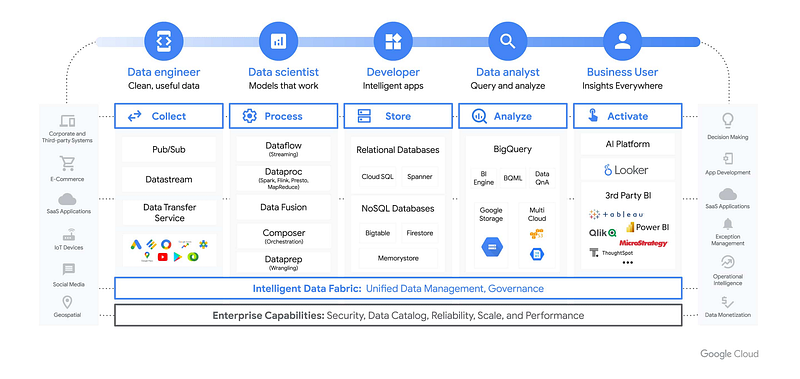
I hope you now have a good overview of what Data as a Service is, how it works and what the benefits and challenges are. To find out more about the topic, please use the resources below.
Sources and Further Readings
[1] Hazelcast, Data-as-a-Service (2022)
[2] talend, What is Data as a Service (2022)
[3] Wikipedia, Data as a Service (2022)
[4] Google, New Google Cloud innovations to unify your data cloud (2022)