
Can Christianity drive you crazy?
A new memoir asks tough questions about religion and mental illness
I’m reading an amazing new book. A man who grew up an Evangelical pastor’s kid writes about his history of crippling anxiety attacks.
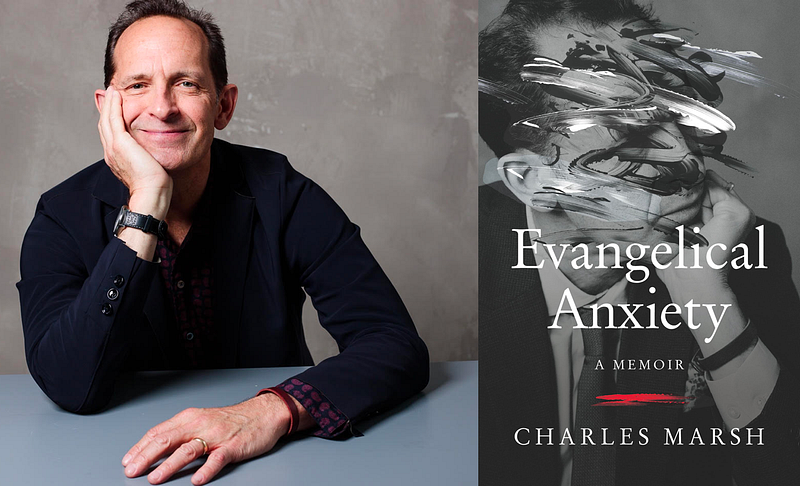
But this is Charles Marsh, the well-known religion scholar and professor at the University of Virginia. In Evangelical Anxiety: A Memoir, he thinks back to 1981 when he was a graduate student at Harvard Divinity School. Sitting in his dorm room, his heartbeat became a “tormenting assault” in an episode that left him “shattered.”

The attacks became commonplace.
And they left him deeply changed. He writes: “I had lost the capacity for happiness. I was the bitch of random freak-outs.”
He did everything a Christian should do. He read his Bible. He prayed. He re-read Christian classics. Above all, he kept up the pose of being normal, as a horrifying awareness set in that he wasn’t anymore.
He writes: “With each passing week, I was all the more sure that there was a malignancy in the world, and I was its source.”
His life became a theater, an effort to pretend he was the way he was before, the way he should be. In reality, he was getting worse. He writes:
“When the protocols of biblical self-help fall short in the treatment of mental illness, as they inevitably do, anxiety and depression will hunt down vulnerable regions of the psyche like an angry infection attacks nerve and muscle.”
Would getting married help?
He’d been promised that being married would bring joy to his life. His wedding night would be blissful. “Our bodies would not clash and collide. They would become a lamp that glows and warms.”
He ended the night crying. He writes: “The lines of desire and purity collided in a heap of shame.”
He shared little with his wife. To admit weakness would be to lose his position as an Evangelical man, and there seemed no point. What was happening to him was inexplicable. He writes:
“How nearly impossible it is for healthy people to understand the sadness at the core of the anxious person.”
Was therapy an option?
Some Christian denominations might let members go to secular psychologists — but not Evangelicals, much less Baptists. An Evangelical in therapy, Marsh writes,“seemed a contradiction in terms.” He explains:
“Evangelicals might do pastoral counseling, which could mean listening to your pastor ramble about sin and how, he is convinced, most mental problems are the result of disobedience to God. You might then be encouraged to take a cleansing dive into the Psalms and to check back a month later.”
His religion had no ability to help him. But they’d forbid him to pursue help elsewhere. His choice was whether to remain a panicking Evangelical, or to become something else.
He decided to pursue psychotherapy.
As a young professor with a wife and child, he had little budget for this extraordinary expense, but in 1994, a Jewish therapist took him on nearly for free. Three times a week, Marsh began to explore his past.
Going to therapy—and a blowjob from a female friend—became the first actual religious experiences of his life. (He marveled at her “gift of tongues…”)
In therapy, he began to think about his life, about his childhood, but mostly, about his religion. He remembered the “siege mentality” of Evangelicalism. So often it was hits of enthusiasm from the idea of Jesus loving them the most, even as they were under fire from ‘the world’.
But they would prevail. They were God’s favorites.
It had been, he realized, a heady mix of “narcissism” and “fear.”
He remembered the violence.
Evangelical identity is created, first, by childhood discipline. Marsh recalls trying to explain the approach to his therapist:
“…the child is a creature in active rebellion against all God-ordained authority and the way to remedy that is to destroy the child’s natural will…”
He remembered church leaders as being brutes, working oddly erotic violence on him as they spanked him as a teenager. He was made to drop his pants and bend over on the command of the man with a paddle.
He writes:
“How did it come about that violent men with no training as teachers or preachers or counselors made their way into positions of power over junior-high and high-school students?”
He remembered the racism.
As he thought over his Evangelical past, he remembered the constant suppression of women.
He remembered the total focus on politics, as if Republican victories would bring on the Kingdom—or was it the Confederacy?
He remembered the mental stagnation of all Christians, who were never too interested in ‘ideas’, and didn’t discuss them. He’d felt unprepared for the world when he encountered it. He writes:
“My knowledge of ancient history pretty much began and ended with the indices of my reference Bible, with its chronology of salvation and its archaeological maps (marking the creation of the world in 4004 BC).”
Even reading the Bible had been anxious.
He’d had ‘dread’, he writes, feeling the scripture were there to “remind you how far you have fallen short…”
The time was always short! He writes:
“Jesus was set to return soon, and very soon. Despite my disciplines of self-denial and mental fitness, I believed in my heart of hearts I wouldn’t make the cut on judgment day.”
But reading the Bible for himself, he’d begun to notice that it wasn’t really the rule manual the religion was claiming. He writes:
“…let’s be honest, if you read the Gospels closely — as closely as an evangelical boy in the throes of puberty — you won’t find Jesus worrying much about sex, though you might linger over the sight of a woman rubbing oil into his feet and his approving observation that she ‘has not stopped kissing’ him.”
He remembered the surveillance.
Religious scrutiny would cramp, Marsh realized, whatever writing he’d ever do. His parents would look over everything, to make sure their Christian son’s output was “correct.”
Did they even care about him? His father, he notes, only called to check up that his son was following the religion. Marsh writes:
“He asked about my studies and the weather, but mostly he wanted to know where I’d attended church that morning. You can only lie about going to church so many times.”
Was he a son—or a religious subject?
He recalled the fixations on death that had come over him.
“I fantasized their death, or my own. I felt fairly certain that if I transgressed — if I let down my guard and fornicated with Marcia, Linda, or Sharon — I’d have to kill myself. I felt fairly certain that the only way to find creative freedom, the breathing room to write, was through my parents’ death.”
His anxiety became less mysterious?
His body, he realized, had buckled under the theological pressure being placed on it. The religion didn’t want him to be what he was: a scholar, an intellectual, an informed person—much less a sexual one.
To be a Christian is to sit there and listen, and obey. He writes:
“Listening to a sermon, you can’t raise your hand with a question. You best not shake your head in dismay. It’s an experience rarely observed outside of totalitarian states…”
You’re told you’re the most important people on earth.
In an interview with Rolling Stone to promote the book, Marsh adds that an Evangelical child is given an amazing narrative:
“…you are right in the center of the metaphysical whirlwind, and you have been invested with a divine, almost superhuman destiny.”
It gives you “a sense of having an answer for every question…”
You only realize later it was “a total mindfuck.” 🔶


