
This Unknown Book Recommended by Andrew Huberman has Changed My Life Forever
I can’t believe nobody is talking about ‘The Secret Pulse of Time’

Time seemed to melt away when I started reading this book.
There is no doubt that this is the best book I have ever read on the concept of time. It is a German book which was published in 2006.
The English Translation was published in 2007 by the name:
‘The Secret Pulse of Time: Making Sense of Life’s Scarcest Commodity’.
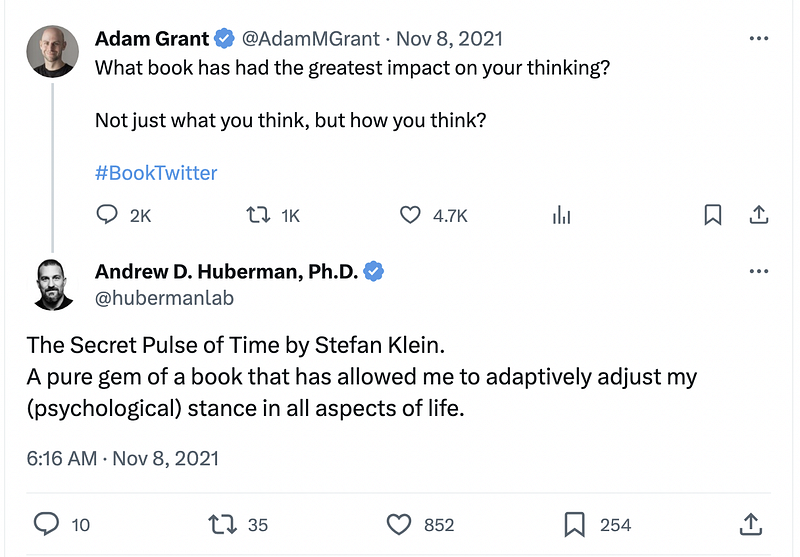
Originally being in German contributes to the fact that it is unknown among the masses. After all, many books on time are best sellers.
This book changed my perception of everything. I’m not kidding when I say that I live in a new reality now.
Here are the key ideas from the book that everyone should know.
Time is Misunderstood
Time is an integral part of our life.
In fact, time is life.
Reading this book, I realized how simple and misleading our understanding of time is. We think it is something that exists apart from us.
In reality, it exists inside us. Each cell of our body is a clock.
Klein tells us about a scientist who spent months in a dark cave to study how humans perceive time. While his perception of time was off, his body adapted and followed an almost 24-hour rhythm.
We know this because he was connected to his team through a telephone and informed them when he woke up and slept, among other things.
Think about it for a second!
Time is not what the clock is showing you. Nor is it the chiming of the church bell.
It exists inside us.
What makes a person a day lark or night owl?
Lifting the curtain from one of the most asked questions.
Our genes determine whether we will be bright in the morning or perked up at night.
By getting to know our natural rhythm, we can schedule our day accordingly. Klein recommends experimenting on our off days.
“Our reliance on mechanical clocks may have impeded our ability to decipher our inner time.”
The 24-hour rhythm varies in different people as well. Usually, it’s 24 and a half hours.
Sunlight also plays an important role.
Early exposure to sunlight resets our biological clock every day. It makes up for the lag we have with the 24-hour day.
Missing daylight every day for an extended period leads to negative outcomes. The lagging of the biological clock becomes significant which hinders our performance and bodily functions.
“Get out in the sun.”
Everyone’s perception of time is different
Time is connected to our feelings, emotions, and movement.
There are moments when time flies. Other times it goes on too slow.
When we are enjoying ourselves, we lose our perception of time. We get surprised at the realization of how much time has passed.
So much time has gone by!
At the doctor’s office or while waiting in line, time drags on.
Time also speeds up as we age.
This is both connected to our feelings and our memories. The author shares the connection of time and memory in detail. He also explores short-term memory vs long-term memory.
We don’t remember anything from our social media scrolling. This is because our brain doesn’t deem that information important.
Another mind-blowing fact shared in the book is that the richer someone is, the more time they lack.
Why?
Because of less money constraints, they have a lot of options.
“Feeling pressed for time is the price we pay for abundance of options.”
In reality, they have more free time. With multiple house workers, they should have all the time in the world.
Having a multitude of options shrinks time.
Time is connected to motion
For the Tai Chi masters, time melts away as they focus on a series of controlled movements. The same happens for tennis players.
When we move quickly or slowly our perception of time changes.
“For the brain, time is motion.”
In the case of movement and time, one cannot exist without the other. The people who have damaged their cerebellum lose their sense of time. They can’t perform simple motor tasks as well.
This reminds me of a saying from my culture, ‘There is abundance in movement.’
Loss of control is loss of time
The modern world is fast-paced.
We can order food at our fingertips, and send instant letters (emails), yet we are always in a hurry.
The reason is that we can be reached anywhere anytime. This means we have lost control of our lives.
“The things happening all around us force their rhythm on us.”
Whether it is work hours or our personal lives, if the control is gone, the feelings of helplessness take over.
The same happens with parents of young children. Children rule their world.
We make more mistakes in a hurry
Why do we make more blunders when in a hurry?
When we are pressed for time, we become stressed. As a result of stress, we make more mistakes.
The reality is because we are stressed, time seems to go at a faster rate.
The executive order function of our brain is dependent on three things:
- Capacity to concentrate
- Level of stress
- Level of motivation
What happens when we are stressed?
The executive function of our brain is affected. Stress hormones block the normal pathway of neural impulses. This leads to us making blunders.
Can this day get any worse?
The solution? Get up and get moving. Take a walk or do yoga.
As Robert Spolasly in his book, ‘Why Zebras Don’t Get Ulcers?’ tells us:
“Exercise frees up far more time than it expends.”
While being pressed for a work deadline, I had to do things, like fix up a meal or pick my child from school. Every time I went away from my desk, I felt the tell-tale signs of stress. E.g. my heart rate is going up.
Since I had been reading ‘The Secret Pulse of Time’, I reminded myself every time, that the more I stress myself out, the faster the time will go. My brain will become overwhelmed and my performance will be affected.
As a result, I won’t be able to do the work on time.
Chill out, I continually said to myself.
It did help me calm down. Not 100% but I wasn’t the cranky self that I usually am in such times.
The power of ‘now’
Our brain keeps jumping between the past and the future.
We keep thinking about the tasks that we have to do. It simply cannot focus on the mundane thing at hand.
“No matter how remarkable the moments of our life are, we fail to notice them if we are not receptive.”
How to circumvent this?
Research shows that when the task required more effort, it was easier for participants to ignore distractions.
By cultivating meaningful leisure activities that involve our mental faculties, we can experience the power of ‘now’.
“By giving more life to our time, we give more time to our life.”
The more enriching experiences in your life, the more time you will have.
Stefan gives us an example of two people of the same age. They have lived for the same amount of time. Yet, the quality of their experiences would determine the amount of time they have truly lived.
What is time?
Stefan Klein is a physicist.
He does a great job of dumbing down Einstein’s theory of relativity with the help of illustrations. To be honest it took me back to my middle school days.
“Science still cannot say what time consists of, but we know why we feel it go by.”
Time is an illusion and a perception.
Einstein said:
“There is no central clock that applies to everyone…”
While there might not be a fixed clock for everyone, we experience time relative to other things and people. One thing is for sure, time travels from the past to the future.
Although a realization so profound feels overwhelming, it also makes you feel in control.
If time is relative, I am going to change myself and my surroundings to make the most of life.
Multitasking is a trap
Don’t fall for the multitasking lie.
It may seem like the computer multitasks, i.e. we are running a program and a download is underway in the background.
In reality, the computer jumps from one task to the other in minuscule parts of a second. Hence it gives the illusion of multitasking.
“… multitasking is one of the surest way to fritter away time…”
For humans, it is even more complex. It takes us 15 minutes for us to concentrate on a task at hand. If distracted, for example by a phone call or a ping on our phone, we lose precious memory and time.
We cannot do two things at once.
The key is to do one thing first and then the other. Only then optimal working can be achieved.
Research confirms this.
Participants took less time to do one task after the other. The same tasks took more time when done simultaneously.
If time becomes endless…
In the epilogue, the author transports us to Diaspar, a fictitious city where time doesn’t exist.
The initial reaction to such an existence sounds enticing.
But as Klein makes us realize, things have lost meaning there. Because everything is the same.
“… for this very reason, each individual moment is worthless”
Diaspar is cut off from the world since they don’t want their city to be disturbed.
Such a life is lackluster.
The key is to be grateful for the gift of time and be mindful of its use.
How to organize time?
The author summarizes the book well at the end and proposes a solution.
Klein gives us a ‘new culture of time’:
This requires 6 steps:
- Have control over time
- Live in harmony with your biological clock
- Cultivate leisure time
- Live in the moment
- Learn to Concentrate
- Set priorities
Sure, we will use our clocks and calendars. But their role will be supportive, not as a guiding light.
Summing up my thoughts
Why did I like this book?
The author provides us with a combination of scientific studies, experiments, philosophy, and literature. Referencing literary works like ‘The Magic Mountain’, it retains the reader’s attention.
Previous and upcoming chapters are referenced continually which gives it cohesiveness. This means a lot, especially for a forgetful person like me.
Klein doesn’t point out problems only. He gives us solutions on individual levels, societal levels, and government levels. He also cites examples of places where such solutions have been implemented already.
Why should you read it?
I say this is a must-read for everyone in the modern world.
We are all struggling with stress and time pressure. Time flies while our to-do lists pile up.
This book will give you a detailed and well-written overview of the reasons why we ‘don’t have enough time’. It will also give you the remedial steps to expand your time. Hence, you can live in a more authentic and meaningful way.
Hope you like this book! If you do, I’d love to listen to your thoughts in the comments below.
I hoped you have found this article useful. If you did, it would be awesome if you gave me a clap or left a response!
If you enjoyed this article and want to support Novel Nest, click this link to get notified whenever I publish something new.
If you enjoyed these book recommendations, check out the rest of my book lists on my blog- https://www.thenovelnest.com/blog
Affiliate Disclaimer: This post features Amazon affiliate links, which means I may earn a small commission if you make a purchase through these links.


