
Black Cemetery Loss Is a National Crisis
Our headstones are gone. The land is flooded or infested. Can Black death and afterlife be saved like Black lives?
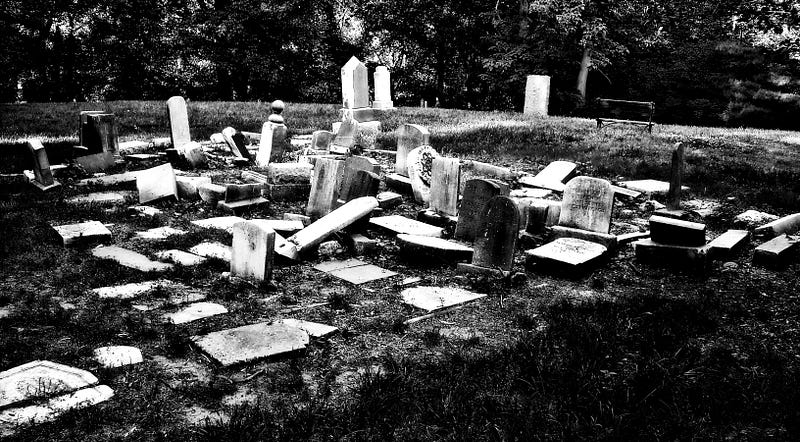
In the spring of 2018, I traveled to Sapelo Island to conduct research for my forthcoming book, Wandering in Strange Lands. A former plantation, Sapelo Island is the fourth largest barrier island in Georgia and was once home to a very active Gullah Geechee community, whose population is currently on the decline. Many Gullah Geechee people have moved to the mainland, such as Savannah, or even farther across the country, and the property taxes on Sapelo have risen 500% as White interlopers have made the island a vacation destination. During a driving tour conducted by a native Sapelo Islander, we approached Behavior Cemetery, where former slaves and their descendants were buried.
This particular cemetery was different from those that I’ve seen growing up in New Jersey because it faced the Atlantic Ocean and, most of all, we weren’t allowed to venture into it without permission as we could for other historical sites. Before I could ask the guide why, he explained to the group that it’s because vandalism had taken place. In Gullah Geechee culture, burial is very sacred. Oftentimes, cemeteries face the ocean because there is a belief that the souls of the enslaved and their descendants would travel back to Africa in the afterlife. Their favorite items would be placed near their headstones so they won’t be lonely during the journey. How could anyone be so inconsiderate to defile a burial place? I thought. But in a matter of days, I’d seen more desecration: cemeteries underwater, cemeteries hidden underneath sprawling golf courses, cemeteries inaccessible to those whose relatives are buried there because they are tucked within gated communities called plantations. It was throughout this fieldwork in the Deep South that I realized that this is another kind of violence, and I wanted to know if these disgraceful acts were nationwide.
Even in death, there was a “spatial segregation” to remind the living that the dead could not be united in their final resting places. But even the Black souls who have transitioned do not have their corpses dignified well after they are gone.
It was in 1945 when Zora Neale Hurston wrote a letter to W.E.B. Du Bois to ask if he would help to secure 100 acres for a Black cemetery in Florida. In it, she writes, “Let no Negro celebrity, no matter what financial condition they might be in death, lie in inconspicuous forgetfulness. We must assume the responsibility of their graves being known and honored.” This correspondence is made all the more devastating that less than 15 years later, Hurston was buried in an unmarked grave, and then another 13 years later, a young Alice Walker found said grave in a snake-infested, segregated cemetery. But these disappearances have been happening and are currently happening in our present day.
In an op-ed for the Washington Post, Clarence B. Jones states, “The neglect of historic African American cemeteries is as widespread as it is unknown. Throughout the 19th century and much of the 20th, African Americans were segregated even in death, often buried in off-the-beaten-path Black cemeteries that, over the years, received little funding and fell into disrepair.” Up until the 1950s, 90% of American cemeteries enacted some kind of racial restrictions. Even in death, there was a “spatial segregation” to remind the living that the dead could not be united in their final resting places. But even the Black souls who have transitioned do not have their corpses dignified well after they are gone.
TaWanda Hunter Stallworth has ancestors buried in Lincoln Cemetery located in Carlisle, Pennsylvania. As she described it, “Pennsylvania is Philadelphia on one side, Pittsburgh on the other side, and Mississippi in the middle.” Carlisle is located in that middle. Like other Black cemeteries in history, Lincoln Cemetery was not situated on a good plot of land, and it was subject to flooding and rat infestation. According to Ivey DeJesus of Pennsylvania Real-Time News, former members of U.S. Guard troops, as well as nurses, teachers, and domestic workers are buried there. At one point, it was the only place where Black Carlisle residents could bury their people. But it was in 1971 when the borough wanted to turn the cemetery into a municipal park.
The bodies were never exhumed. Hunter Stallworth’s great-grandmother, Fleta Jordan, petitioned the court to have her family’s headstone stay put. To this day, it’s one of the few remaining headstones. The rest have been removed and lost. Hunter Stallworth said, “Any time I’m driving out on a back road or something like that and I come across some headstones, I’m like, ‘This is probably where Black people are buried.’” Since her interview with Pennsylvania Real-Time News last year, Hunter Stallworth says that the borough hasn’t advanced any work, though the local historical society is collecting oral histories.
“The world she [Fannie] knew — when the government owned something, it didn’t always work out for the benefit of Black people. The spirit of the cemetery was created so that families could have somewhere to put our dearly departed.”
Adia Winfrey, who is currently running for election to the U.S. House of Representatives for Alabama’s 3rd Congressional District, is drawing attention to McClellan Cemetery of Talladega, which is just 50 miles east of Birmingham. Her great-great-grandmother, Fannie McClellan, bought land for a cemetery and houses on October 17, 1901, from former plantation owners, one of them being William Blount McClellan, who, according to family lore, could possibly be Fannie’s biological father. Fannie was adamant to not let the city take over McClellan Cemetery, for there was another Black cemetery that had already been relinquished. Though that cemetery has been maintained, this persistence to hold it has come with some personal regrets. When Winfrey was growing up in the ’90s, she heard the elders of her community speak of the sanctity of the cemetery, but she and her peers did not pay it much mind.
Now that the elders have passed on, the cemetery has deteriorated, beginning in the early 2000s. “The world she [Fannie] knew — when the government owned something, it didn’t always work out for the benefit of Black people. The spirit of the cemetery was created so that families could have somewhere to put our dearly departed.” The cemetery itself is in a historically Black neighborhood called Knoxville, and not one historical marker is in the community. Winfrey hopes that McClellan can get some official recognition, and a monthly budget of $1,250 a month would help. Though community clean-ups have been happening, because of McClellan’s sheer size, these residents need extra assistance.
And for others of the diaspora, cemeteries are in peril due to the layering of other racist and xenophobic implementations. Lupe Alberto Flores is a PhD student in the sociocultural anthropology department at Rice University in Houston, but their roots are in Hidalgo County, Texas. It was there, in their hometown near the Rio Grande Valley, where they would hear stories about their ancestors “of color,” who were Black. Flores is the descendant of John Webber and Nathaniel Jackson, two White men who fell in love with enslaved Black women, Sylvia Hector and Matilda, respectively, freed them, and moved their growing families to the Rio Grande Valley. These two families — the Jacksons and Webbers — were responsible for smuggling enslaved Black people into Mexico, and there are efforts underway to get their ranches recognized as Underground Railroad sites.
It is said that alongside the Jacksons and Webbers, other Black families, such as the Rutledges and Singletaries, are buried in either the Jackson or Webber cemetery. Currently, the Jackson Cemetery is being occupied by the Carrizo/Comecrudo tribe, who were given permission by the family to settle there. The Webber cemetery is still active. However, both of these cemeteries are being threatened by President Trump’s border wall. In Flores’ words, “It hurts me to tell you the Webber Cemetery is just maybe less than a mile from border wall construction. I would say 10 meters from my grandmother’s house is bulldozers and machinery already building another section of the border wall.” The Carrizo/Comecrudo tribe, whose camp resides at Jackson Cemetery, is protecting the grounds, but who knows for how long? There is a national wildlife refuge that’s situated between both cemeteries. There were protests to save the refuge from border wall construction. The refuge was spared but the government has decided to start building at the end of Flores’ grandmother’s house, where there’s a levee in front of the Rio Grande, and is slated to go down a few miles to skip the refuge and cross right where Jackson Ranch Cemetery exists.
All of these cemeteries, from Texas to Alabama to Pennsylvania, began either in the Reconstruction era or at the turn of the 20th century, and their dilemmas prove that this crisis is not region-specific. Some Black cemeteries, like that of Capote Baptist Church of Seguin, Texas, have been luckier. Cheryl Mims is the great-granddaughter of Hiram Wilson, who was a successful pottery businessman who bought land from his former slave owner. His descendants maintain that cemetery to this day, but identification is insurmountably difficult. Over 300 people are buried in Capote Baptist Cemetery, but not all graves are demarcated. Mims said, “What they did was they put shells here and left it at that. My dad would say, ‘This is a grave here but we don’t know who it is.’ There would be markers, but you couldn’t see etching through the years. It’s just really deteriorated out.” In African American tradition permuted from the culture of the Kongo people, seashells signified a soul’s “immortal presence.”
Black cemeteries require strategy, community organizing, money, and, of course, remembrance of who dwells underneath the soil. There is ample evidence to show our assessments of Black life, death, and the afterlife are bound by man-made, racist enactment where respect and honor are never a given. Both qualities have to be fought for by those who remain and those who are descendants, as Black Americans are in a continual loop of remembrance and present-day living. The past and present are blurred when our burial grounds and our headstones are debased, because we have to correct the past and speak the names of the deceased or else we risk cultural amnesia, and could be doomed to be left undignified in our passing too.