
81-Year-Old Graham Nash’s Intimate Show Takes Me On a Musical Tour of My Life
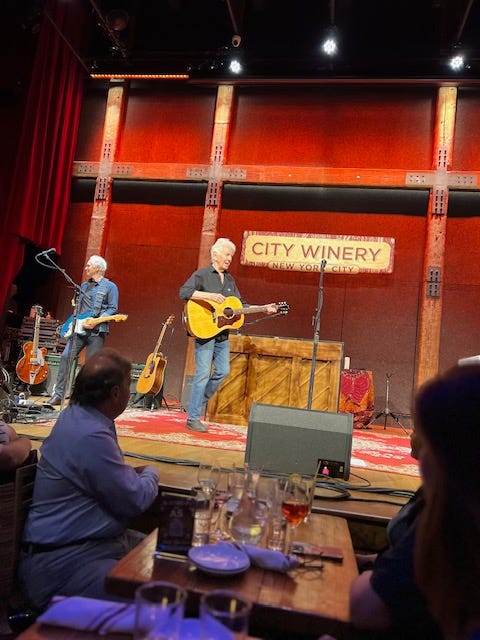
At 81, Graham Nash is 10 years older than me. In 1962, when he was 21 and starting The Hollies, I was 11 and starting 6th grade. My family had just moved from the little chicken farm in rural central New Jersey where I was born to the teeming Philadelphia suburb of Baby Boomer kids that was Levittown, Pennsylvania. My life was a bubbling cauldron of transition. And so was its soundtrack, which was about to be jolted from Elvis’s slick pompadour and baritone voice to the Beatles’ textured mop-tops and Buddy Holly-influenced harmonies.
Holly, an early ’50s rock ’n’ roller known for nerdy, thick horn-rimmed black glasses and catchy country- and R&B-infused tunes like “That’ll Be the Day” and “Peggy Sue,” rose to fame with his band the Crickets, who are credited with originating the foundational band structure of lead, rhythm and bass guitar plus drums. Holly and the Crickets are said to have inspired the Beatles to name themselves after another insect, and influenced their harmonies, as well as those of Nash and the Hollies, who took their name from the man himself. And it was Graham Nash’s beautifully harmonizing, high-register voice that came to distinguish the sound of the Hollies in the early ’60s, as well as his solo and group endeavors of the ’70s and all the way through to today.
Still Lovely After All These Years The tone and texture of Nash’s voice sounded as pristine as ever when I saw him perform the other night at City Winery, along with guitarist Shane Fontayne and keyboardist Todd Caldwell. Here was an octogenarian at the top of his game: thin, fit, looking good and still introducing brand new music, from his new album “Now,” along with old stuff from the Hollies, Crosby, Stills, Nash and Young, from Nash’s longtime collaboration with David Crosby, and even from the Beatles.
I took it all in from a second row-center table that was as close to Nash as I was to Neil Young when I saw him perform one solo set and one with his band Crazy Horse at the Electric Factory in Philadelphia all the way back in 1970, when I was a freshman in college. In his two-hour set, Nash kept me and the audience in thrall with his music, seasoned with intimate stories of his eventful life. He reminisced about past loves, including Joni Mitchell, and turbulent friendships, like his tumultuous bond with his best buddy Crosby, who died in January, at Nash’s age of 81.
The Los Angeles Times reported that the two were feuding at the time, but that Crosby wanted to make amends and had sent Nash an email saying he wanted to speak by phone at 2 o’clock the next day. “He never called, and then he was gone,” Nash said in an interview. Nash told the story at his show, trying to avoid sentimentality, but transmitting the pain through his voice and face.
On a lighter note, he recounted the time he wrote “Just a Song Before I Go” on a $500 bet that he couldn’t crank out a tune in the few minutes he had left before leaving Hawaii to return to a recording session in LA. with Crosby, Stills and Young. He said a family member of the guy who lost the bet — a low-level weed dealer — finally tracked him down at a concert and paid his debt some 50 years later.
The stories embellished the performance like a wine perfectly paired with dinner, the dinner in this case being the phenomenal music, performed with precision and a lifetime of craftsmanship by Nash and his accompanists.
Parallel Lifetimes Augmenting the experience exponentially for this 71-year-old fan was the way the musicians’ lifetimes paralleled my own, separated by a decade or so in years but barely at all in terms of the events and emotions they sang about: “Find the Cost of Freedom” and “Military Madness,” angry anti-war anthems in reaction to the Vietnam War; “Our House,” about the idyllic existence of Mitchell and Nash, two young lovers, blossoming together creatively in the musical garden that was the Laurel Canyon of southern California in the ’70s; and, most unexpectedly, the Beatles’ “A Day in the Life,” the lyrics of which I remember our 11th grade English teacher analyzing with us in class.
I recently caught New Yorker editor David Remnick on Morning Joe talking about his latest book, “Holding the Note: Profiles in Popular Music,” a collection of portraits of some of the most influential musicians and songwriters or the past 50 years. They include Aretha Franklin, Paul McCartney, Keith Richards, Bruce Springsteen and Bob Dylan. “Songs are emotionally charged and brief,” Remnick noted, and “we remember them whole: the melody, the hook, the lyrics… where we were… what we felt.”
In her classic “Blue,” Joni Mitchell sang that “Songs are like tattoos.” Every song in Nash’s performance made another of my musical tattoos tingle. When he sang “Marrakesh Express,” I was transported to a summer afternoon baking in the sun at Seaside Park on the Jersey Shore with my best friend Phil in 1969. He told me about a new album by a group made up of guys from other bands we both loved, including The Byrds and Buffalo Springfield. Not long after we both bought and listened to it — the seminal album by Crosby, Stills & Nash — we started scheming to be there when they performed that August in Woodstock, weeks before we were to head to different colleges in different parts of the country.
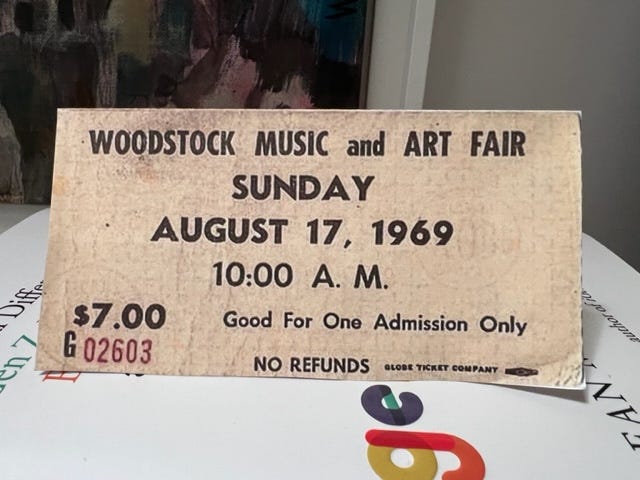
Sure enough, at 3:30 in the morning on Monday, Aug. 18 of that summer, we were standing in mud and muck and pre-dawn chill just a few meters away from the stage where Crosby, Stills and Nash performed in public for only the second time ever. We’d see them again at Woodstock ’94 in Saugerties, New York. And we’d each see solo performances by the band’s members many times throughout the years.
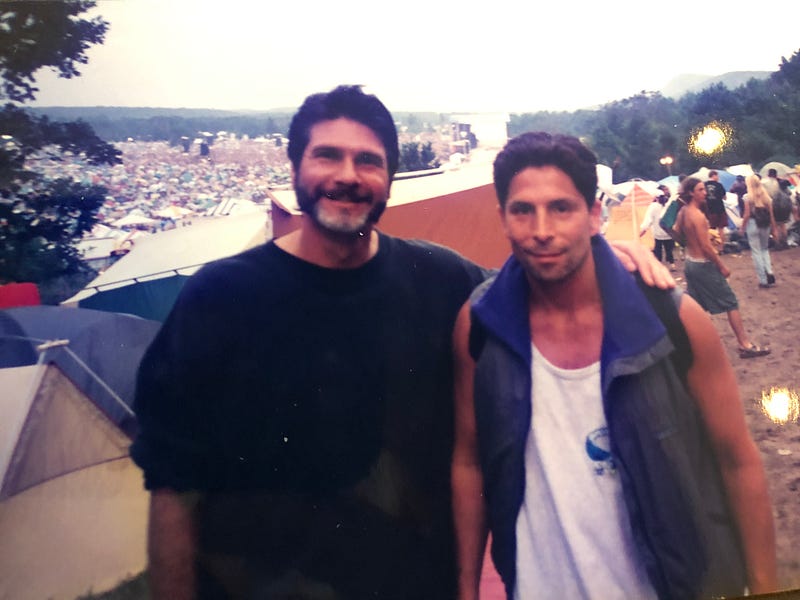
Long May They Run Watching the 81-year-old Nash seemingly still at the top of his game after all that time, I found myself wondering how long he and my other idols of that golden period of singer-songwriters of the early ‘60s-to-mid-’70s would still be “holding the note,” to use Remnick’s term for keeping their writing and performing capabilities at a high level into their old age.
As I look around, many are dying. Leonard Cohen died at 82 in 2016. His fellow Canadian Gordon Lightfoot died at 84 in May of this year. And Tina Turner passed away at 83 that same month. I remember the evening Phil and I parked on the side of a country road and trudged through a marsh to sneak under the concert tent where the Ike and Tuna Turner Review were performing in Lambertville, New Jersey, when we were in high school.
So many musical memories bonded my friend and me that I texted him from my seat at City Winery, sending him pictures of the show and 10- to 15-second video clips from the performance.
More recently I sent him a clip from a beautiful brand new song I saw my original musical idol, 80-year-old Eric Andersen, perform at the intimate Loft upstairs at City Winery.
Maybe someday Phil and I will see another of our favorite acts together again. Maybe Jorma Kaukonen of the Jefferson Airplane, who’s still touring as Hot Tuna Acoustic at 82. Or Joni Mitchell, who at 79 still seems to have a concert or two in her, even after suffering a ruptured brain aneurysm that caused her to have to learn how to speak again.
After seeing her return to the stage recently, pop music critic Lindsay Zoldadz, writing for The New York Times, called Mitchell’s performance “breathtaking.” “To hear Mitchell hit certain notes again in that inimitable voice was like glimpsing, in the wild, a magnificent bird long feared to have gone extinct,” she wrote.
Who else? Phil and I would both love to see Jackson Browne, who’s 74, and John David Souther, the writer of many songs by the Eagles and Linda Ronstadt, who’s a spry 77. I dream of once again seeing Bonnie Raitt, who, at 73, won this year’s Grammy for writing the Best Song of the Year, the haunting “Just Like That.”
We’d be down to see The Boss, still going strong at 73, and his good buddy, my fellow 71-year-old, John Mellencamp, whose album of new songs, Orpheus Descending, comes out this week. Mellencamp recently told Esquire magazine, “My goal is to get to 80. That gives me 10 years. … “I’ve got 10 summers left. Ten summers is not that long.”
If genetics and healthy living count for anything, I hope to have a lot more summers than that. Precious time for one more visit or two with some of the great singer-songwriters who shaped my youth and immeasurably enriched the lives of so many of my generation. It breaks my heart whenever I see one of them go. But it fills me with inspiration every time I see one of them still creating and performing new music.