avatarRobert Knight

Summary

Dia de Muertos (Day of the Dead) in Mexico is an ancient, festive, and UNESCO-recognized tradition honoring the dead with elaborate altars, vibrant celebrations, and unique cultural practices, distinct from Halloween.

Abstract

Dia de Muertos, a renowned Mexican holiday, is a vibrant celebration that honors the deceased. It is deeply rooted in the pre-Hispanic cultures of Mexico, where it was believed that the dead visited the living during this time. The holiday, which occurs on November 1st and 2nd, coincides with All Saints' and All Souls' Days, integrating indigenous customs with Catholic traditions. UNESCO has recognized this festive commemoration as an Intangible Cultural Heritage of Humanity. Families create altars adorned with offerings such as food, drinks, and personal mementos of the departed to welcome their spirits. The celebration is marked by joyous street festivities, music, dancing, and the iconic use of marigolds to guide the spirits. Participants often dress as skeletons, or calaveras, with the Catrina and Catrin being emblematic figures poking fun at the European-influenced attire of the Mexican elite. Decorative papel picado symbolizes the fragility of life, and Patzcuaro is highlighted as a quintessential location to experience the authentic traditions of Dia de Muertos, including the poignant all-night vigil on Janitzio island's cemetery.

Opinions

  • The author emphasizes that Day of the Dead is a unique cultural event, not to be confused with Halloween, highlighting its distinct origins and significance.
  • The incorporation of the holiday into the Catholic church's calendar is seen as a blending of beliefs rather than a replacement, showing the adaptability of cultural practices.
  • UNESCO's recognition of Dia de Muertos as a cultural heritage is presented as a testament to its importance and the skill involved in its celebration.
  • The festive nature of the holiday is underscored, suggesting a celebration of life rather than a somber event, with an atmosphere of joy and hope.
  • The tradition of dressing as calaveras, particularly the Catrina and Catrin, is viewed as a satirical commentary on class and identity, as well as a reminder of the common human experience beneath social constructs.
  • The use of marigolds, altars, and papel picado is interpreted as symbolic elements that enrich the cultural tapestry of the celebration.
  • Patzcuaro is recommended as an authentic destination for experiencing the Day of the Dead, indicating a personal or widely held belief in the authenticity and cultural richness of the celebrations there.

8 Things About the Day of the Dead in Mexico

Dia de Muertos (the Day of the Dead) is probably the best-known Mexican holiday worldwide.
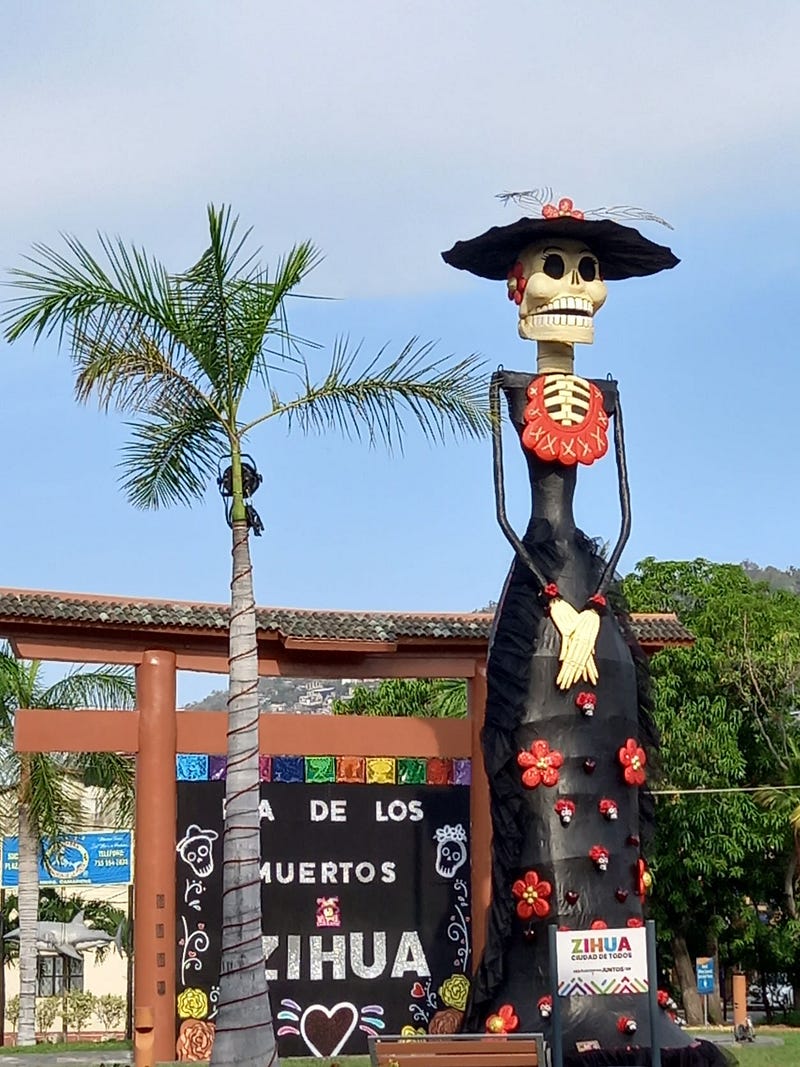
A very large Catrina figure at a Plaza in Zihuatanejo, Mexico/photo by author
  1. The Day of the Dead in Mexico is NOT Mexican Halloween. It occurs at around the same time but has nothing to do with the American tradition of trick or treat and Halloween.
  2. Day of the Dead is thousands of years old and dates from the early Aztec and other Nahua cultures that considered death to be an integral part of life. The dead were thought to still be a part of the community and were honored on this special day when they were believed to return to earth to visit.
  3. When the Catholic church came to the Americas this celebration was incorporated into the church and celebrated on the 1st and 2nd of November (All Saints’ Day and All Souls’ Day in the Catholic calendar).
  4. In 2008 UNESCO recognized Dia de Muertos as a cultural heritage of humanity. It is celebrated throughout Latin America, but nowhere as elaborately as in Mexico.
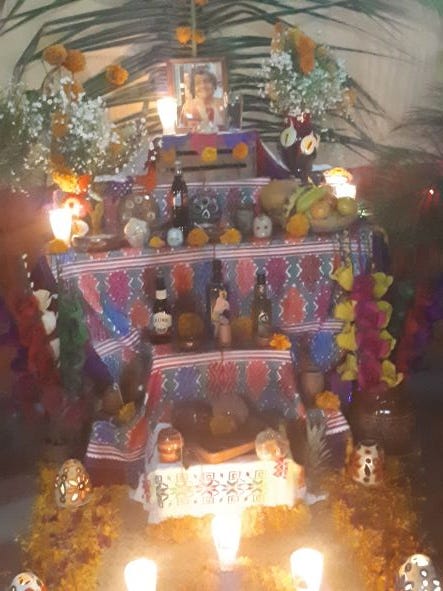
a Dia de Muertos altar in front of a home/photo by author

5. It is thought that the spirits of the dead return on these days to visit the living. Families prepare elaborate altars at home as well as at the cemeteries, laden with some of the favorite things of the departed such as food, drink, souvenirs, and photos of the dead to welcome them. It is not a macabre holiday, but a joyous one. The atmosphere is festive with dancing and music in the streets. Marigolds are scattered to show the way from the cemetery to the altar.
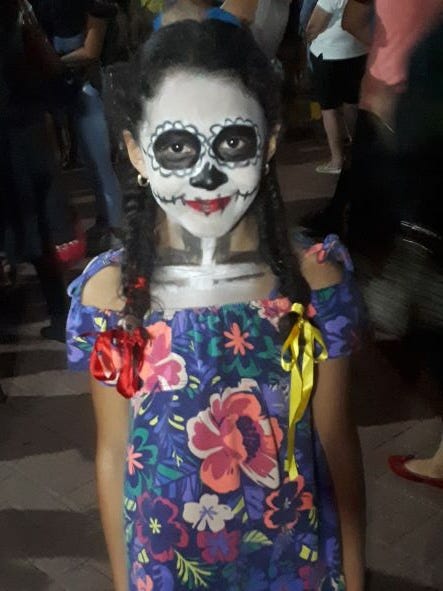
A little calavera/photo by author with permission

6. People dress up as skeletons (called calaveras) using makeup that is amazingly creative. The most famous skeletons are the Catrina and Catrin. These are skeletons dressed in formal attire of the 1700s originally thought to be poking fun at the way upper class Mexicans of the time tended to emulate European dress. One Mexican writer commented that we are all skeletons beneath our costumes.
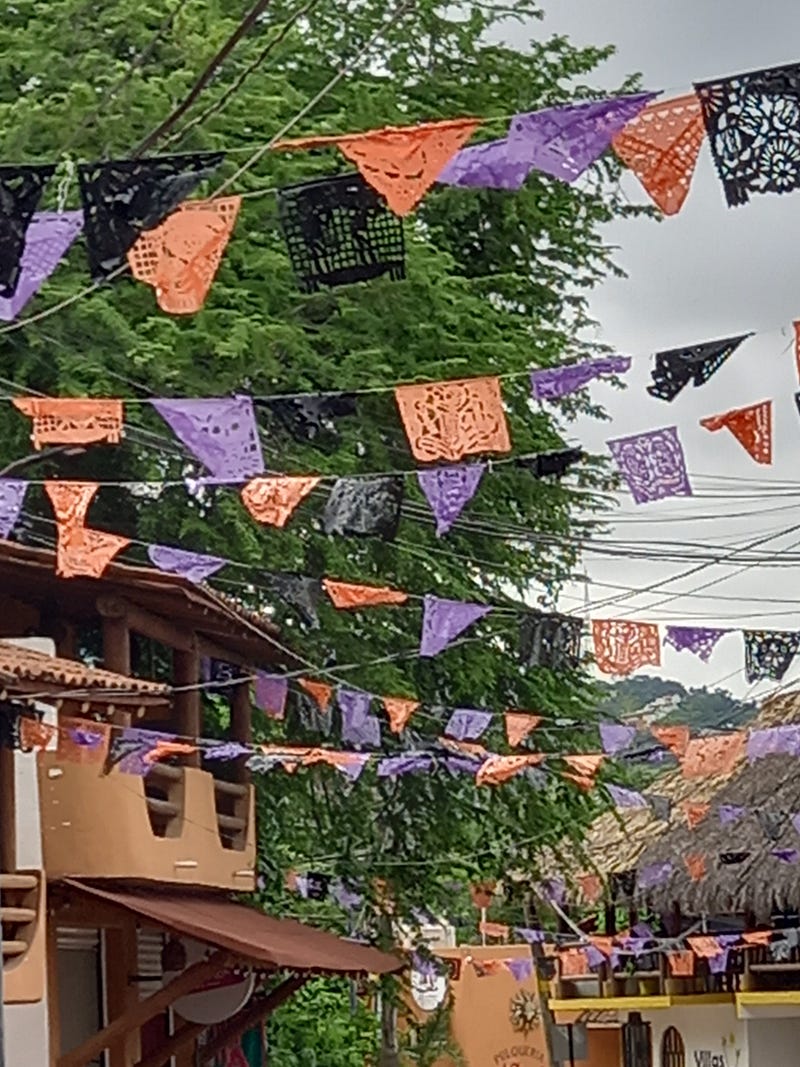
Papel Picado hanging in the street celebrating Dia de Muertos/photo by author

7. “Papel picado” or pierced paper is hung along the streets from posts or balconies during the time before, and for some time after, the Day of the Dead celebrations. While this decorative paper often with skull figures or other decoration of the season is not exclusive to the Day of the Dead it is almost always present at this time. This delicate decoration represents the fragility of life.
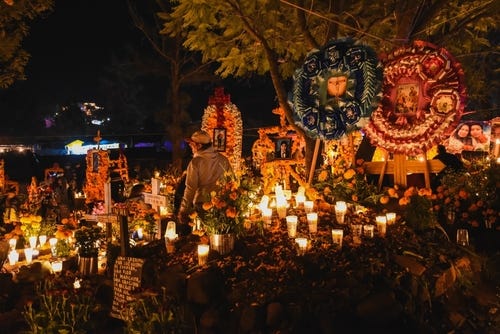
Celebrating the Dia de Muertos in Patzcuaro/photo by Eve Orea/Shutterstock.com

8. One of the most authentic and popular places to visit in Mexico to experience the Day of the Dead is in Patzcuaro, only a few hours' drive from Zihuatanejo. Indigenous natives from the surrounding area board boats on the lake, each with a candle on the bow, to paddle out to Janitzio. Janitzio is an island in the middle of Patzcuaro lake composed primarily of a cemetery. There they decorate the graves of departed relatives and hold an all-night vigil to welcome their dead.

While it is true that the theme of the Day of the Dead is death, it is celebrated in an atmosphere of joy and hope with dancing in the streets, costumes and parades, and in general a celebration of life.

Travel
Culture
Mexico
Day Of The Dead
Monthly Challenge
Recommended from ReadMedium