
8 Proven Steps For Overcoming Depressive Symptoms
The most effective treatment approach for adolescents and adults experiencing lack of motivation, lethargy, and self-isolation — according to ABA experts.

An Overview of Depressive Symptoms
There are so many misconceptions on “depression” in the media that it can be difficult to assess whether you might be struggling with it or not. For this reason, I’ll begin with some brief psychoeducation.
Depression is a mood disorder that causes persistent feelings of sadness and loss of interest. Also called “major depressive disorder” or “clinical depression,” it affects how you feel, think and behave and can lead to a variety of emotional and physical problems. You may have trouble doing normal day-to-day activities, and sometimes you may feel like life isn’t worth living.
Although depression may occur only once during your lifetime, people typically have multiple episodes. During these episodes, symptoms occur most of the day, nearly every day, and may include:
- Feelings of sadness, tearfulness, emptiness, or hopelessness
- Angry outbursts, irritability, or frustration
- Loss of interest or pleasure in most or all normal activities
- Sleep disturbances
- Tiredness and lack of energy
- Weight changes
- Slowed thinking, speaking, or body movements
- Feelings of worthlessness or guilt
- Trouble thinking, concentrating, making decisions, and remembering things
- Frequent or recurrent thoughts of death, suicidal thoughts, suicide attempts, or suicide
Behavioral Activation: The Link Between What We Do and How We Feel
Applied behavioral psychologists have found that there is a close relationship between our behavior and our mood. Have you noticed that when you feel good, you tend to spend more time with people whose company you enjoy? Perhaps take on activities and tasks that challenge you, just for the sake of it?
Our behavior changes our thought patterns for the better because:
- Doing activities we enjoy — gives us feelings of pleasure
- Challenging ourselves helps us to grow and develop — giving us a sense of mastery
- Having positive relationships with other people — gives us a sense of belongingness
Likewise, the opposite is true too.
Consider the following vicious cycle:
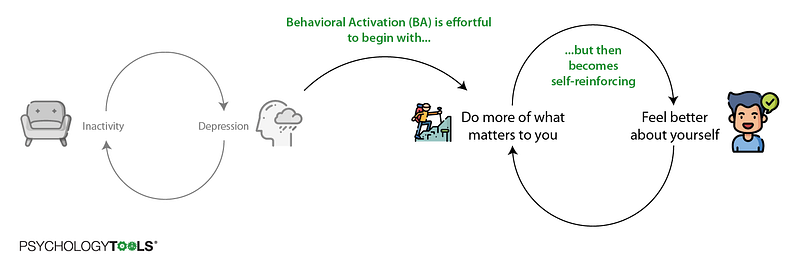
As you can see, the less active you are, the more you reinforce your depressive symptoms. The longer this goes on, the more aware you become of your own depression. The cycle goes on and eventually transforms into lethargy, self-isolation, irritability, loss of interest, and the two most significant: hopelessness and helplessness. (According to research, these are the two most significant predictors of suicidal ideation).
On the other hand, doing more of what matters to you reinforces your self-esteem, self-efficacy, and motivation — which in the end, will help you build grit and resilience as well as make you feel better.
8 Steps For Combatting Depression
In summary, the basic concept behind this strategy is that “depressed” behaviors are reinforced (by sympathy and avoidance) and create “depressed” body chemistry — both of which lead to more depressed behavior.
“Nondepressed” behavior brings you in contact with more positive consequences and changes body chemistry to a more elevated mood, which makes it easier to engage in more “nondepressed” behavior, and so on in an upwards spiral.
The strategy, therefore, is to behave in ways that people who are not depressed do (i.e., “nondepressed” behavior). That said, the following 8 steps should be completed every day for 6 months or until visible symptoms begin to disappear.
1. Regulate Sleep
Inadequate sleep results in irritability, memory problems, lack of focus, and lethargy. REM sleep — which refreshes the brain — occurs in the last 2–3 hours of sleep. Therefore, if sleep is cut short, the body will still get refreshed (deep body sleep is primarily in the first 3–4 hours of sleep), but the brain will not.
Examples:
- Go to bed at a scheduled time
- Sleep 8 hours at night
- Do not nap during the day
2. Regulate Eating
Not eating 3 meals a day lowers blood sugar, which leads to increased depression. In addition, limiting overeating and weight gain can help build a healthy self-image. Remember to avoid having alcohol or caffeine in the evening, as these interfere with sleep.
Examples:
- Eat healthy, moderate breakfast, lunch, and dinner
- Do not snack unless hungry
3. Keep A Routine
Keep a regular schedule. This includes: waking up on time, bathing, brushing teeth, getting dressed, eating meals, doing chores, and going to bed on time.
Examples:
- Get up on schedule
- Complete morning hygiene/dressing
- Complete bedtime hygiene
4. Socialize
Have conversations with people every day. Make sure that most of the conversations are about positive things.
Examples:
- Do a fun activity with a family member or friend
- Have a conversation with a family member or friend
- Get out of the house
- Interact with a stranger or acquaintance
5. Control Negativity
It’s hard to continue thinking negative thoughts while talking about more positive topics. If you’re in need of a listening ear, talk with a counselor. But try to stay positive when conversing with friendships and avoid “venting” to them.
Examples:
- Use distraction or replacement thoughts
- Do not talk about your problems
- Talk/think about interesting/funny topics
6. Activity Level
Stay busy. Do things that you used to like or try new things that you have never done before but think you might like.
Examples:
- Get up and move at least every 30–60 minutes
- Be on your feet during the day more often (rather than sitting/laying down)
- Try a new hobby, such as painting a picture or landscaping
7. Be Productive
Completing projects gives a sense of accomplishment, even if the project was not particularly fun (e.g., chores). Do chores, learn new skills, inform yourself about current events by reading the newspaper, do volunteer work, go to work, etc.
Examples:
- Accomplish something small every hour
- Complete 1 or more items on the “To Do” list
- Do something you are proud of
8. Exercise
Many research studies have proven the positive effects of exercise on energy, mood, sleep, and overall brain function. It is hard to get motivated to exercise when you are depressed, so start small but do it regularly. As the exercise starts to improve your energy and mood, you will be able to increase the amount of exercise.
Examples:
- Stretch tight muscles (e.g., back, neck)
- Walk around the neighborhood
- Visit your local gym
Final Thoughts
Because when you are depressed, it is hard to get motivated to do “non-depressed behavior,” it is important to have motivation strategies in place before you begin. This will ensure your success in applying behavioral activation in your life.
Three of the most effective strategies are:
1) Self-monitoring — which is recording on a checklist which “nondepressed” behaviors you do each day and set daily goals to continue increasing the number of them that you do.
2) Having a “Coach” — to hold you accountable for making progress. Let that person know your daily goals and ask them to check with you on a regular basis to see how you are progressing. Choose someone who is dependable and positive.
3) Pair by association— which is when you pair an unpleasurable activity with one which elicits an emotional response, in order to tolerate the behavior and reward yourself in the process. This could mean completing one of the “nondepressed” behaviors while listening to music or rewarding yourself by completing the behavior and then going out to eat.
“You don’t overcome challenges by making them smaller but by making yourself bigger.” — John C. Maxwell
In the end, my best advice for you to get started is this: remind yourself why you’re doing this. Thoughts like “I’ll do it when I feel better” perpetuate the vicious cycle that has you where you are currently. Recognize that it’s important to get active even if you don’t feel like it and that behavioral activation is a different strategy than the one you’re currently using. If that one is not working, perhaps it may be time to try a new one.