
8 Learning Hacks to Avoid Frustration
Make it easier to master a new skill or subject

Learning something new is not always fun when it becomes tedious and time-consuming.
Soon, you may spend less time on your new endeavor and eventually give up.
It does not have to be that way. Science proves you can overcome learning hurdles with these proven hacks:
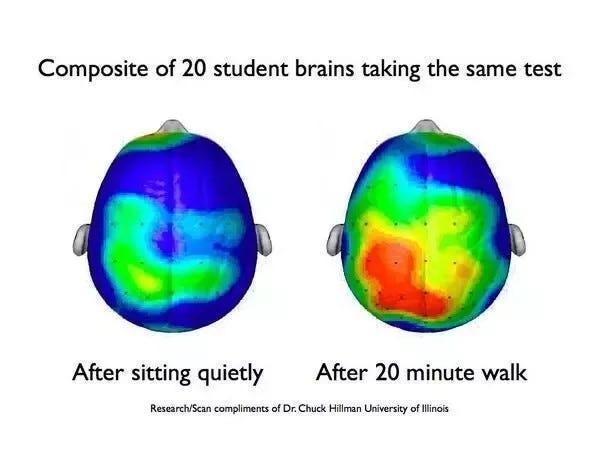
1. Exercise before studying or learning.
Twenty minutes of exercise increases focus and concentration. The following are brain scans showing the influence of exercise:
2. Use as many senses as possible when learning.
You may think reading out loud will slow you down but using visual and audio cues save time in the long run.
A study from the University of Waterloo found that speaking and hearing oneself helped retain more information than just reading to oneself or hearing someone else read. Colin M. MacLeod, a professor and chair of the Department of Psychology at Waterloo stated:
“When we add an active measure or a production element to a word, that word becomes more distinct in long-term memory, and hence more memorable.”
3. Find a new environment.
According to research published in the scientific journal Neuron, find new surroundings when it comes to learning. The study indicates that a break from your routine activates dopamine in your brain. These triggered releases of dopamine help the brain acquire and retain new information.
Unfortunately, each of your learning sessions requires a new place. To apply this tip, you may have to get creative to repeatedly find new locations where you can be comfortable and productive.
4. Sleep between learning sessions.
Learning something before bed and reviewing that same material after getting up proves to be an effective learning method. From a 2016 study published in Psychological Science:
“Researchers found that interleaving sleep between learning sessions not only reduced the amount of practice needed by half but also ensured much better long-term retention. Sleeping after learning is definitely a good strategy, but sleeping between learning sessions is a better strategy.”
5. Learn from mistakes and unexpected successes.
Look back to make greater gains in the future. We have all heard, “Don’t make the same mistake twice?” Equally important, learn from your unexpected successes. Maybe, you surprisingly made more sales in the latest quarter, or your baked goods turned out perfectly this time. Sometimes, good things happen during times of dumb luck. Instead of celebrating immediately, find out why the unexpected result occurred. Finding out what happened may be applied for further gains.
6. Apply the Feynman technique.
This technique, named after Nobel Prize winning physicist Richard Feynman, involves simplifying complex subject matter so that a novice may understand it. Break the information into smaller pieces and reassemble them to see how they fit.
This method prevents mindless memorization and ensures a deeper understanding of why something works. To apply this technique, see if you can explain your subject to a young child. Any complex subject consists of many simpler concepts. Explaining these simple concepts and adding layers of complexity, you demonstrate mastery of the subject. If things are unclear for the child, examine the material again.
7. Check with family, friends, and co-workers.
People in your circle may be an expert, or at least more advanced, in your area of study. Tapping into a personal resource may save you loads of time and energy. They may have suggestions on tools to use and barriers to avoid. Learn from their successes and failures.
8. Keep a log during your learning process.
Documenting your journey allows you to retrace any steps easily. You may need to reconsider a previous topic from a different perspective. You may have a different perspective because of new information you acquired.
Phil Lui Ph. D., Chief Scientist at zyGnosis, is a big proponent of detailed logs. He explains a log allows one to “make greater sense of complexity, dive into past solutions and synthesize new connections.”
Closing Thoughts
We have all experienced frustration with learning a language, an instrument, or programming. We put in the time only to get half the expected results.
Well, these setbacks are not your fault. Everyone has spent thousands of hours in school. We have been taught everything under the sun except…how to learn.
Apply any or all of the above to accelerate your learning.
You may also enjoy: