
8 Key Points From “Man’s Search for Meaning”
I should have read it much earlier.
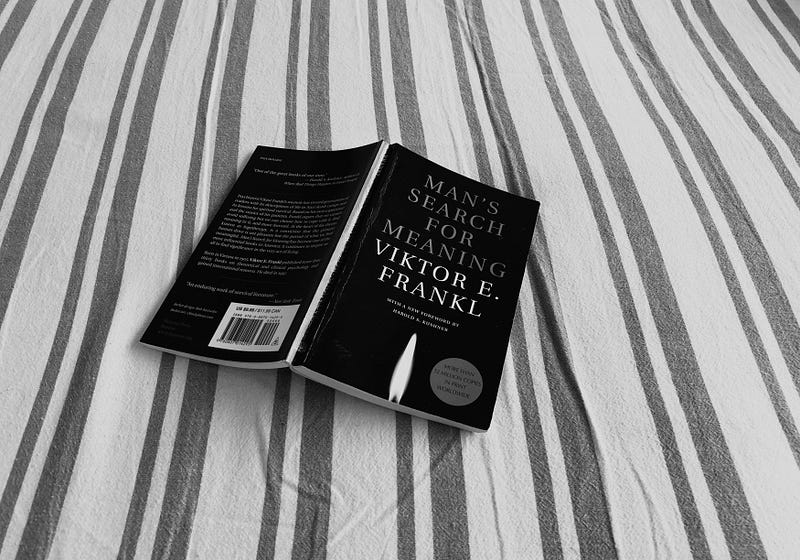
At first glance, I was enthusiastic about the title. I, too, am looking for meaning in my life. Without it, I feel like I’m sinking into the void of existence, and that drains me of all my energy and motivation. But when I read the summary and realized that it was mostly about the Holocaust, I held back. My mental state wasn’t the strongest at the time. I put it aside for later.
Last night I finished Man’s Search for Meaning by Viktor Frankl. From the time I downloaded it to my Kindle to the time I read the last line, it was 24 hours. That says it all.
The book is divided into two parts. The first is an autobiographical account written by Viktor E. Frankl, an Austrian professor of neurology and psychiatry, about his years in a concentration camp. The second is an introduction to the therapeutic movement he founded, logotherapy, which is based on the human need for meaning.
In both parts, passages resonated with me. I have underlined 32 of them and I kept only 8. These are the ones that prompted the most reflection, questioning, or resonance. They changed my vision of certain things, and by extension, changed my vision of life. And the meaning I give to it.
Here are the eight most important passages for me. I can only encourage you to read the whole book.
“After a few minutes of moving silence, one prisoner said to another, ‘How beautiful the world could be!’”
This sentence was uttered after a prisoner called out to the others, urging them to hurry up and watch a beautiful sunset. I love it because it highlights a very important thing we forget to do on a daily basis: realize how lucky we are to be alive, how beautiful the world around us is — despite all the bad things that exist.
Let’s stop thinking as if we were prisoners of our own existence. Instead, let’s open our eyes and see how beautiful the world is.
“An active life serves the purpose of giving man the opportunity to realize values in creative work, while a passive life of enjoyment affords him the opportunity to obtain fulfillment in experiencing beauty, art, or nature.”
This one takes the pressure off one thing: you don’t have to lead a creative life, or an extremely busy one, to make it “worthwhile.” Rest, pleasure, beauty, contemplation, art are all equal when it comes to living. For living is first and foremost about experiencing life as a human being, taking the time to do so, and paying attention to our five senses. Life should not be about productivity or work, at least not all the time.
“Every situation is distinguished by its uniqueness, and there is always only one right answer to the problem posed by the situation at hand.”
“One right answer”. When something is on my mind, or I feel an inner imbalance, my response is not to crawl under the covers. I’m the type to get up and face the discomfort. To try to find solutions. But even though this is, I suppose, the best way to find solutions, it can take time. And now I understand why: there is only one right answer.
To find it, I suggest you rely on trial and error: read, listen and watch for ideas, experiment with the ones that resonate with you, keep what works and throw the rest out the window. That’s growth. Sometimes, it won’t work right away. You’ll feel doubt creeping in. Keep doing it anyway.
“Logotherapy […] focuses on the meaning of human existence as well as on man’s search for such a meaning. According to logotherapy, this striving to find a meaning in one’s life is the primary motivational force in man.”
The meaning of life is not something that is handed to us. It’s something we have to find. And to find it, we must search. Work. Learn. Fail and try differently. Searching for meaning is part of the meaning. Searching for meaning is part of life. And as Frankl has written many times: there is no universal meaning to life. Each human being has its own. No one can find it for them.
“Mental health is based on a certain degree of tension, the tension between what one has already achieved and what one still ought to accomplish, or the gap between what one is and what one should become.”
For once, this challenges the belief that we should be content with what we have and stop trying to have more. I only half agree with this idea: we really need to learn to appreciate what we have.
But if we stay stuck on what we have, convincing ourselves that it’s enough, we’ll get bored. We need that tension to push us to achieve, to keep working, to keep striving. While appreciating what we have, which applies to both achievements and material possessions, and recognizing the beauty of what makes up our life. The one we already have. Those things we have worked hard for. There’s a balance to find here.
“What he needs is not the discharge of tension at any cost but the call of a potential meaning waiting to be fulfilled by him.”
In recent years, I have tried, half unconsciously, to remove all discomfort from my life. I thought that this was where well-being and happiness lay. It wasn’t. I ended up getting bored. I felt like I wasn’t living.
Discomfort, inconvenience… Tension IS life. We must learn to work with it, not against it, not without it. Let’s get out of our comfort zone, that’s where life is waiting for us.
“Live as if you were living already for the second time and as if you had acted the first time as wrongly as you are about to act now!”
I stopped in my reading when I stumbled upon this. I tried the exercise. And I realized that once again, the comfort and convenience we seek are just anesthetics. Staying in comfort is not really living.
Pretending that I have already made these mistakes once, I now know that generating discomfort is crucial to my development and well-being. When I’m in the situation in question, I do just fine. And afterward, I feel great.
“Allport […] once said, ‘As the focus of striving shifts from the conflict to selfless goals, the life as a whole becomes sounder…’”
I want to write a book. But I tend to focus on the difficulty of the exercise rather than the goal itself. This leads me to give up all the time. This is probably what happens to you too if you have not yet completed or started something important to you. But it is not an end in itself. It’s fear that keeps you from moving forward. And that makes you see the difficulties before the rest. The fear of wasting your time. Fear of failing. Except that you have nothing to lose. Steve Jobs said it himself:
“Remembering that you are going to die is the best way I know to avoid the trap of thinking you have something to lose. You are already naked. There is no reason not to follow your heart.”
Same with fitness: I wanted to move my body more often, but I was always focusing on the discomfort of it instead of the well-being that comes after. I now focus on the goal instead of the conflict. This means seeing the positive instead of the negative. And it works.
When you stop focusing on the conflict and start focusing on the goal, the obstacles seem much more accessible and only then do you start moving mountains. Almost effortlessly.


