
Culture and History
8 Facts About The Undiscovered City Of Pompeii — That You Might Not Know About!
Pompeii was one of the richest, flourishing and modern cities of the Roman empire that got razed down by a volcano almost two millenia ago. But how was the culture, food and business like in Pompeii? What did they do that we do differently today? Let’s do an analysis on it.
History Of Pompeii
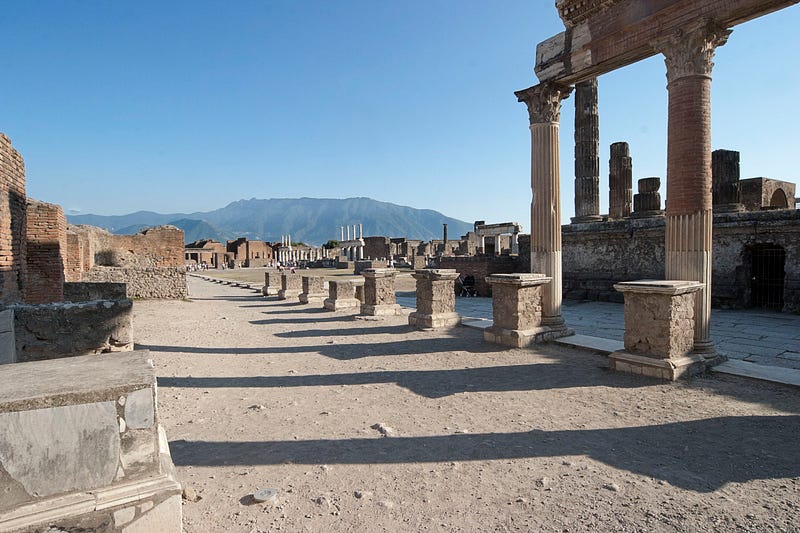
Pompeii is regarded as one of the most famous cities of history, especially when it comes to understanding European (primarily Roman or Italian) culture. Pompeii is that city, that got burnt and buried by a raging volcano called Mount Vesuvius, back in 79 AD.
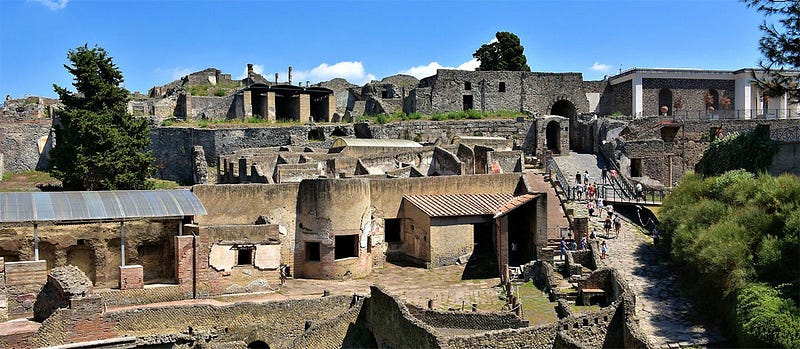
The remains of the city still exist in Bay of Naples in modern day Italy. Where now, more than 3 million people are living in just around 10 km radius of Mount Vesuvius, which is still regarded as an active volcano.
But before we jump to the culture of Pompeii, let us look at some more facts that will help us analyse things better.
Pompeii was a city of a population of around 20 thousand people at the time, which isn’t much if you think about it today, but back then the population of the world used to be less than 500 million. Considering this number, Pompeii was a fairly big city with a lot people living there.
Which means it was also booming with economy, business and culture. And it was a modern city of that time, and not a suburb or rural settlement. And now coming to the point of this story — 10 Most Interesting Facts About The City.
1. Unawareness Of The Locals
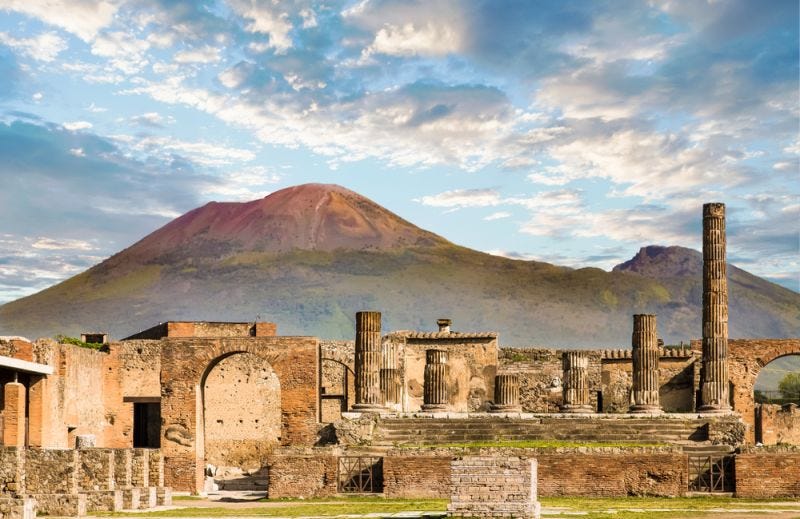
When the volcano started to erupt, there was still a lot of time for the locals to run for shelter, and to vacate the city. What killed the entire city, was not the volcano, but lack of awareness.
The locals were simply not aware of something called a volcano. They treated Vesuvius as a normal mountain, and were surprised when it started to throw out flame and smoke. Even when the eruption started, the locals were unaware that it would reach the city soon and engulf everything. They kept waiting in that city not knowing what to do, and eventually died.
On the afternoon of August 24th in 79 AD, Mt Vesuvius started to erupt. Just one day ago, the locals had celebrated a festival to pay their respect to the God of fire. You might call it pure irony or co-incidence, that just a day after their celebration, God of fire decided to visit them in person, in the form of a volcanic eruption.
Although, the eruption lasted for few hours, it was the volcanic ash and thick smoke that killed the remaining residents who were not killed by the lava and debris. The lava covered the city by almost 9 feet and preserved everything right in the moment. The entire city went into a deep slumber, not to be disturbed for thousands of years in future.
This sudden and unexpected burial protected the city, and even remains of it for next 15 centuries, from vandalism, destruction by weather or climate, and looting from the invaders. That is why we were able to see the exact things that existed in 79 AD!
2. Undiscovered Until Thousands Of Years
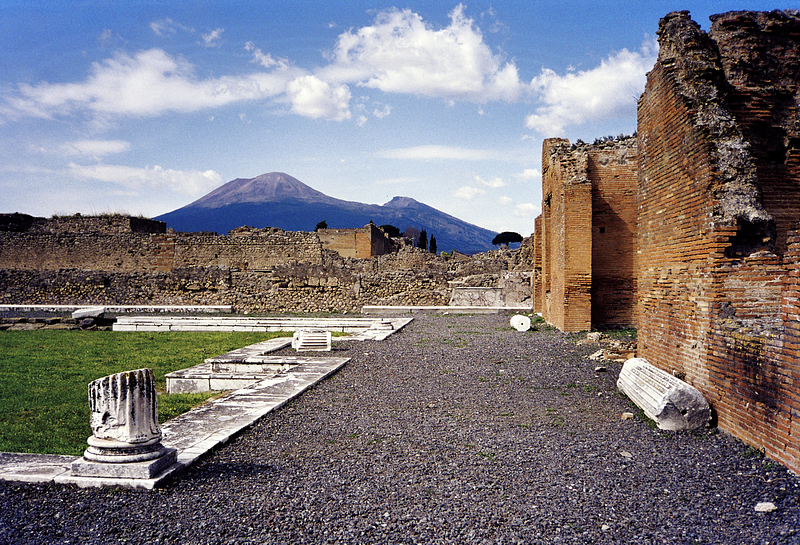
Pompeii was not discovered until more than 1500 years after its destruction. It is shocking, but since the city was buried with volcanic ash, no one really got to know that an entire city got wiped out by a volcano, more than thousand years ago!
It was an accidental discovery by Architect Domenico Fontana, in late 16th Century. In 1750s and 1760s, an inscription that read ‘Rei Publicae Pompeianorum’ was discovered near the ruins, and excavation work began, which led to the discovery of entire city that remained buried underground for more than — a staggering 1500 years!
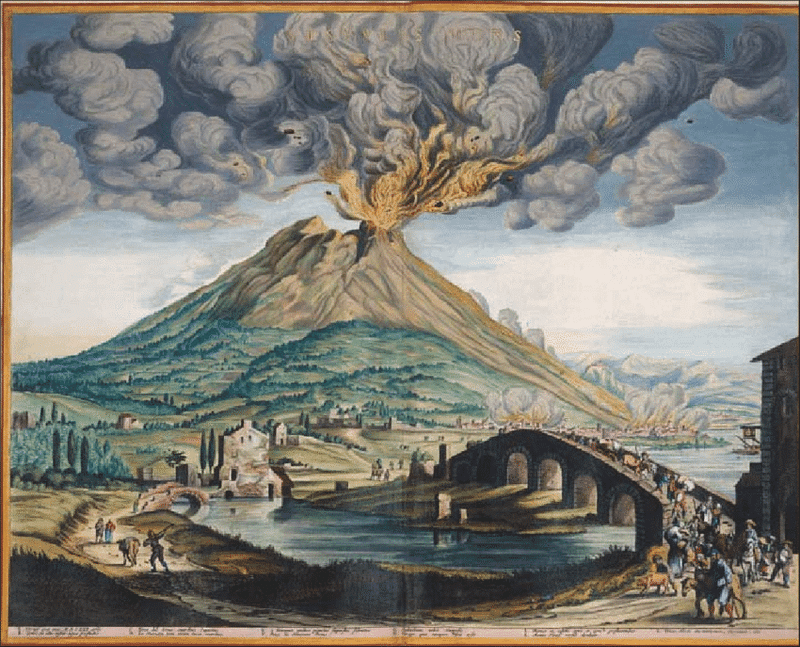
The last time Mount Vesuvius erupted was in 1944, and it had erupted multiple times between the years 79 and 1944. In 1631 also, it erupted once, based upon which the artist Österreich Nationalbibliotek, created this painting as well. But even in 1631, it was not known that there exists an entire city under the volcanic ruins.
3. Direction Of The Wind
As per the historians Pompeii could have been saved if the wind blew in a different direction the day volcanic eruption happened.
Only because of the wind, strong volcanic ash entered the city, asphyxiated the people, animals, plants and various other life form — and killed it. So, not just the volcano, but even wind is to be blamed for wiping out a thriving city from the history of mankind.
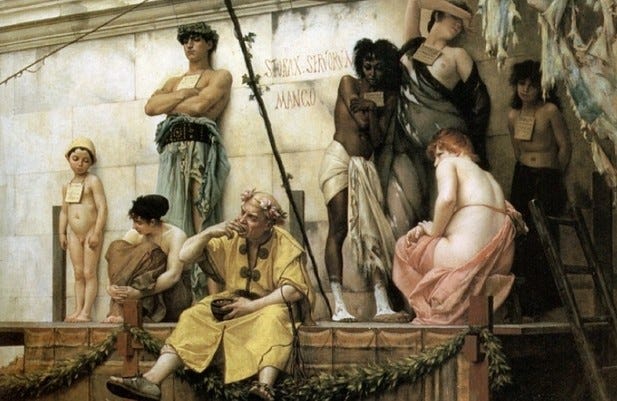
4. City Of The Rich
Pompeii was a rich city, inhabited by affluent Romans of that time, surrounded by Naples. It was not only a large city, but also one of the most developed ones. When archaeologists found the remains of the city, they discovered big buildings, lavish private houses, open theatres etc.
One of the major businesses of the city was the maritime business. There was a small port near the river, that used to host a fleet of ships and boats for trade. Of course, air travel was not introduced at the time, so major transport of goods happened through naval routes.
Another reason behind the wealth of Pompeii was rich, fertile agricultural land. The desirability to live on the Bay of Naples was high among the Romans, and that led to a lot of migration from surrounding villages and cities. Many villas and farms were also built nearby, outside the city and were later discovered during the excavation projects.
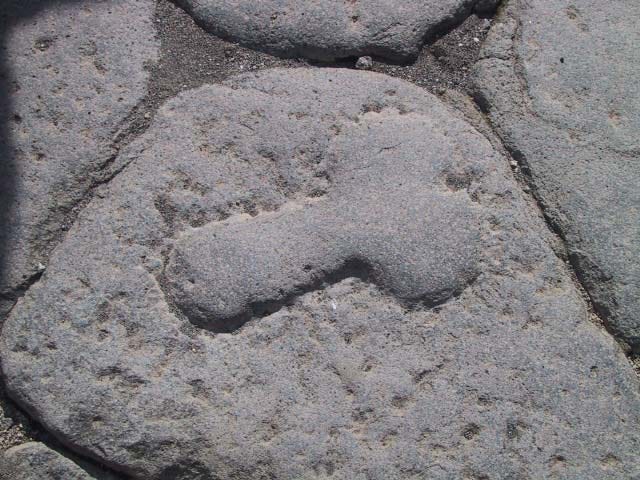
5. Pompeii Was Famous For Sex Trade And Brothels
Being a modern city, Pompeii was flourishing with sex trade and brothels. Indeed prostitution is considered to be the oldest profession of the world, so how can it be absent from the city of Pompeii?
You can still find signs (like above), on the streets of the city, which also act as arrows, pointing towards the direction of the brothels.
There are many remains and excavations that have proved the existence of various modes of entertainment for the public, and prostitution being one of them. But how was it confirmed that the area was a brothel or a normal home? Well, look at this image for instance —
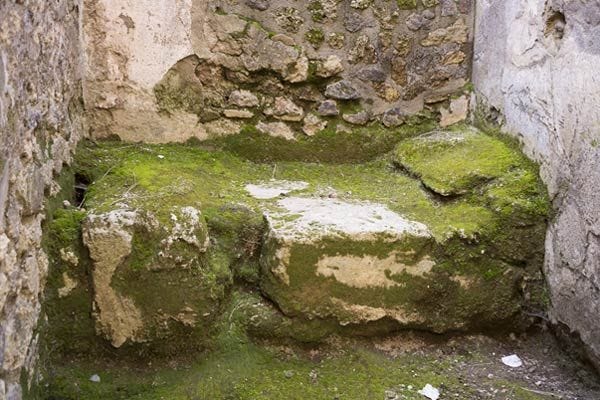
There is nothing in this room, apart from this small bed, and the area in which this room is found, has tens of rooms that look just like this. Small, uncomfortable stone beds. Purely made for business.
Along with such beds, some erotic and pornographic paintings were also discovered in the rooms, that looked like this —
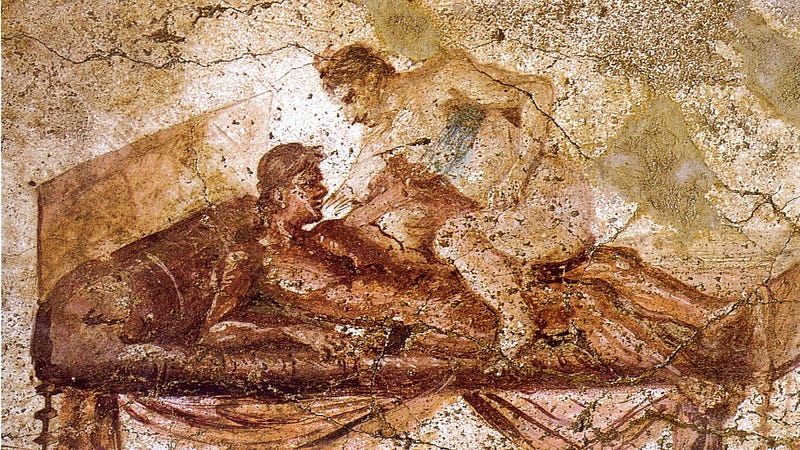
In this painting for example, you can see a dark-skinned female with a light-skinned male, signifying that the prostitutes might have been from other areas, and there is also a high possibility of females being traded as sex-slaves, but the men who engaged with them, were mostly local Romans.
Such paintings were put up to arouse the men who came into the brothels. And since art like this, was not suitable for a normal household in this ancient Roman city. So, there was definitely existence of brothels and prostitutes in the city, that acted as an additional lucrative benefit for the men to come and trade in Pompeii.
6. What Did The Locals Eat?
Now, this is one of the most recent discoveries. In December 2020, a site was excavated in Pompeii, that came out looking like this —
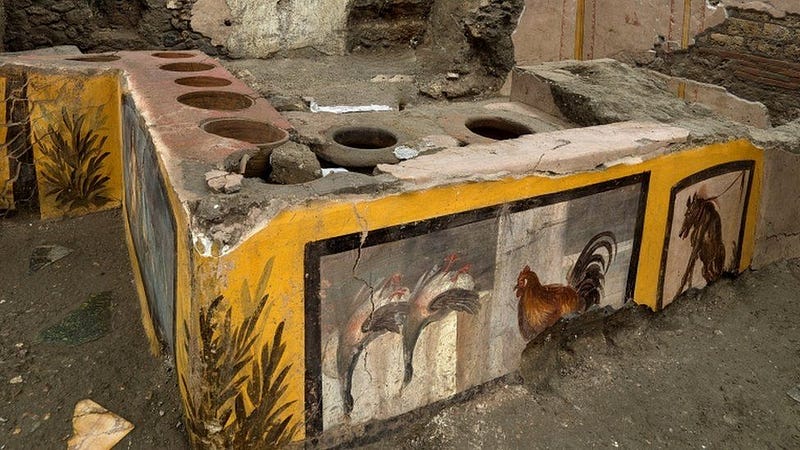
Since there were images of chickens, roosters, upside down turkey, ducks and other animals around this small structure, it was assumed that this might have been a restaurant. If not a restaurant that hosted people, but it could definitely be a restaurant that handed over pick-ups to people, or assisted in food deliveries over the town.
Which confirms, that indeed the Pompeii residents were living a modern life after-all, and they had options to order fast food too!
Not only this, but even many containers were found around this site. As everything was engulfed with volcanic ash within minutes, therefore a lot of things were rather well-preserved. After opening those containers, traces of fish, crabs, snails and other sea food were discovered.
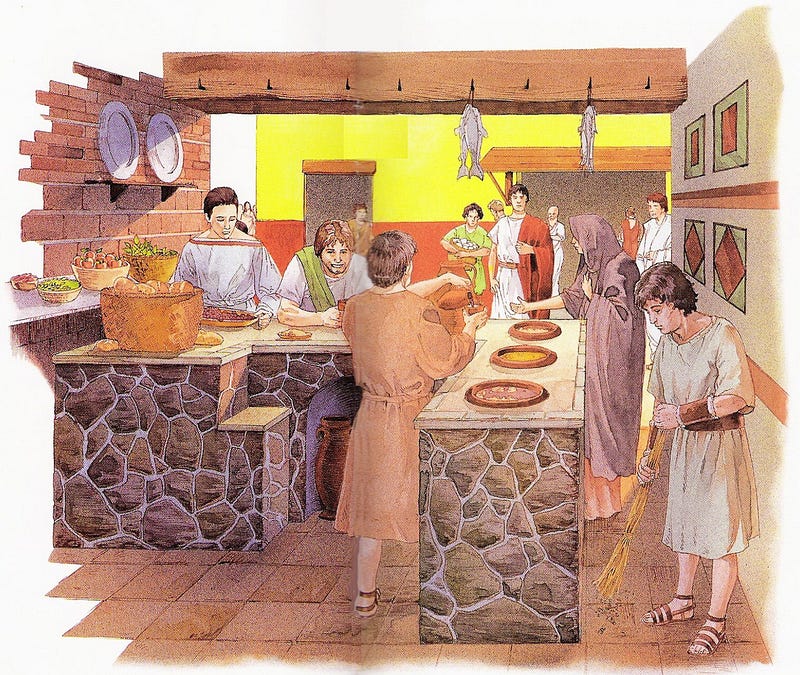
The circular openings on the structure acted as hollow cavities, inside which the food was cooked, and there could also be a chance of locals hosting something like a self-service buffet. Such restaurants not only provided food but also drinks to the customers, and that was confirmed after finding utensils and crockery around that area.
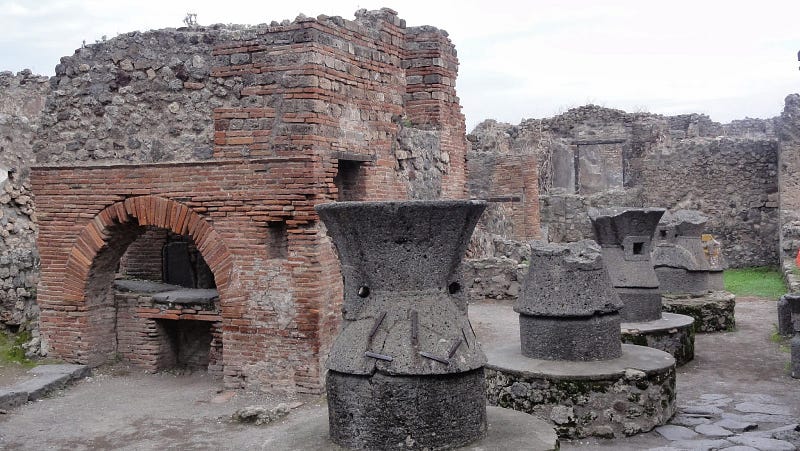
Apart from such fast food joints, in historical times bakeries have also been discovered including mills, kneading machines and ovens. Some of the ovens still had ash covered loaves of bread in them, which reveals a lot about staple food in the city.
7. What Different Businesses Did The Residents Do?
We already talked about maritime trade and naval routes that were a major business in Pompeii, and also prostitution and sex slavery that was rampant there. But apart from these two, there were multiple other businesses that ran to provide a comfortable life to the locals.
Many fullers (cleaning plants for wool), have been discovered in the past, which indicates that sheep rearing and shearing was a common practice at the time. The wool was used to make fabric for the locals, to survive the cold weather.
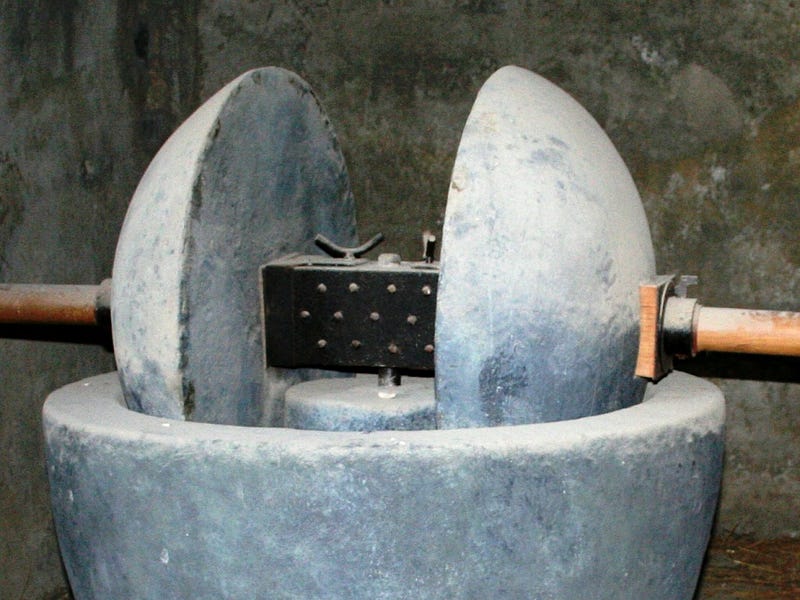
And because the land was rich and fertile, agriculture was also an important and essential business to harvest your own crops. Olive crushers (like the one in the image above), were also discovered proving that producing olive oil could also be a common practice at the time. Fishing was common due to the existence of a river nearby, and traces of that can also be found in the food they ate.
There were also shops of sculptor, gem cutter and toolmaker that were discovered, indicating that ornaments were commonly worn by the locals. Multiple wine and food shops also indicated at the presence of restaurants and bars, just like modern day world. Apart from that there were merchants, traders and businessmen who imported and exported multiple goods in and out of the city.
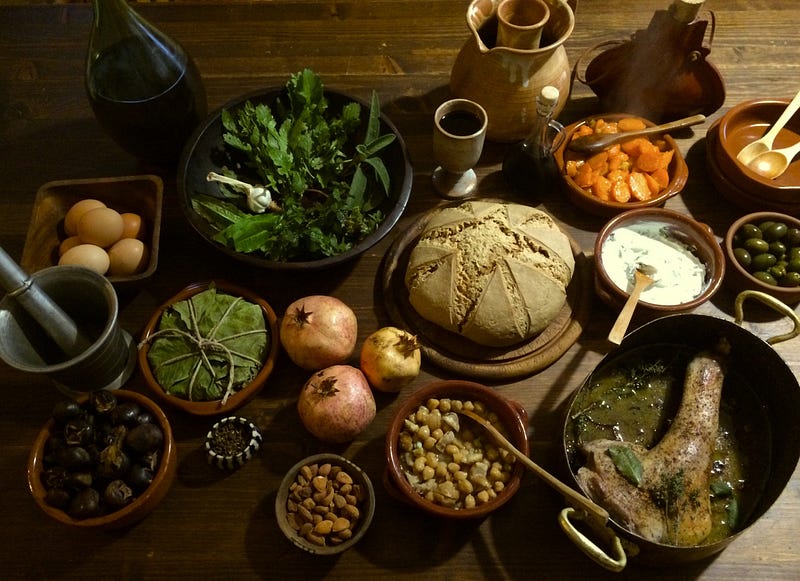
8. The Eating Habits Of The Rich And The Poor
Since Pompeii was a city that hosted both — rich tradesmen and businessmen, and poor workers, servants and slaves, so life was drastically different for both of these classes. If you read about ancient Roman culture, you will find that the wealthy Romans ate foods that were rich in fats, they got intoxicated on wine and exotic alcohol. Basically similar to today’s rich and affluent!
Well, mostly the difference lied in the buying power of the rich and the poor. The rich could afford more extravagant food like imported sea food, birds like flamingos and even meat of giraffe. They also seasoned their food with spices majorly imported from Indonesia.
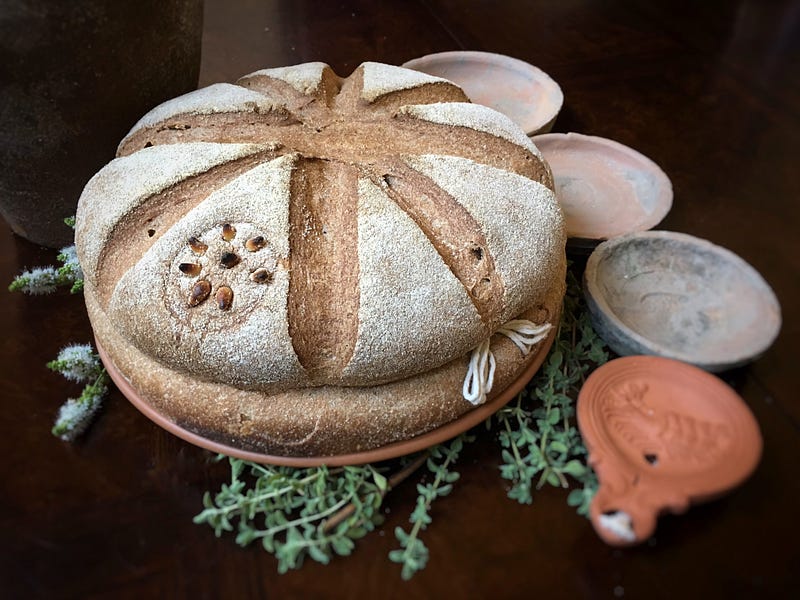
While you might think that rich people of Pompeii would go out dining like today’s elite class? No, actually the rich of that time, preferred to ate at home, surrounded by their servants and slaves who would clean up after them, help them finish their meal and even cook for them.
If you talk about the poor, they majorly ate what was either widely available, or left-over, from their masters. Most common things at the time were grains, fruits, nuts, local fish, chicken, eggs etc. Spices were expensive so they rarely seasoned their food. Vegetables were locally produced, so they were abundant in quantity. One of the most common vegetable of the time was cauliflower that usually ended up at the tables of the poor, while fruits were used as dessert.
Apart from that, bread was one of the most common and staple dishes that was found in almost all households — doesn't matter whether rich or poor. Just that, more recently baked, fresh bread would land into the homes of the rich, while stale and old bread found its way to the poor tables.
While the rich preferred to eat in the comfort of their homes, the poor were the ones who mostly preferred to dine outside or rely on fast-food joints for their meals. Fast food joints also acted as places for the people who had no place to eat at their homes, or who had no homes at all, like the workers who were coming to work in the city for some time — they were the ones who relied on such fast-food joints the most.
These were some of the most extraordinary facts about the undiscovered city of Pompeii, that not only gives us a glimpse into their life and lifestyle, but also forces us to think about the differences and similarities in cultures of today and that time. Humans have evolved a lot over time, but we are still the same in many traits, even today.


