
8 Books Every Intelligent Person Must Read to Double Your Business
Reading not only shows your vision and knowledge but it also determines your fate.

What is the difference between the readers and non-readers?
Their mindset
Let me share with you some facts:
Jewish people rank #1 in the world in terms of the number of books read each year. On average, one person read 64 books a year. Since the establishment of the Nobel Prize, Jewish people have won a total of 20% in chemistry, 25% in physics, 27% in medicine, 41% in economics, 12% in the literature.
However, Jewish people make up only 0.3℅ of the world’s population.
A country that loves reading is going to be prosperous for sure.
If you don’t read books and have a few small accomplishments, you won’t be able to recognize the greater achievements after reading.
Reading not only shows your vision and knowledge but it also determines your fate.
To build your systems mindset, I would like to introduce my favorite 8 books, each of which can allow you to think and make improvements based on different perspectives.
#1: Worldviews: an introduction to the history and philosophy of science by Richard DeWitt

“If you only read books that you can understand, then you can only know your own worldview”, the so-called growth and development mean using “ worldview” to boost your cognition.
This book is quite popular with young people in the United States. This is a science philosophy book that allows people to open and train their minds. The book introduces the basics of a scientific philosophy and the history of science, such as truths, philosophical facts or concepts, etc.
Science brings about not only knowledge but also a new cognitive system, such as the transition from Aristotle’s worldview to Newton’s. The book also discusses the impacts and challenges of modern scientific development on the worldview, especially the theory of relativity, quantum mechanics, and the theory of evolution.
#2. What Intelligence Tests Miss: The Psychology of Rational Thought by Keith E.Stanovich
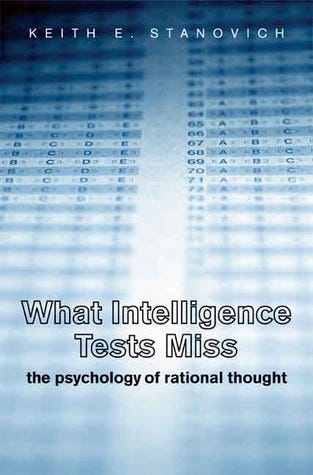
Does high IQ mean being able to make good and valid decisions? Wrong!
Research has shown that smart people are no different from ordinary people in making correct decisions.
Some examples: mathematicians buying large quantities of stocks that continue to decrease, and eventually exhausted all their saving accounts, education experts come to Mexico to meet folk physicians instead of scientifically tested medical methods, history professors join cults, middle school teachers entice peers colleagues into multi-level marketing, etc
Most people think that “good critical thinking” includes judging and making wise decisions, but common IQ tests don’t completely evaluate the individual’s ability to judge and make decisions.
If you desire to have a better life, achieve certain long-term goals, just having a high IQ is not enough. You still need a high level of rationality which can completely be improved through the learning process.
#3. Critical Thinking by Richard W. Paul and Linda Elder
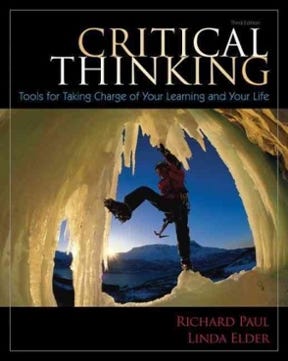
This book provides readers with the intellectual tools they need for lifelong learning, reasoning, and self-discipline.
Critical thinking is not an abstract term. If you learn how to master it, you can control your way of thinking, become a wise thinker, capture your career, or even your emotions. Gradually, you will no longer be influenced by others, thereby your quality of life is enhanced.
Critical thinking is a crucial skill for many innovative companies such as Tesla, Apple, Amazon. The book is used in more than 300 universities in the United States. School doesn’t teach you the method of critical thinking, so you need to broaden your mind and improve the core competitiveness of creativity.
#4. Asking the Right Questions by Neil Browne and Stuart M. Keeley
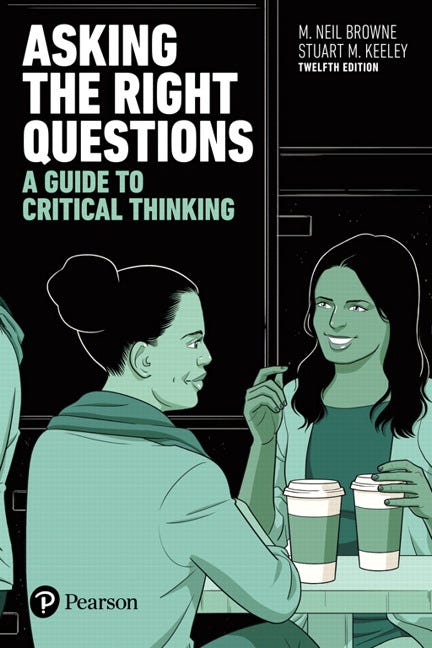
If businesses in your hometown restrict production due to haze prevention, would you support or oppose? If the subway in your city upgraded security procedures for security reasons, would you cooperate or get angry? Many experts expect the stock market will fall, housing prices will rise wildly, who do you believe? Behind all these questions, what’s your point? What is your reason? Do you have any solid evidence to support that?
The world we are living in is noisy, hectic, surrounded by information flooded at all times. If you don’t have a standpoint and independent judgment, you can only accept the views of others.
No matter what experts say, we need to rely on our brains to stimulate critical thinking, ask the right questions to make controversial opinions become clear. Critical thinking is the right approach to deal with today’s turbulent world.
#5. The way of nowhere” by John Nicholas Udall and Nic Turner
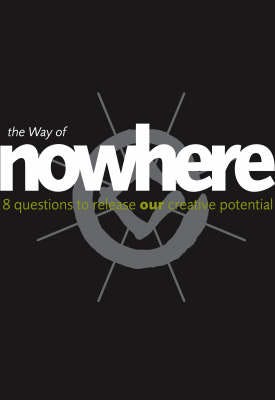
How to find creative breakthroughs within individuals and organizations, hence breaking the shackles of traditional rules? The author presents “eight groundbreaking issues” in the book.
These issues can help individuals, groups, and large-scale social systems discover their intangible power, gaining a complete system view of change, development, and transformation.
The purpose of this book is to promote motivation and innovation within people, further enhance their cognitive abilities and help people find ways to turn their knowledge into action. Therefore, inspire people around them, form mutual encouragement for the entire organization, and recognize innovation force from the inside.
#6. True Professionalism: The Courage to Care about Your People, Your Clients, and Your Career by David H. Maister
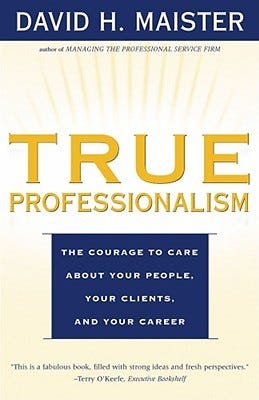
Everyone needs to equip themselves with professionalism, especially those working in professional service industries.
What is professionalism? Professionalism is not related to your education, industry, or position. It only includes your pride at work, the pursuit of high quality, and positive interest in customers. Professionalism is an attitude, not a skill. Professionalism is not a brand you create for yourself, but an appreciation from others.
The author analyzes how to achieve professionalism from the perspectives of individuals, companies, and customers, and offers a range of effective business proposals, such as how to ensure development, how professional service companies add value.
The book explains in a comprehensive way how professionalism can bring happiness and improvement to itself, and how to ensure and improve customer satisfaction with its services.
#7. An Introductory View of Management by Peter Drucker
What is management? What is an enterprise? What are the principles and mission of the business? Who are the consumers and customers of the business? How to think about business operations? How to create good productivity at work?
Classical management knowledge comes from practice, from macro to micro, to help you master the basic logic of “management”. The book is a treasure that people should memorize and carry this knowledge during their careers.
Each chapter raises questions to help you better understand the main nature of management.
#8: The Evolution of Everything: How Ideas Emerge by Matthew White Ridley
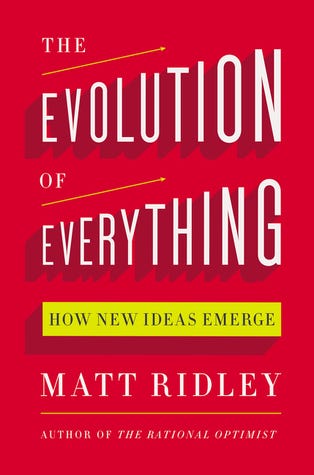
The natural world doesn’t exist in primitive design, everything comes from natural growth. Ethics, politics, economics, science, technology also follow similar evolutionary logic.
Why does monogamy replace other marriage regimes to become mainstream?
Why are scientific concepts emerging from private enterprises?
Why encouraging innovation never brings innovation?
Why did the US Federal Reserve’s regulatory constraint in reverse cause a financial crisis?


