
Measuring Wellness for Goal Setting
Explore 8 Lifestyle Tasks with Printable Wellness Worksheet
The New Year is when we make our diet goals and start our wellness journey….again. Focusing on our health and well-being is a yearly tradition we check off our list after the holiday parties and all the delicious cookies are gone!
Am I starting over again? 😳
YES — you do every year.
Feeling a little deja vu?
I propose that we look at our wellness journey differently this year.
Wellness is a lot more than diets and weight loss —
Even though the commercials will relentlessly sell you the newest workout gadget that will solve all your problems!

Wellness is the interconnectedness of mind, body, and spirit working in harmony with each other.
- Our self-esteem and our ability to have healthy social/emotional connections make up the building blocks of our mental wellness.
- Our mental, spiritual, and social experiences either promote or hinder our wellness.
We have a personal responsibility to improve our wellness and health.
This year is the year we will make our goals and keep them.

Goal-Directed Behavior
Let’s explore the power of goals before we set them.
Alfred Adler, the founder of Individual Psychology, believed that we all strive to contribute socially and have the skills and courage to overcome obstacles to attain our goals.
Healthy striving enables us to be creative to overcome life challenges.
The basic assumption is that people’s thoughts, feelings, and actions are all directed toward a perceived goal.
This goal is constantly changing and influenced by the perception of our experiences.
In this activity, you’ll focus on eight core areas of your life. We’re going to create goals to increase our wellness.
8 Areas of Well-being
For this exercise, you’ll measure your wellness on a scale of 1–10.
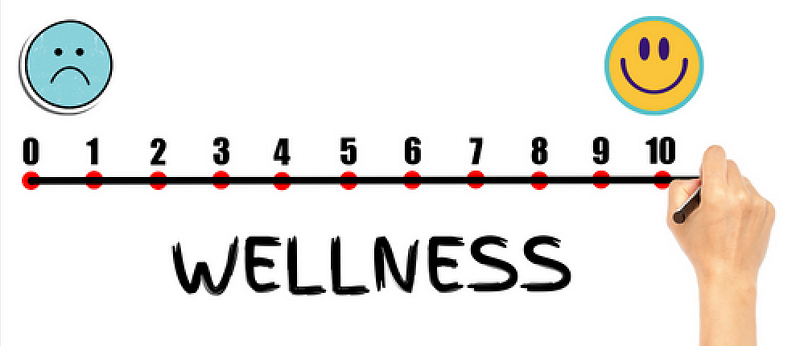
The eight areas below are key tasks in your life that impact mental health.
If one area lacks wellness, it can impact other areas of wellness.
1. Personal Growth
Our sense of meaning and purpose in life. It can include gender, cultural identity, spirituality, physical health, beliefs, self-esteem, and self-care. Self-care encompasses one’s decisions to maintain healthy habits for a more fulfilling life.
2. Health
Our exercise and nutrition habits. Exercise includes being active, and nutrition includes eating well, limiting unhealthy snacks, having a healthy weight, and avoiding unhealthy eating patterns (i.e., undereating or overeating). This also includes getting enough sleep. People with poor health habits are more susceptible to stress, which may negatively impact our physical and mental health.
3. Family
Our Family includes the relationships with those closest to us, with whom we learned traditions, gained a sense of belonging, and learned how to connect with others.
4. Relationships
Our ability to maintain significant and intimate relationships with others. It also includes how we cooperate with others in our community. Includes our ability to have positive relationships with others.
5. Recreation & Creativity
This area includes our unique talents and qualities influencing how we find our place in the world. We are constantly constructing our lives through knowledge and social experiences. Recreational activities include those activities or hobbies that we enjoy outside of work.
6. Spirituality
The spiritual task represents our life meaning, relationship with God, religion, and the Universe.
7. Work/Career
This area includes how we use our unique qualities to construct our lives, including our sense of contribution and fullness of life — the ability to contribute and create a better life for us and others in our community.
8. Finance
I added this here because this can be one of the most significant stressors people put on themselves. It includes managing expenses, paying debts, saving money for unexpected emergencies, and having a nest egg for future retirement.
Measure Your Wellness
Download the Wellness Worksheet here:
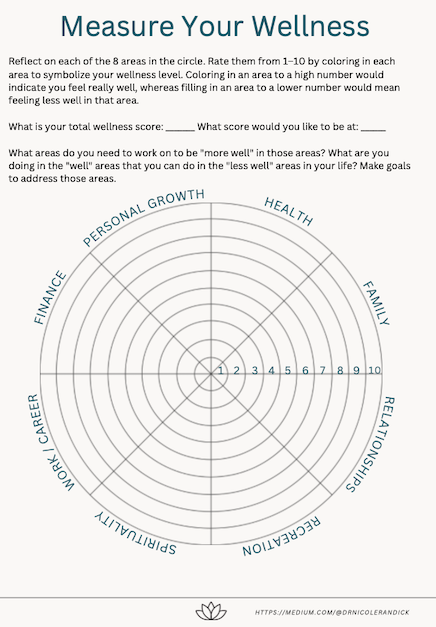
Reflect on each of the 8 areas in the circle. Rate them from 1–10 by coloring in each area to symbolize your wellness level. Coloring in an area to a high number would indicate you fell really well, whereas filling in an area to a lower number would mean feeling less well in that area.
What is your total wellness score: _______
What score would you like to be at: ______
Plan Your Goals
Download these free PLANNING WORKSHEETS to complete this activity. Make sure you make goals that are SMART — specific, measurable, attainable, relevant, and timely. Reflect on these questions.
- What areas did you score high (more well)?
- What areas did you score low (less well)?
- What are you doing in the “more well” areas that you can do in the “less well” areas in your life?
- List out the people in your life that help you reach your goals. Explore the ones who hinder your attainment of these goals.
- What strengths and resources do you have to help in the “less well” areas? List them out in the worksheet.
- How can you improve in ALL areas of wellness? We are always learning and growing. Try to set a goal in each area.
We always have time to make good lifestyle decisions that can lead to greater satisfaction and life-enhancing behaviors.
References:
Bitter, J. R. (2007). Am I an Adlerian? The Journal of Individual Psychology, 63(1), 3–31.
Hettler, W. (1984). Wellness: Encouraging a lifetime pursuit of excellence. Health Values: Achieving High Level Wellness, 8, 13–17.
Myers, J. E. (1992). Wellness, prevention, development: The cornerstone of the profession. Journal of Counseling & Development, 71, 136–139.
Myers, J. E., & Sweeney, T. (2005). The indivisible self: An evidence-based model of wellness. The Journal of Individual Psychology, 61(3), 269–279.
Myers, J.E., & Sweeney, T. (2008). Wellness counseling: The evidence base for practice. Journal of Counseling & Development, 86, 482–493.
Wolf, C. P., Thompson, I. A., & Smith-Adcock, S. (2012). Wellness in counselor preparation: Promoting individual well-being. The Journal of Individual Psychology, 68(2), 164–181.
Subscribe here to receive an email whenever I publish. Don’t forget to follow me to learn more about personal growth and healing!


