
We Age Our Anxious Children From The Day They’re Born
We need to stop this cradle-to-grave anxiety response.
The superstitious — or, actually, anxious — side of me often whispers loudly in my ear.
It tells me to stop making public proclamations of wanting to work until the day I die.
Of talking about the things I’m doing today — at age 48 — to preserve my physical and mental health in relative old age and beyond. Of aiming to work less now so I can work less longer. Of not being all that concerned with the what-ifs of life. Of saying I have a goal to live — and live well — to 100.
All this stuff I go on and on about in my writing.
But I can’t stop.
I can’t stop because this is what I live and it’s what I believe.
Plus, I constantly have to prevent my logical and optimistic self from giving in to my anxious side. Because it’s illogical and pessimistic — borderline inane really — to think that because I say something positive I’m somehow jinxing myself into having the opposite — something bad — happen.
If you’re anything like me, you know how difficult it is to merely think, let alone type the last part of that last sentence.
So, yeah, I’m well aware that I might end up one of those people who fall ill — one way or another — before my time.
I’m too aware.
This is, in part, why I focus so much on not giving in to anxiety and accepting some prescribed reality that old age almost always leads to decreased mobility, degrading physical (and maybe mental) health, and the elimination of a whole host of activities from your life. Everything from sex to traveling to climbing stairs.
Speaking of climbing stairs. This interaction on my most recent Crow’s Feet article got me thinking again about something I think about frequently.
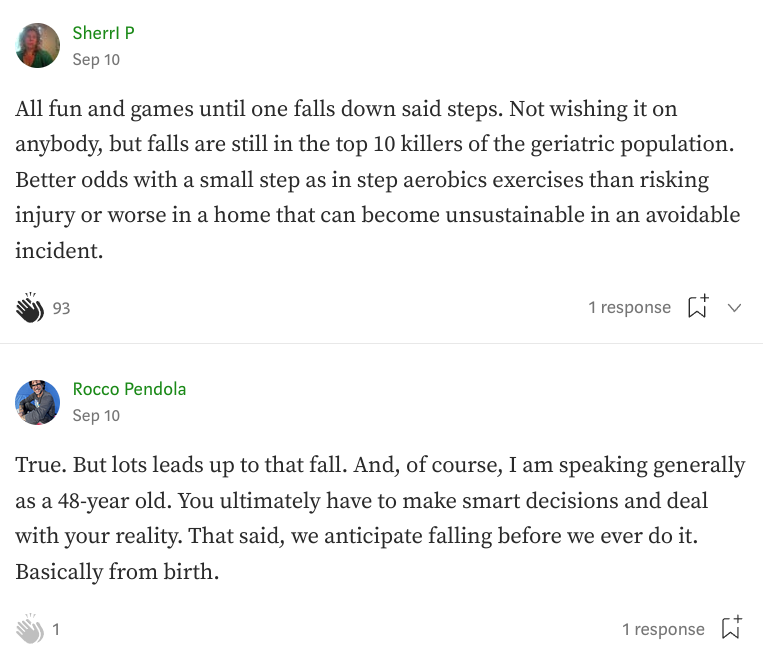
Here again, shit happens. I know this. Obviously.
But it doesn’t always have to happen. And it’s certainly not inevitable.
As the longevity crowd loves to riff, aging is a disease. And, while they can be as annoying as the leaders of any other good idea that turns into a cult-like, bandwagon movement, longevity researchers and activists are clearly onto something.
It’s not just conjecture. Science supports the notion that we can do things to not only live longer but to be in relatively good health until we’re very old, if not until the day we die. The World Health Organization already considers aging a disease; it’s time for agencies such as the Food and Drug Administration to get on board.
This said we need more than an official designation.
As with most pressing issues in America, we require a mindset shift.
Because, from the time we’re little kids the people around us prepare us to be anxious messes. Of course, this anxiety alone can contribute to ill health and other issues across the lifespan. However, it also helps us accept the idea that a slower, less satisfying life is inevitable. One that will likely include poor, if not outright terrible health and premature death.
We’re conditioned to believe that we only have a limited number of good, active years on Earth that will quickly morph into several decades of hell on Earth. Sitting around watching TV on a fixed income in between doctor’s appointments.
Here are some real-life — this happened to me and probably you — examples of what I mean.
And they all stem from anxiety at their core.
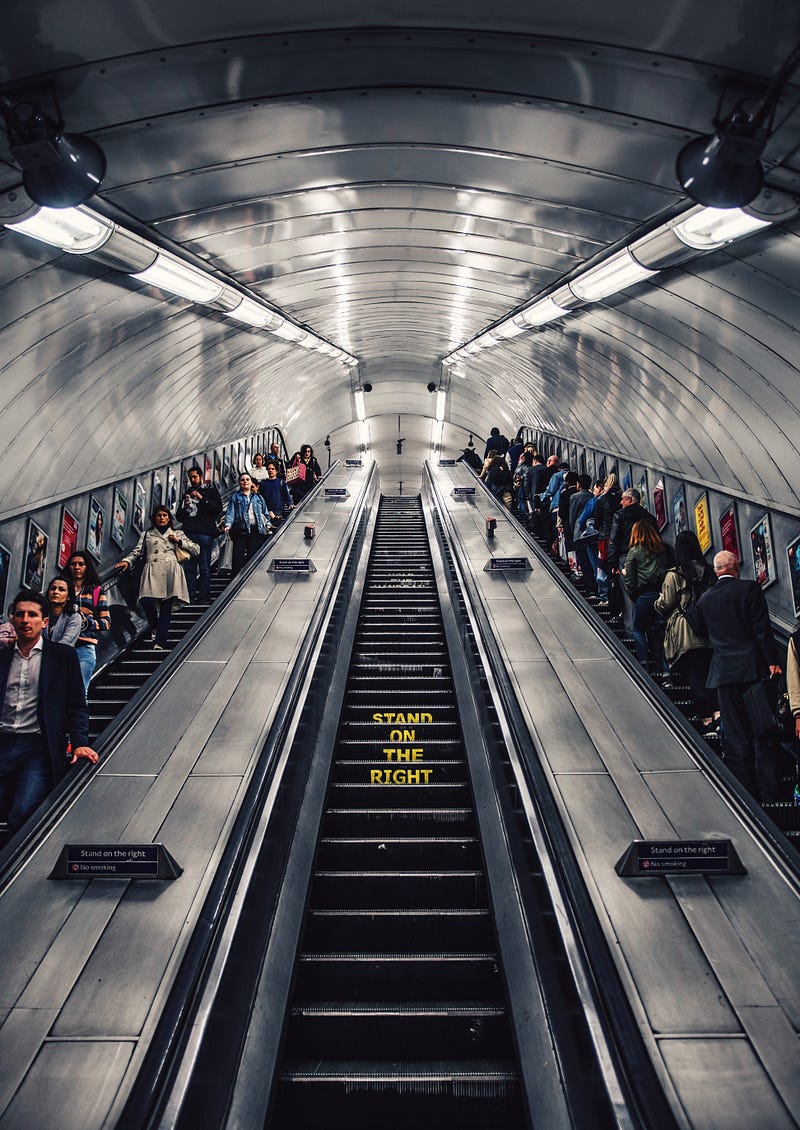
When my now 20-year-old daughter was little, her Grandmother (who was a wonderful woman) used to somewhat frantically remind her to check her shoelaces and pant legs as we approached an escalator because they could get caught and she could fall and crack her head open.
A bit dramatic. Because I can’t come up with an instance of this — or anything close to it — happening. I mean I’m sure it has, but we’re talking close to struck by lightning stuff.
But, even if it was more common, how about calmly expressing the concern? The kid will get it, follow your lead, and learn how to perform a routine life function she probably — by instinct — knew how to do already.
When my daughter was little and she fell on the playground, I rarely ran over to her. Other parents — and, if they were around, my older relatives — would immediately sprint over to offer assistance. This almost always led to crying, even though nothing was wrong. When I’d leave her there for a second, almost to an instance, she would look up, look around, realize she was okay, maybe self-soothe a bit, and move on with her day.
Rushing over — like a helicopter partner — is yet another anxiety response.
Of anticipating horrible pain, even tragedy before it happens in situations where it’s highly unlikely to even happen in the first place.
We do something similar with aging.
From the time our kids are little, their elders (and even their relatively spry parents) tell them to do this, that, and another other thing before they’re old. Because once you’re old, you won’t be able to. Exact words.
Here again, it makes sense to live life, live it well, and live it now because you never know what’s going to happen tomorrow. But it’s just that. You never know.
The better thing that “old” people — and others — often say is, do it today because you could get hit by a bus tomorrow. Exactly. And six million other things that can happen to you between tomorrow and whatever day they pick you up in an ambulance for the last — and hopefully — first time.
All of this stuff — and so much more that would turn this into a 100-minute read — has a cumulative effect. It creates the conditions for us to believe that we’re basically screwed.
When we’re young this can keep some of us in fight or flight. It foreshadows a future we’re absolutely not destined to have.
Then, as we get older, this purely psychological condition causes us to needlessly slow down. Not just make prudent, age-appropriate choices, but to stop doing things we don’t need to stop doing because — as we were taught — we’re gonna need to stop doing them soon anyway.
If you’d like to know more about the journey I’m on, follow me on Medium.
You can also subscribe to my Never Retire: Living The Semi-Retired Life newsletter where I chronicle my big decisions on lifestyle, housing and cost of living, which includes moving to Spain sooner rather than later.