
The Enervated Speech Is a Trump Homestretch Hallmark
Trump saved the fireworks for after his speech
Donald Trump could not have become president without his outrageous and unusual campaign rallies, events where he could celebrate war crimes or undermine historic alliances in asides while waging wholesale attacks on his opponents. But he also would not have been elected president if he hadn’t spent the homestretch of the 2016 election simply reciting the clichés that he was given by his speechwriters.
What Trump has shown time and again since 2015 is that, although he is a remarkable entertainer, he’s also a terrible orator. As a Republican presidential candidate, Trump became the frontrunner through rallies that were cable news catnip. The reason: No one knew what he would say next, often including Trump himself. His remarks were a bizarre mix of Andrew Dice Clay and improvisational riffs. Trump would begin an idea, insult two opponents, share his latest thoughts on cable news personalities, and discuss three unrelated topics before somehow returning to where he had left a thought hanging 15 minutes before.
His oratory when working from prepared remarks, though, is ponderous and brutal. The “American Carnage” of his inaugural address was an analogy that could just as easily be used to describe the prose he recited as the grim vision of America that he shared.
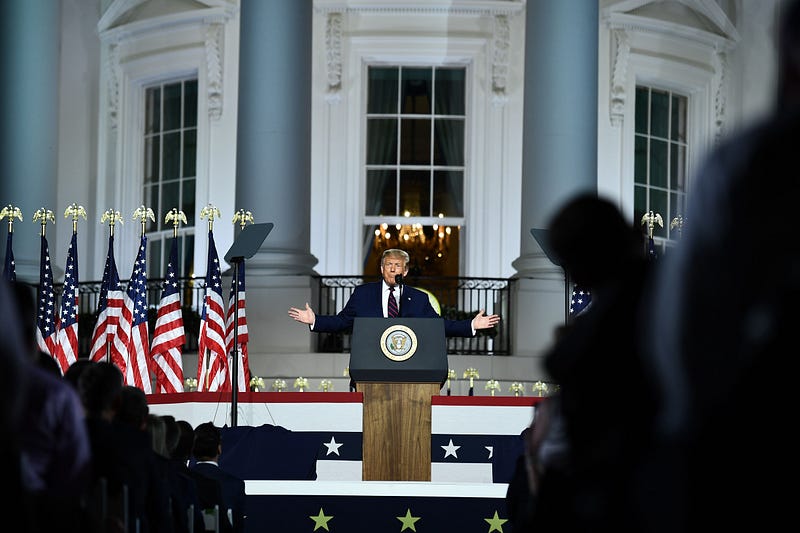
It was no different when Trump formally accepted the Republican presidential nomination Thursday night in a speech he often appeared to be reading for the first time as he spoke it aloud. Trump’s stilted delivery at the teleprompter was further undermined by prose so turgid it almost felt a deliberate act of linguistic vandalism.
From the moment the president began his speech by “profoundly accepting his nomination” to his closing, when he noted that Western pioneers “didn’t have money, they didn’t have fame—but they had each other,” it was a remarkable assault on the English language. Mencken once said that Warren Harding’s speeches were “so bad that a sort of grandeur creeps into it.” The more apt comparison in today’s world might be Ron Burgundy. You can’t be mad at Trump’s prose, only amazed.
The only frissons of excitement during Trump’s acceptance speech were when he went off script and ad-libbed from his prepared remarks before the crowd of 1,500, which had been assembled on the South Lawn in an unmasked, undistanced gathering in defiance of D.C. public health regulations and the Hatch Act, the 80-year-old law that prohibits the use of government assets in campaigns. Whether he was sharing familiar saws — “that’s all we need is more lawyers” — or insisting Democrats spied on his campaign, it was Trump’s off-script moments that drew a robust reaction from the crowd. That was the Trump they came to see, not the man who squinted to read Wyatt Earp’s name off a teleprompter.
Tension between these two Trumps defines his candidacy and his presidency. Trump has long mocked the idea of being presidential. Free associating at his rallies, he will sometimes impersonate a wooden politician who says nothing interesting and simply reads from the much-scorned teleprompters. “Rally Trump” comes with risks: When he strays from the script, anything can and often does happen. But when he sticks to it, he commits a sin that is perhaps worse than a gaffe for a former reality TV star. He is boring. But boring, scripted candidates win.
Trump was never more scripted than in the home stretch of his 2016 presidential campaign. He stuck to his teleprompter with only occasional asides. At least by his lax standards, he was a disciplined candidate, and it worked. Trump may have been boring — but he also didn’t make major mistakes. The failures of the Hillary Clinton campaign — combined, of course, with last-minute intervention from James Comey—did just enough for Trump to squeak by in an upset that surprised him as much as it did almost everyone else.
“Rally Trump” kept on peeking out Thursday. Even clothed in the dignity of a formal address given against the backdrop of the brightly lit White House, Trump couldn’t resist. For a brief moment in the midst of the pandemic, he was able to address a cheering, whooping, applauding, maskless crowd. While the VIPs sitting outdoors during the humid D.C. night lacked the rowdiness of a rally full of diehards, it was still a lawn packed with ardent supporters. As the speech went on, Trump increasingly gave in to the temptation to play to the crowd.
Trump will need to strike a new balance in order to win reelection. Hillary Clinton was historically unpopular. Joe Biden is not. The economy in 2016 was relatively good, and the country was at relative peace. In 2020, the United States is facing the combination of a historic pandemic and the accompanying recession as well as levels of racial tension and unrest not seen in decades. And, Trump is not the underdog challenger but the leader of the free world.
Neither of his approaches from 2016 will work this year. The question now is whether Trump found the right balance — and messages — on Thursday.