
Society | Advice | Life Lessons
On Language and Monkeys Who Don’t Eat Bananas
Fighting against the conformism of life
When I was a kid, I had an obsession with questioning everything that was handed down to me with unshakable certainty.
I hated the answer “because I say so” or ”it has always been that way”. I wanted a clear answer as to why things were the way they were.
I know that today we associate the age of the why with a certain part of childhood, but in my case, this attitude has become an integral part of my personality, even to this day.
I remember two situations in particular that illustrate well this obsession with the why of things:
- the first, was when I was about 10 years old. I discussed with my father the possibility that I could cross the road outside the crosswalk. He told me that I could not cross the road outside the crosswalk. I countered, saying, yes I can, but I won’t, and that’s the catch;
- in the second situation, in a conversation with my mother, I told her, somewhere around mid-adolescence, that the economic value of the engagement rings was based on a historical value: if, in the past, socks had been exchanged during the first marriages, today socks would cost several hundred euros or dollars.
Apart from the image of an insolent child that the reader may be creating in his head — and with which I will not disagree — I was bothered by the idea of prohibition as a creator of automatism.
At some point, we would stop wondering why we were doing a certain action, doing it just because we were. And how tormented I was with the idea of an unthought life as if we were robots, puppets in someone’s hands.
If in the marriage rings situation, it was a mere thought exercise, the act of crossing the road contained real danger. But somehow I gave immense importance to the fact that this perception of danger originated in the mind of the subject in action.
And it was also one of the first moments, which I cherish when I realized the power of language, the magic that is embedded in the use of a word. It is never just a word, but a world within each one.
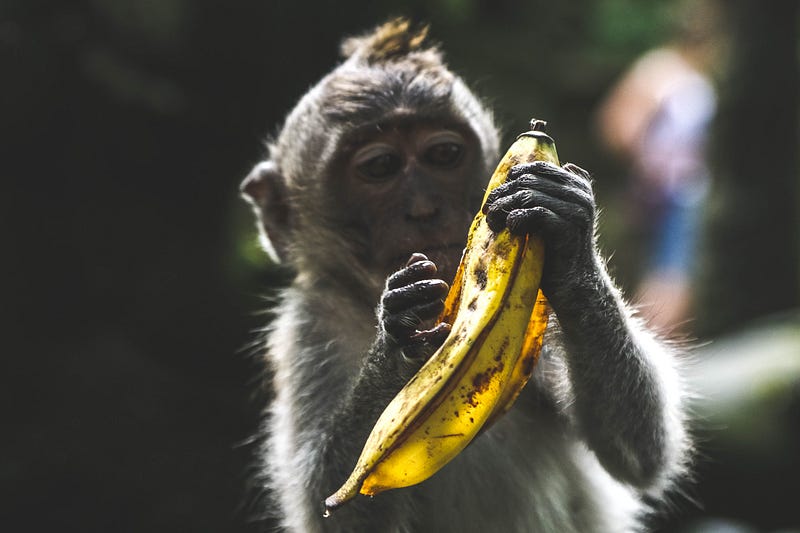
The story of the monkeys in the cage
This attitude, the fundamentals of which I realized later — at that time I only knew that it irritated me — takes me back to the story of the monkeys in a cage.
I discovered it in the book The Art of Non-Conformity, by Chris Guillebeau, although I have not traced the origin of it (if any reader would like to enlighten me on this in the comments, feel free).
So, this story tells us, a sadist put five monkeys inside a cage, forced into a boring life, although with enough food and water at the bottom of the cage.
At the top, the sadist placed a beautiful bunch of bananas. As soon as the first monkey climbs the cage to try to reach the bananas, the sadist turns on a hose and leaves not only that monkey but all the others, completely soaked, in an experience that is repeated.
Every time a monkey tries to reach the bananas, everyone else gets soaked. Until, after a few repetitions, the monkeys settle on the idea that they cannot eat the bananas.
Lo and behold, then the process changes. The sadist removes one monkey and replaces him with another, who is unaware of the rules of the game. As soon as this new monkey tries to climb the cage, the others pull him down, quickly getting him used to the idea of not reaching the bananas.
The original monkeys are replaced, one by one, until the time comes when none of them are part of the original gang, that is, none of them have ever been drenched by the hose.
Then one of them wonders: Why can’t we eat the bananas?
To which the other answers: We don’t know, we just know that we can’t.
As if not, this fable illustrates well a thinking mechanism that happens so often to human beings.
We get used to certain ways of thinking that we accept as normal, as the rule, and we don’t question them. It is important that we always have an open mind, that we defend it from becoming atrophied, or else one day we will look back and realize that we have lived a life thought up by others.
In conclusion
This doesn’t mean that we should question everything to infinity, losing ourselves in our own vortex of doubt.
Like everything in life, I think, we should find the balance between our existing knowledge about the world and our reflected perception of that knowledge: only then we are actually producing knowledge, and not repeating it.
Only then can we enjoy a good bunch of bananas.
Before you go…
Did you enjoy reading my story? How about becoming a member here on Medium? Your membership fee, only 5$/month, will give you the opportunity to read all the stories you want, while supporting me and other writers to continue to bring you insights every day. Click here to become a member.


