avatarJ3

Free AI web copilot to create summaries, insights and extended knowledge, download it at here

4809

Abstract

-keyword">of</span> this<span class="hljs-built_in"> sort</span> really just acts <span class="hljs-keyword">as</span> a <span class="hljs-number">16</span> <span class="hljs-keyword">to</span> one <span class="hljs-number">1</span> <span class="hljs-keyword">switch</span>;</pre></div><div id="7428"><pre>- <span class="hljs-number">4</span> digital pins are used <span class="hljs-keyword">to</span> <span class="hljs-keyword">set</span> HIGH <span class="hljs-built_in">or</span> LOW, <span class="hljs-keyword">in</span> a <span class="hljs-keyword">binary</span> fashion (<span class="hljs-number">0</span><span class="hljs-number">15</span>) <span class="hljs-keyword">to</span> determine what pin “SIG” <span class="hljs-built_in">is</span> connected <span class="hljs-keyword">to</span>;</pre></div><div id="0dd7"><pre>- <span class="hljs-keyword">Bringing </span>all <span class="hljs-number">4</span> pins LOW would <span class="hljs-keyword">switch </span>the CD74HC4067 to channel <span class="hljs-number">0</span> (so SIG <span class="hljs-keyword">and </span>C0 would <span class="hljs-keyword">be </span>connected);</pre></div><div id="bef5"><pre>- <span class="hljs-keyword">Bringing </span>them all HIGH would <span class="hljs-keyword">switch </span>it to <span class="hljs-number">15</span> (so SIG <span class="hljs-keyword">and </span>C15 would <span class="hljs-keyword">be </span>connected);</pre></div><div id="098d"><pre>- The EN pin control <span class="hljs-keyword">when</span> the mux <span class="hljs-keyword">is</span> enabled <span class="hljs-keyword">or</span> disabled; </pre></div><div id="b29e"><pre>- The EN pin <span class="hljs-keyword">is</span> a kill switch: pull it up <span class="hljs-keyword">to</span> <span class="hljs-number">5</span>v <span class="hljs-keyword">to</span> <span class="hljs-keyword">disable</span> <span class="hljs-keyword">all</span> channels, <span class="hljs-keyword">and</span> ground it <span class="hljs-keyword">to</span> <span class="hljs-keyword">enable</span> them;</pre></div><div id="209e"><pre>- The CD74HC4067 <span class="hljs-keyword">is</span> capable <span class="hljs-keyword">of</span> more than reading analog signals, It can be <span class="hljs-keyword">uses</span> <span class="hljs-keyword">in</span> either direction;</pre></div><div id="71f7"><pre>- So let us <span class="hljs-keyword">put</span> this <span class="hljs-keyword">to</span> good use:

  • <span class="hljs-keyword">if</span> you needed <span class="hljs-keyword">to</span> control <span class="hljs-number">16</span> relays, just connect SIG <span class="hljs-keyword">to</span> <span class="hljs-number">5</span>v, <span class="hljs-keyword">and</span> <span class="hljs-keyword">then</span> be able <span class="hljs-keyword">to</span> switch <span class="hljs-keyword">the</span> <span class="hljs-number">5</span>v <span class="hljs-keyword">to</span> one <span class="hljs-keyword">of</span> <span class="hljs-number">16</span> channel pins
  • <span class="hljs-keyword">if</span> you had <span class="hljs-number">16</span> RFID readers <span class="hljs-keyword">that</span> output serial just connect <span class="hljs-keyword">the</span> SIG pin <span class="hljs-keyword">of</span> <span class="hljs-keyword">the</span> CD74HC4067 <span class="hljs-keyword">to</span> digital <span class="hljs-number">0</span> <span class="hljs-keyword">on</span> <span class="hljs-keyword">the</span> arduino (Serial RX pin) <span class="hljs-keyword">and</span> <span class="hljs-keyword">the</span> serial <span class="hljs-keyword">out of</span> an RFID reader <span class="hljs-keyword">to</span> one <span class="hljs-keyword">of</span> <span class="hljs-keyword">the</span> channels <span class="hljs-keyword">and</span> be able <span class="hljs-keyword">to</span> <span class="hljs-built_in">read</span> <span class="hljs-keyword">from</span> all <span class="hljs-number">16</span> RFID readers;</pre></div><div id="98b5"><pre>- Open you data sheet <span class="hljs-keyword">and</span> consider:
  • “DC Electrical Specifications” — minimum voltage that can be considered <span class="hljs-keyword">as</span> <span class="hljs-keyword">a</span> HIGH <span class="hljs-keyword">and</span> <span class="hljs-keyword">the</span> maximum <span class="hljs-keyword">for</span> <span class="hljs-keyword">a</span> LOW depending <span class="hljs-keyword">on</span> <span class="hljs-title">your</span> <span class="hljs-title">supply</span> <span class="hljs-title">voltage</span>;
  • “ON” resistance — that is <span class="hljs-keyword">the</span> resistance <span class="hljs-keyword">in</span> Ohms (O) between <span class="hljs-literal">one</span> <span class="hljs-keyword">of</span> <span class="hljs-keyword">the</span> sixteen inputs/outputs

Options

<span class="hljs-keyword">and</span> <span class="hljs-keyword">the</span> common pin;

</pre></div><p id="f7c2">Consider the pinout diagram from the datasheet:</p><h2 id="c754">Pinout</h2><figure id="2fed"><img src="https://cdn-images-1.readmedium.com/v2/resize:fit:800/1*A0HQnOWcgvIvADvXzE4LHg.png"><figcaption>Fig 2. 74HC4067 pinout</figcaption></figure><h2 id="9b42">How to Soldering</h2><p id="82ca">[TODO: VID SOLDERING GOES HERE!]</p><p id="8570">Fig 3. Lab video w/ HC4067</p><h2 id="59be">The Fritz</h2><figure id="60b0"><img src="https://cdn-images-1.readmedium.com/v2/resize:fit:800/1*8BzpTuMz8bwb-NyUyNX1TA.png"><figcaption>Fig 4. CD74HC4067 Analogue/Digital Module MUX-Breakout-16-Channel-DeMultiplexer</figcaption></figure><div id="2938"><pre>Demultiplexer is a combinational logic circuit designed <span class="hljs-keyword">to</span> <span class="hljs-keyword">switch</span> <span class="hljs-keyword">one</span> <span class="hljs-keyword">common</span> input line <span class="hljs-keyword">to</span> <span class="hljs-keyword">one</span> of several separate output line<span class="hljs-comment">;</span></pre></div><div id="8637"><pre>Multiplexer is <span class="hljs-selector-tag">a</span> combinational logic circuit designed <span class="hljs-selector-tag">to</span> switch one of several <span class="hljs-selector-tag">input</span> lines <span class="hljs-selector-tag">to</span> <span class="hljs-selector-tag">a</span> single common output line;</pre></div><h2 id="155a">The Code</h2> <figure id="2720"> <div> <div>

            <iframe class="gist-iframe" src="/gist/giljr/4c84d07e3a27d36b85fc5ca55bf96a1b.js" allowfullscreen="" frameborder="0" height="undefined" width="undefined">
          </div>
        </div>
    </figure></iframe></div></div></figure><h2 id="d2d1">The video</h2><p id="8965">[TODO: VID 1 GOES HERE!]</p><p id="c758">Fig 5. Lab video w/ HC4067</p><h2 id="c84b">Credits &amp; References</h2><div id="6a62" class="link-block">
      <a href="https://bildr.org/2011/02/cd74hc4067-arduino/">
        <div>
          <div>
            <h2>bildr " Muxing Around With The CD74HC4067 + Arduino</h2>
            <div><h3>Have you ever found yourself running out of pins to read an array of analog sensors? Don't worry, you're not alone, it…</h3></div>
            <div><p>bildr.org</p></div>
          </div>
          <div>
            <div style="background-image: url(https://miro.readmedium.com/v2/resize:fit:320/0*eX3bMjda7x2UPXui)"></div>
          </div>
        </div>
      </a>
    </div><div id="336a" class="link-block">
      <a href="https://tronixstuff.com/2013/08/05/part-review-74hc4067-16-channel-analog-multiplexerdemultiplexer/">
        <div>
          <div>
            <h2>Tutorial - 74HC4067 16-Channel Analog Multiplexer Demultiplexer</h2>
            <div><h3>Now and again there's a need to expand the I/O capabilities of your chosen microcontroller, and instead of upgrading…</h3></div>
            <div><p>tronixstuff.com</p></div>
          </div>
          <div>
            <div style="background-image: url(https://miro.readmedium.com/v2/resize:fit:320/0*LllHkvQ_IHy94Fkm)"></div>
          </div>
        </div>
      </a>
    </div><div id="3aa2" class="link-block">
      <a href="http://mayhewlabs.com/products">
        <div>
          <div>
            <h2>Products</h2>
            <div><h3>Edit description</h3></div>
            <div><p>mayhewlabs.com</p></div>
          </div>
          <div>
            <div style="background-image: url(https://miro.readmedium.com/v2/resize:fit:320/0*_Y6c7BprsLWBlXIO)"></div>
          </div>
        </div>
      </a>
    </div><p id="70c2"><a href="https://www.sparkfun.com/products/9056">SparkFun Analog/Digital MUX Breakout — CD74HC4067</a> by <a href="https://www.sparkfun.com/">https://www.sparkfun.com</a></p><p id="5bf5">Datasheet <a href="https://www.sparkfun.com/datasheets/IC/cd74hc4067.pdf">High-Speed CMOS Logic 16-Channel Analog Multiplexer/Demultiplexer</a> by Texas Instruments</p><p id="6c31"><a href="https://www.electronics-tutorials.ws/combination/comb_2.html">The Multiplexer</a> by <a href="https://www.electronics-tutorials.ws/">https://www.electronics-tutorials.ws</a></p><p id="4eda"><a href="https://www.electronics-tutorials.ws/combination/comb_3.html">The Demultiplexer</a> by <a href="https://www.electronics-tutorials.ws/">https://www.electronics-tutorials.ws</a></p><figure id="3682"><img src="https://cdn-images-1.readmedium.com/v2/resize:fit:800/1*MCP-dWpRLkJ1yhD3xiVV2A.jpeg"><figcaption></figcaption></figure></article></body>

74HC4067 — DeMux For Arduino

A multiplexer of this sort really just acts as a 16 to one 1 switch — Ardu_Serie # 83

Hi, in this post we're gonna talk about this 74HC4067 board:
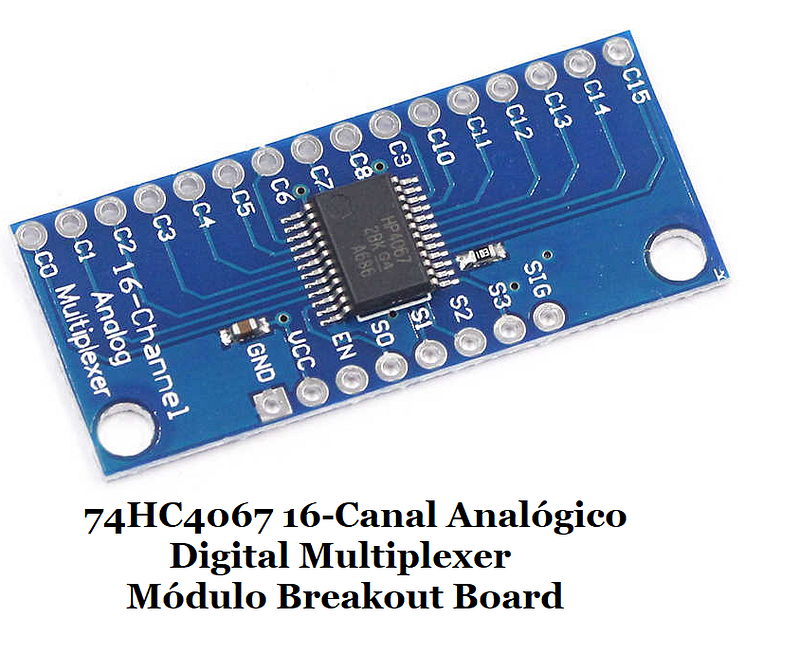
Fig 1. 16-Channel Analog Multiplexer/Demultiplexer for Arduino

At this point, you should download the datasheet, as we refer to it through the course of the article

Specifications

(from https://www.sparkfun.com/products/9056)

  • 2V to 6V operation
  • “On” resistance: 70 Ohms @ 4.5V
  • 6ns break-before-make @ 4.5V
  • Wide operating temperature range: -55C to 125C

Here are the summary notes from my internet research:

Notes

-You can consider the 74HC4067 to be a digital replacement to those rotary switches that allow you to select one of sixteen positions;
- 74HC4067 can operate on voltages between 2 and 6V DC (74HCT4067 it can only work on 4.5~5.5V DC);
- The CD74HC4067 is a 16-Channel Analog Multiplexer/Demultiplexer;
- CD74HC4067 is a super simple to use bidirectional mux that can make your life a lot easier;
- It's a must having if you ate running out of pins to read an array of analog sensors;
- Instead of upgrading your microcontroller, with this board you can to expand the I/O capabilities of your chosen microcontroller;
- It’s an IC that can direct a flow of current in either direction from one pin to any one of sixteen pins;
- The part itself is available in through-hole and surface mount versions;
- can help multiply the amount of pins you have;
- it is easy to connect to your arduino or other microcontroller;
- it allows you to do is use 4 digital pins, to control the flow of one pin to 16 others;
- It can actually be used in either direction, and even with serial or other digital interfaces;
- A multiplexer of this sort really just acts as a 16 to one 1 switch;
- 4 digital pins are used to set HIGH or LOW, in a binary fashion (015) to determine what pin “SIG” is connected to;
- Bringing all 4 pins LOW would switch the CD74HC4067 to channel 0 (so SIG and C0 would be connected);
- Bringing them all HIGH would switch it to 15 (so SIG and C15 would be connected);
- The EN pin control when the mux is enabled or disabled; 
- The EN pin is a kill switch: pull it up to 5v to disable all channels, and ground it to enable them;
- The CD74HC4067 is capable of more than reading analog signals, It can be uses in either direction;
- So let us put this to good use:
- if you needed to control 16 relays, just connect SIG to 5v, and then be able to switch the 5v to one of 16 channel pins
- if you had 16 RFID readers that output serial just connect the SIG pin of the CD74HC4067 to digital 0 on the arduino (Serial RX pin) and the serial out of an RFID reader to one of the channels and be able to read from all 16 RFID readers;
- Open you data sheet and consider: 
- “DC Electrical Specifications” — minimum voltage that can be considered as a HIGH and the maximum for a 
LOW depending on your supply voltage;
- “ON” resistance — that is the resistance in Ohms (O) between one of the sixteen inputs/outputs and the common pin; 
 

Consider the pinout diagram from the datasheet:

Pinout
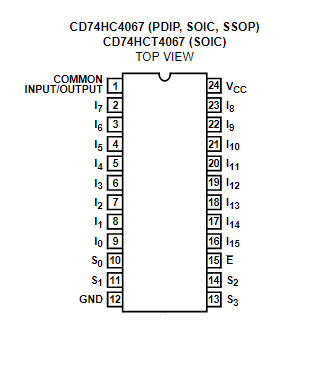
Fig 2. 74HC4067 pinout

How to Soldering

[TODO: VID SOLDERING GOES HERE!]

Fig 3. Lab video w/ HC4067

The Fritz
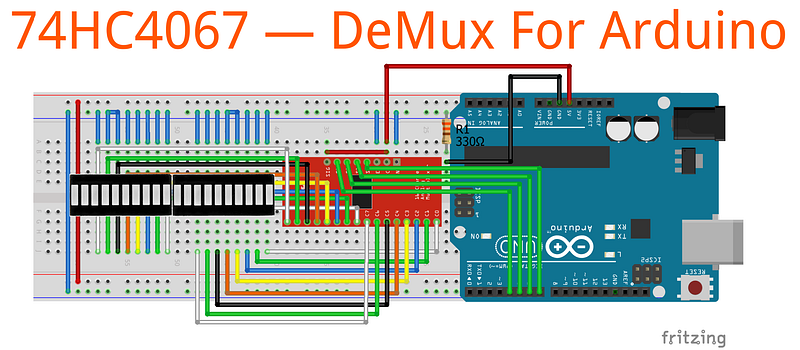
Fig 4. CD74HC4067 Analogue/Digital Module MUX-Breakout-16-Channel-DeMultiplexer
Demultiplexer is a combinational logic circuit designed to switch one common input line to one of several separate output line;
Multiplexer is a combinational logic circuit designed to switch one of several input lines to a single common output line;

The Code

The video

[TODO: VID 1 GOES HERE!]

Fig 5. Lab video w/ HC4067

Credits & References

SparkFun Analog/Digital MUX Breakout — CD74HC4067 by https://www.sparkfun.com

Datasheet High-Speed CMOS Logic 16-Channel Analog Multiplexer/Demultiplexer by Texas Instruments

The Multiplexer by https://www.electronics-tutorials.ws

The Demultiplexer by https://www.electronics-tutorials.ws
Recommended from ReadMedium