
Decode Your Love Interest By Sensing Their Attachment Style
Real-life examples to help you understand how they think and feel

I want you to play along with me. Let’s imagine that last week, you went to a bar and met four people you were attracted to. You thought giving a compliment would be a pretty safe thing to do. So, you say the same thing to each person, “You look great tonight.”
You got a glare, a beaming smile, silence, and a nervous laugh. In the same outfit, the same mood, and with the same line — you got four very different responses. You had been out of the dating game for a while and were suddenly reminded of exactly how mystifying it could all be.
You were about to give up and walk away when a dear friend of yours explained that their reaction was more about them and less about you and that you should pay attention to the cues they were giving out.
“Phew,” you thought. Then you realized that knowing that you have to read people differently doesn’t make you any better at reading them! That’s like saying you should look out for grammatical errors when no one had taught you the grammatical rules in the first place.
Well, have no fear. That same dear friend (i.e. me) is back to help you out — especially since needing to read their cues doesn’t stop after the first meeting. Fortunately for you, psychologists have been studying the patterns for how people think, feel, and act when they form close bonds with other people for decades. They call these patterns attachment styles and there are four main types.
Understanding your own attachment style and that of your love interest provides a more predictable framework to help you understand how people will respond to you in a relationship. It’s like finally having the rulebook to a game you didn’t choose to play.
The tricky part is that while you can easily take a quiz to understand your own attachment style, it may not be as easy to get your love interest to do the same. So, I’m going to give you some examples of how people with different attachment styles behave in various relationship scenarios. These examples are based on real responses from real people. But first, let’s do a quick review of the traits of the four attachment styles:
Attachment Styles
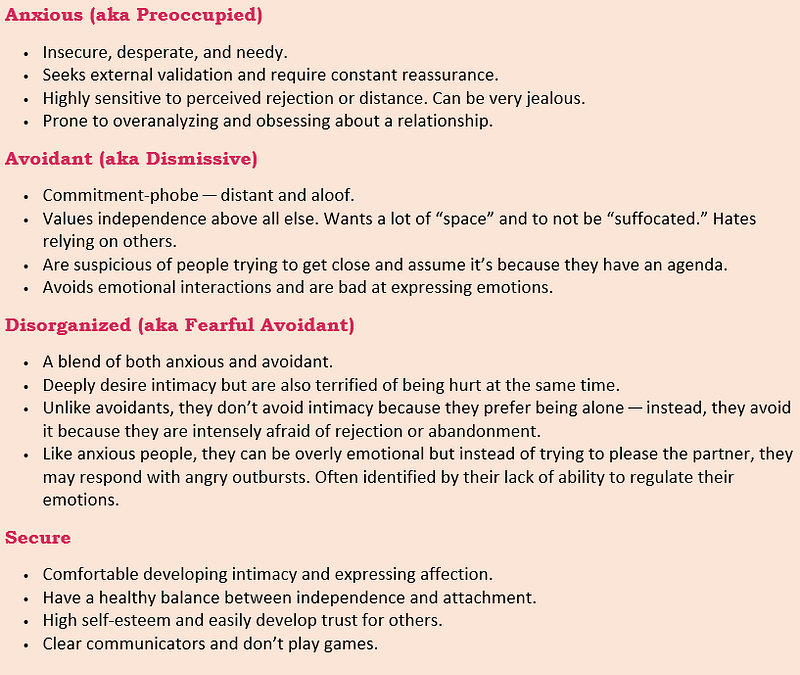
How attachment styles play out in real life
The examples below are stereotypes of what people with each attachment style may say in various situations. Most people don’t always fit neatly into one category and may exhibit a mix of attachment styles depending on the situation. However, the behavior that your love interest displays the most consistently across the various scenarios likely represents their primary attachment style.
1. First Date
On your first date, you compliment them by saying they look great and share that you’re really enjoying yourself. After some small talk, you also touched a little on your childhood.
Anxious
- “You like this dress? I gained a few pounds recently and I wasn’t sure if it would look good.” (Tends to be insecure about themselves.)
- “Oh, I’m sorry. You must think I talk too much.” (Cares a lot about what you think of them.)
- “I had a terrible childhood. My father was an alcoholic and my mom was sick all the time. And..” (Continues for a while. Tends to overshare and may get upset if you don’t respond the way they expect.)
Avoidant
- “Uhm yeah, the food is nice.” (Said in response to you saying that you enjoyed spending time with them. Generally, they won’t freely share how they feel about you.)
- “I don’t really want to talk about my childhood. Let’s not go there.” (Some topics are off the table and they feel uncomfortable sharing personal stories.)
Disorganized
- “You don’t seem like you’re too interested in this conversation.” (Cares about how enthusiastic you are to be with them.)
Secure
- “Thank you! I adore this dress and I’m having a great time hanging out with you too!” (Receives and gives compliments freely.)
- “That’s interesting what you said about your brother. I had a similar dynamic with my sister. How did that make you feel?” (Is curious and empathetic about you. Willing to open up as well.)
2. Responding to your communication
You’ve been texting nonstop every day but suddenly a project at work turns into a crisis and you drop everything to be in an all-day workshop with your team — neglecting to respond to texts for a few hours.
Anxious
- “Hey, didn’t hear back from you since this morning so was just checking to see if everything is OK? Did I say something to upset you?” (Gets anxious if you suddenly seem distant and need constant reassurances that you still like them.)
- “I’m sorry I called so many times. You must think I’m annoying.” (Worries about coming across negatively.)
- “You seemed upset when we talked about Sam last night. Is this what this silence is about?” (Overanalyzes everything.)
Avoidant
- “No worries.” (Non-reactive but also not especially empathetic and doesn’t ask follow-up questions about how you are doing.)
Disorganized
- “Hello? Why haven’t you texted back? I’ve been texting all morning.” (Differs from the anxious attachment style in that they tend to respond with anger instead of trying to please you.)
- “Thanks for not answering my call. I guess you’ve got more important things to do today.”(Tends to use passive-aggressive language.)
Secure
- “Hey! It’s great to hear from you! I totally understand about your work situation. Hope everything got sorted out?” (Doesn’t assume. Waits and reacts with understanding when you finally respond.)
3. Their communication to you
You’ve been seeing each other for a few weeks and things have generally been going well.
Anxious
- “Hiii!! Just checking in. What are you doing right now?” (You’ll get about 5 of these before lunch. They seek constant contact and will keep texting even before you get a chance to respond.)
Avoidant
- “Hey, how’s it going?” (Less likely to use terms of affection and keeps questions fairly surface level. May send mixed signals — e.g. alternates between texting every day and radio silence for a few days.)
Disorganized
- I was hoping for more of a response to my text. (Expects you to show enthusiasm when they reach out and can feel let down.)
Secure
- Hey you, I really enjoyed our time together the other day and just felt like telling you I was thinking of you. (Easily shares how they feel about you and also matches your pace of communication instead of bombarding you constantly.)
4. Making Plans
You’ve been seeing each other at least twice a week and you texted them about hanging out on the weekend.
Anxious
- “I missed you so much today. When are we going to hang out next? I’m free whenever and can do whatever you want.” (Needs to know when they will see you next and will plan their life around yours.)
Avoidant
- “I’ve made plans to hang out with my friends, you can join us if you want.” (Will prioritize their life over the relationship.)
- “Not sure about the weekend, let’s touch base later.” (Does not like to plan ahead and prefers deciding last minute. Leaves you unclear as to when you’ll see each other next and what their intentions are.)
Disorganized
- “I’d really like to see you more.” (Expresses desire to spend more time together but is always vague about setting up an actual time.)
Secure
- Weekend sounds good. I’m free on Saturday after 11 am. (Is responsive, makes clear plans, and commits to it.)
5. Changing Plans
You had planned a weekend getaway together but your best friend suddenly becomes very sick and needs you to look after them.
Anxious
- “I’m really disappointed by this. I cleared my weekend to be with you and I was really looking forward to it. I don’t appreciate you making plans you can’t stick to.” (Is overly emotional in their response and tends to make everything about them.)
- “It feels like you care about everything else more than this relationship.” (Interprets everything as a rejection or a reflection of the state of the relationship.)
Avoidant
- “No problem. I have a ton of work to catch up on.” (Unemotional about the getaway not happening and not especially interested in checking in on your situation.)
Disorganized
- “I knew you would change your mind. People always let me down.” (Has a strong fear of abandonment and always expects that people will disappoint them.)
Secure
- “I totally understand! I hope your friend feels better soon! Let me know when this blows over and I’m looking forward to planning another getaway.” (Empathetic and supportive while still expressing the desire to have the getaway.)
6. “The talk” to define the relationship
After dating for several months, you initiate a conversation about where the relationship is headed.
Anxious
- “I really want to be with you. How can I be the person you want me to be?” (Anxious to mold themselves into your perfect person.)
Avoidant
- “Do we really have to talk about this again and label it? Can’t we just enjoy what we have?” (Reluctant to commit and tends to be dismissive of your feelings.)
- “I want more time to think about this by myself. I’ll get back to you.” (Makes decisions alone and does not share their inner process.)
Disorganized
- “Don’t say it unless you mean it.” (Mistrustful that anyone would actually love them.)
- “I don’t deserve you. I don’t know if I’m what you want.” (Doesn’t feel like they are good enough for you.)
Secure
- “I really enjoy spending time with you too. I don’t feel like I want to see other people right now.” (Expressions of emotions or a desire for closeness tend to be rewarded with the same. They easily share how they feel.)
7. In a fight / Dealing with issues
As the honeymoon period wears off and issues begin to emerge, you decide to bring up some things that aren’t working for you.
Anxious
- “I’m sorry, it’s all my fault. What can I do to make you happy? I’ll do anything!” (Keen to please all the time.)
- “If you don’t know what the issue is then I’m not going to tell you! If you really cared, you would just know!” (Has difficulty expressing what’s upsetting them and wants you to guess. Tends to bottle things up.)
Avoidant
- “Forget it. Do whatever you want. This was never going to work anyway.” (Pushes you away at the first sign of trouble.)
- “I can’t deal with this. Maybe we should have some space.” (Tends to use distancing strategies like asking for an undefined period of space.)
Disorganized
- “I hate you! Please don’t leave me.” (Finds it hard to regulate emotions but is anxious about being abandoned at the same time. Will alternate between anxious and avoidant reactions.)
Secure
- “Help me understand why you are so upset. Can we talk through this? (Doesn’t immediately react. Seeks to understand.)
- “I know you’re not mean but when you do this, it makes me feel bad.” (Separates your actions (meanness) from who you are (mean person). Good at clearly describing what is upsetting them).
- I can see why that would hurt you or trigger you. (Tries to empathize with your point of view.)
8. Planning for the future
You’ve been dating for a few months and one of you gets offered a job to go overseas.
Anxious
- “Oh my God, you’re taking a job overseas? You’re leaving me, aren’t you? I can’t believe you’re even considering it after everything I’ve done for you.” (Assumes the worse and reacts in an overly emotional manner. Makes the situation all about them.)
Avoidant
- “Just so you know, I’m going to take the job in Singapore if they offer it to me.” (Does not consult you or explain how they want the relationship to progress.)
Disorganized
- “I want to go with you to Singapore but you don’t seem too excited about me coming. I feel like I’ve been doing all the planning.” (Your enthusiasm is important to them. Will not commit until they are sure you are excited and worries about putting more effort in than you will return to them.)
- “Are we really doing this? I don’t want to make all these sacrifices for you to change your mind.” (Wants multiple reassurances before believing that you are actually committing to them.)
Secure
- “I’m thinking of taking a job in Singapore but wanted to talk to you about it first. How would you feel about living overseas or a long-distance relationship?” (Includes you in decision making and works through things together.)
The importance of identifying attachment styles
One of the biggest ironies about attachment styles is that incompatible attachment styles can be strongly drawn to each other. My friend Sandra, who has an anxious attachment style, was repeatedly drawn to avoidant men. In turn, they were also drawn to her passion — at least initially. She would desperately crave their attention, which would cause them to pull away.
She repeated this cycle of being ghosted and rejected repeatedly until her therapist explained attachment styles to her. Once, I was with Sandra when she found out that a guy she had been seeing had entered a relationship after telling her, “he wasn’t ready for a relationship.”
The old Sandra would have felt like something was wrong with her and would have been completely crushed. But now that she understood attachment styles, Sanda simply smiled and said, “We were never going to be emotionally compatible anyway.”
The other key point is this — attachment styles are not easily changeable. So, it’s worth understanding which attachment styles are fundamentally incompatible with yours before you start investing a lot of time, money, and emotional energy into a difficult relationship.
“All happiness or unhappiness solely depends upon the quality of the object to which we are attached by love.“ — Baruch Spinoza
If you want to learn to connect more authentically, subscribe to my mailing list to get regular tips and 5 questions to instantly create intimacy.
Related stories:


