
Incredible Word Counts
Prolific fantasy author J. F. Danskin explains the techniques behind writing hundreds of thousands of words.

I am an author of LitRPG and historical fantasy. LitRPG? Well, this term is used for books that are set in some kind of game world, and use roleplaying stats.
My most recent novel series is called Sparta Online. It follows a 15-year-old boy in a futuristic society which trains military recruits via simulation of ancient Greece. Specifically, the city state of Sparta (the military-obsessed place that warred with Athens for centuries. Think ‘The 300’!).
I’ve also written other books too, many of which are over 100,000 words long, with seven novels completed over the past year, plus a lot of non-fiction writing completed, too.
Today, I want to share with you how I manage to produce such high word counts on a regular basis.
First, the stats (as every LitRPG author likes to say). Exactly how much do authors like myself produce?
As it happens, there is a friendly-competitive leaderboard where authors share regularly share their word counts, with no prizes but plenty of kudos for being in the monthly top 3. You can see a screenshot here for the current month:
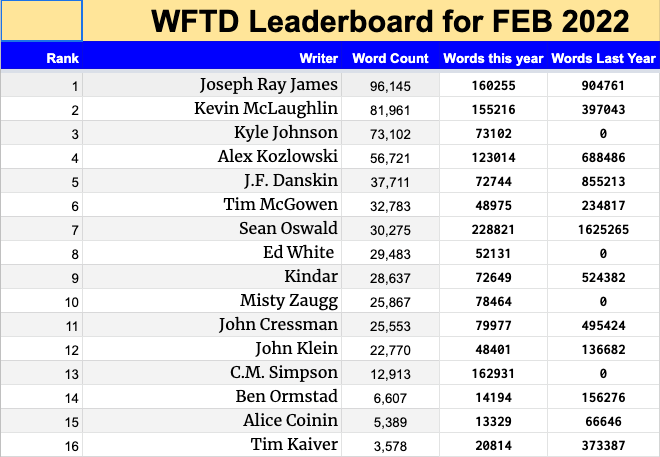
The image shows the words so far this year, as well as last year’s totals for those who participated, including mine — over 850k words (though this feels less amazing in comparison to Sean Oswald’s total!)
To break this down for you, the 855,243 words I wrote last year fell in the following months of the year as follows:
- January: 100,006
- February: 65,486
- March: 77,012
- April: 83,599
- May: 80,241
- June: zero
- July: 47,190
- August: 76,863
- September: 122,607
- October: 52,260
- November: 102,009
- December: 47,940
As you can see, I had 3 months where I was really on fire, as well as one where I didn’t write at all (at least not creative writing – I was too busy with a research project, non-fiction, and work emails. Yes… I have a full-time job as well).
There is variation from day to day, too. In September 2021, my biggest writing day, 25th September, saw me produce a total of 11,579 words. Clearly I would only need to do that for about 10 days in the month and I could match some of the best totals around.
In practice, I tend to write nearly every day, aiming for 3–4k per day in a good month.
What does this tell you? I believe there are several lessons:
1) I think it’s important to recognise that this is not innate talent. I couldn’t have done this when I was twenty or even twenty-five years old. It took a lot of practice to get my writing speed up.
2) I do agree that a writing habit is important, but it is also the case that you can take a break — and it can even be beneficial to do so. As you can see above, I didn’t get faster and faster, but rather had good months and bad months.
3) In fact, the bad months were more ‘doing other things’ months, and they were often when I was editing something for publication. A lot of new words usually correlates with producing a first draft.
4) The external validation that comes from the ‘leaderboard’ shown in the image earlier is a useful nudge, prompting me to keep going and keep updating my totals.
Increasing your own word counts
Okay – now, I imagine that you are reading this article not to find out about my writing, but to learn how you can increase your own productivity.
As mentioned above, this isn’t an innate talent. In fact, many people take part in NaNoWriMo or other challenges, and produce a 50,000-word (short) novel draft in a month. Do that every month, and you will have written 600,000 words, equivalent to six fantasy novels!
So here are my top tips for improving your own word counts:
- Know what you are going to write. In time when you can’t write (e.g. when driving or in the shower), think about your next scene. Visualise it in your head. Craft an opening line, or think about how you would sell a story to a potential reader. Knowing exactly what you are going to write next helps you to…
- …get going quickly. I think the biggest block to productivity is procrastination. Many people stare at a screen for time that they could be writing, or go on social media. People also spend a lot of time talking about writing without actually doing it. When I write, I open my laptop and start typing immediately.
- Don’t stop when it gets hard. I think the next biggest block to productivity is to stop writing when it gets difficult. “This is hard!” Well, yeah, it is, but you have to keep going anyway. The novel won’t write itself! To put it another way, keep knocking out those words even when it stops being fun and you start to question if what you are writing is any good (it is probably better than you think).
- Break up longer blocks of time. Long periods of time can become very inefficient. I produce high word counts in just a couple of focused hours per day. If you have four hours to write, I suggest setting three of them as ‘writing sprints’, with 20-minute breaks in between each one. Try to write more words in the second sprint compared to the first one, and so on!
- Use simple writing software. This morning, I spent 20 minutes getting Word to load properly on my computer. This is why I don’t generally write on Word! It’s slow and clunky. I recommend Scrivener as writing software.
- Add words in your down time. Even when I’m not at my computer, I might be planning a scene (see above), or jotting down a paragraph or two in the ‘notes’ app on my phone. I can later paste that into my main document. It all adds up!
- Commit. See writing as your thing. Ultimately, I think the best way to do something is to say “I’m going to do this.” And tell as many people as possible! Make your targets public, share them with friends and on social media, and you will soon see the benefits of having others cheer you on and share in your successes.
I hope these tips help you — they have all made a massive difference to my writing output.
Good luck, and happy writing!
J. F. Danskin is an author of LitRPG and historical fantasy. You can find the first two books in the Shadow Kingdoms series here and here, as well as reading this web-novel which is set in the same game world.
He has also written ‘The Tooth and Claw Guild’ — a web-novel which is in many ways a classic LitRPG, but with some real twists the further you go. ‘Sparta Online’ is an ebook series based on ancient Greek wars and myths, and it ties into the same overall world.


