

DOES YOUR AIRLINE EVEN WANT YOU TO FLY THEM..??
Many highly-coveted airline perks such as free bags, priority boarding, and club lounge access, can now be obtained by carrying an airline’s co-branded credit card. In fact — some airline credit cards allow you to earn elite VIP status simply by spending on the card.
The trend of extending these valued benefits to co-brand cardholders, together with recent program changes at the world’s largest frequent flyer programs (FFPs), have left many frequent bum-in-seat business travelers wondering if the airlines still care about them earning benefits the hard way.
I asked Mike Hecht, Delta’s General Manager of Co-Brand Strategy about this at the Mega Loyalty Conference in San Diego.
He revealed that Delta don’t mind whether their customers are loyal by way of credit card spend, or from actual bum-in-seat flying — either way they’re being loyal and should be rewarded with status.
In comparison — JetBlue’s Manager of TrueBlue Partnerships, Whitnee Hawthorne, said that they would prefer customers to be loyal by both flying, and by engaging with co-brand products.
To those who thought that frequent flyer programs were all about encouraging airline loyalty — giving an airline a greater share of your business, flying more often and spending more — the idea that use of a mile-earning credit card is more important, may be perplexing.
For those that are confused — let’s take a quick look at how frequent flyer programs make money…
It’s easy to see why airlines would rather you earn your miles from partners such as credit cards, hotels and rental car companies.
The miles-selling business is BIG business for the airlines.
American Airlines sold 182.7 billion miles to banks and other partners in 2015, generating an estimated $2.25 billion.
Analysis by Catchit Loyalty reveals that American’s Partner Marketing revenue has increased 83% since 2007, and a whopping 160% since 2001.
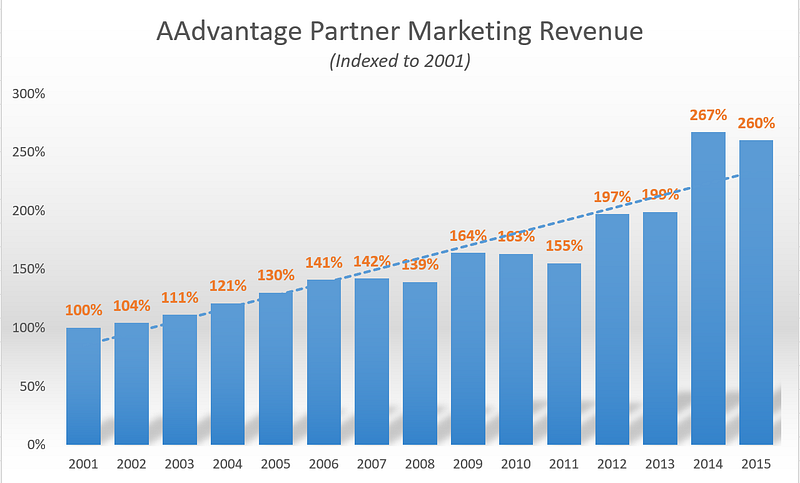
According to American Airlines — “This high yielding revenue comprises a respectable portion of American’s passenger revenue”.
Airlines are trying to give away LESS miles for flying, but sell MORE miles to banks and partners…
Around 60% of all miles issued to American AAdvantage members are sold to third parties such as banks and hotels.
American’s recent changes to its program, which will see an estimated 20 billion fewer miles being awarded to members for flying, will result in potential savings to the airline of around $28.4 million according to Catchit Loyalty’s analysis.
The catch — is that the most profitable co-brand partnership is only useful if customers perceive value in the airline mileage currency.

By enacting such drastic reductions in mileage earning for many customer segments — there is a sizeable risk that customers will no longer desire to collect the airline’s currency and will instead focus on other reward options such as cash-back cards or bank rewards programs.
If customer apathy toward the program results in the growth in mileage sales slowing by a mere 1.26% — the entire savings from recent program changes will be wiped out.
As highlighted in “The Worldwide Currency Worth Billions but Technically Doesn’t Exist” — If airlines ignore the aspirational attraction of the loyalty program through continual enhancements and devaluations, then the points currency itself becomes worthless if customers no longer desire it.
Managing Partner of Airline Weekly Seth Kaplan explains that “Airlines, although they don’t need to be as generous as they once were… can’t have you think the program’s worthless. Because if you cut up that credit card, or if you stop caring about accumulating miles in other ways, that’s billions of dollars of revenue that’s at risk.”
“The risk of erosion of customer loyalty, therefore, is real for airlines… If customers put a lower value on a certain reward currency, they have little incentive to use the associated credit card to earn that currency…Customers can change behavior quickly, especially when they perceive their marginal utility of reward points to be declining.” — Oliver Wyman
The key for airlines is to ensure that passengers are ‘engaged’ in the program sufficiently to want to sign-up for the co-brand credit card, and to credit their hotel stays, car rentals, dining and shopping to the airline program.
Should awarding miles for flying be viewed as a ‘cost’ or as an ‘investment’?
Awarding miles to actual flyers shouldn’t be viewed as a cost, but as an investment which delivers returns via increased loyalty, higher engagement, and participation in high-margin partner & co-brand offers. Structured correctly, it’s even profitable to generously reward once-a-year flyers, as they will either fly more often; engage with high-margin ancillary offers; or ultimately, suffer breakage (and the airline wins when the miles expire unused).
Selling miles to third parties such as banks is enormously lucrative for airline frequent flyer programs. But does the airline actually make more money from its loyalty initiatives?
It’s often more difficult to highlight the additional revenue that comes from loyalty initiatives — but a well designed program can actually deliver profits to the host airline up to 10 times what the FFP itself generates.
Phil Gunter from New World Loyalty, is the former head of Virgin Australia’s Velocity Frequent Flyer Program. He explains…
“Although the cost of a FFP is easy to quantify (and often large) and there has been a lot of interest in the profit a FFP can make through selling points, airlines should never forget that the biggest impact of a successful FFP is greater AIRLINE revenue! I have completed a number of in depth analysis’ and each time the airline revenue driven by the FFP is far greater than either the cost of the program or the FFP business unit profit. Unfortunately it is not uncommon for airlines to forget this and focus primarily on either reducing costs or driving FFP profit (often at the expense of Airline profit).”
SO SHOULD YOUR AIRLINE CARE IF YOU FLY?

In short — yes they should.
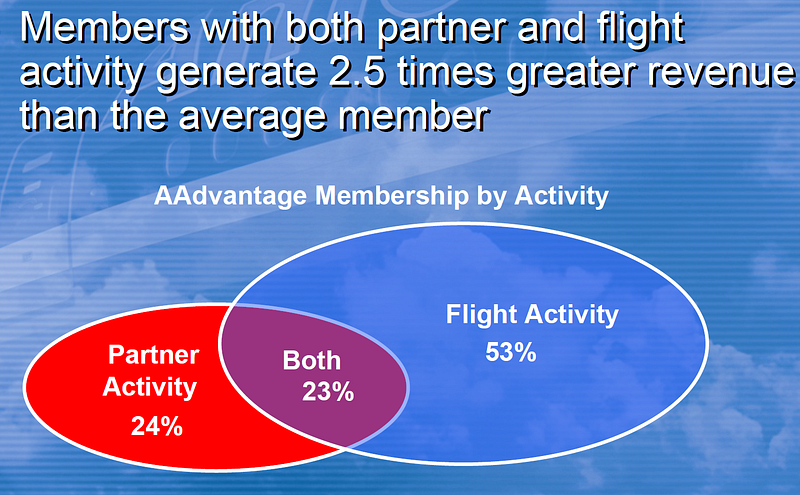
This investor presentation by American Airlines shows that those customers with both partner and flight activity generate 2.5 times greater revenue than the average AAdvantage member.
87% of American’s passengers only fly once per year — getting them to engage with the program is the key to new revenues.
As a publisher and global speaker on hotel & airline loyalty programs, David is focused on developing strategic solutions for loyalty programs, and is passionate about the critical link between loyalty strategy and the customer experience. David can be contacted here.
— — — — — — — — — — — —
More Articles by David Feldman
THE PSYCHOLOGY OF LOYALTY PROGRAMS
The Direct Booking Challenge: How Hotels Can Stop Sabotaging Their Own Campaigns
HOW THE SUCCESS OF FREQUENT FLYER PROGRAMS IS DRIVING AWAY LOYAL CUSTOMERS
HOW STARBUCKS BOTCHED ITS REWARD PROGRAM — Lessons for Loyalty Program Managers
WHY AMERICAN AIRLINES IS RISKING IT ALL WITH *CONFIRMED* CHANGES TO THE AADVANTAGE PROGRAM
— — — — — — — — — — — —
References and Further Reading:
- Catchit Loyalty analysis based on airline 10-K SEC filings, investor presentations, and discussions with airline executives
- Seth Kaplan — CNBC Power Lunch 29 July 2016
- Oliver Wyman — The New Economics of Loyalty Programs


