avatarShin Jie Yong, MSc (Res)

Free AI web copilot to create summaries, insights and extended knowledge, download it at here

2621

Abstract

ersin.org/articles/10.3389/fnins.2019.01361/full">my paper</a> in <i>Frontiers of Neuroscience</i>. Who did the 2008 paper referenced? Another two review papers in which there’s no direct mention that 70% of the immune system is in the gut. The same scenario applies to West et al. (2015), Jung et al. (2010), and others, as far as I know.</p><figure id="e104"><img src="https://cdn-images-1.readmedium.com/v2/resize:fit:800/1*J0HEBW9CBnuAeZzPzYNYYg.png"><figcaption><a href="https://www.wikidoc.org/index.php/Gut-associated_lymphoid_tissue">Source</a>: Adapted from Wikipedia as of 5th May 2020</figcaption></figure><p id="430d">Even Wikidoc (medical wiki encyclopedia oriented more to medical experts) <a href="https://www.wikidoc.org/index.php/Gut-associated_lymphoid_tissue">demands</a> citation for this statement, “About 70% of the body’s immune system is found in the digestive tract.”</p><p id="26a9">70% of the immune system resides in the gut is, thus, subjective. It’s more accurate to say GALT comprises the majority of the immune system. As Dan Peterson, assistant professor of pathology at the Johns Hopkins University School of Medicine, said, “<a href="https://www.hopkinsmedicine.org/research/advancements-in-research/fundamentals/in-depth/the-gut-where-bacteria-and-immune-system-meet">A huge proportion</a> of your immune system is actually in your gastrointestinal tract.”</p><p id="32f1" type="7">How huge? Probably around 70%; could be less or more.</p><h2 id="4e6b">But Still a Warranted Statement</h2><p id="f05d">The gastrointestinal tract is the largest area where the body meets the outside environment. It makes sense that more immunological resources are dedicated to the gut, where it encounters a huge source of <a href="https://www.ncbi.nlm.nih.gov/pmc/articles/PMC2515351/#b7">foreign antigens</a> — from the food eaten or the trillions of gut microbes.</p><p id="27c1" type="7">GALT has to distinguish if an immune response has to be mounted against any of those foreign antigens, whose number is perhaps unimaginable.</p><p id="207d">This means GALT is responsible for homeostasis —optimal physiological balance — during nutrient absorbance, be it from food or metabolites produced by the gut microbiota. GALT decides if the host has any food sensitivities (or allergic reactions), either directly from food proteins or indirectly from the food metabolism of gut microbes.</p><p id="c371">Given the gut barrier that is leaky to some extent, immune cells in the gut have to be on constant vigilance <a href="http://Mu, Q., Kirby, J., Reilly, C. M., & Luo, X. M. (2017). Leaky Gut As

Options

a Danger Signal for Autoimmune Diseases. Frontiers in immunology, 8, 598. https://doi.org/10.3389/fimmu.2017.00598">to deal with</a> any leaked microbes or microbial toxins. Otherwise, these foreign antigens continue to leak into the blood circulation and cause systemic inflammation in distant organs or tissues. Likewise, GALT also determines whether the gut microbiota confers anti-inflammatory benefits for the host.</p><figure id="614a"><img src="https://cdn-images-1.readmedium.com/v2/resize:fit:800/1*vtGfilUBdf-b13EQHZ1cOw.png"><figcaption><a href="http://Mu, Q., Kirby, J., Reilly, C. M., &amp; Luo, X. M. (2017). Leaky Gut As a Danger Signal for Autoimmune Diseases. Frontiers in immunology, 8, 598. https://doi.org/10.3389/fimmu.2017.00598">Open-access source</a>: Mu, Q., Kirby, J., Reilly, C. M., & Luo, X. M. (2017). Leaky Gut As a Danger Signal for Autoimmune Diseases. <i>Frontiers in immunology</i>, <i>8</i>, 598. <a href="https://doi.org/10.3389/fimmu.2017.00598">https://doi.org/10.3389/fimmu.2017.00598</a></figcaption></figure><p id="db0b">“The GALT is necessary for preventing acute pro-inflammatory immune responses <b>against the microbiota</b> resulting in inflammatory bowel diseases or <b>against</b> <b>food protein</b> causing food allergy and celiac disease,” <a href="https://www.frontiersin.org/articles/10.3389/fmicb.2014.00781/full">explained</a> Dimitry A. Chistiakov, professor of genetics at Pirogov Russian State Medical University, and colleagues in <i>Frontiers of Microbiology.</i></p><p id="3bd3">If the gut microbiota is <a href="https://readmedium.com/gut-microbiota-an-entity-that-connects-to-distant-organs-a463a5b0667">integral to health</a>, then GALT that watches over the gut microbiota is of equal, if not greater, importance. Does 70% of the immune system reside in the gut? There’s no direct quantitative evidence but it is certainly a warranted statement.</p><div id="b41a" class="link-block"> <a href="https://readmedium.com/gut-microbiota-an-entity-that-connects-to-distant-organs-a463a5b0667"> <div> <div> <h2>Gut Microbiota: An Entity That Connects to Distant Organs</h2> <div><h3>Gut microbes intertwine with 12 organs of its host and they are revolutionizing healthcare.</h3></div> <div><p>medium.com</p></div> </div> <div> <div style="background-image: url(https://miro.readmedium.com/v2/resize:fit:320/1*oTA530Y7RsBA0y8VPAY00g.png)"></div> </div> </div> </a> </div></article></body>

It’s an Assumption that 70% of the Immune System Is in the Gut

Even Wikidoc demands a citation for this statement.

Source: vectorstock.com

Is it Factual or Subjective?

Gut-associated lymphoid tissue (GALT) is the largest immune network in the body. Scientists say GALT comprises about 70% of the immune system. But what is this is based on exactly?

  • “With about 70% of the cellular component of the immune system present as GALT…,” Christina E. West, MD, Ph.D., and six others wrote in the Journal of Allergy and Clinical Immunology in 2015.
  • “The GALT consists of both isolated and aggregated lymphoid follicles and is one of the largest lymphoid organs, containing up to 70% of the body’s immunocytes,” Camille Jung, MD, Ph.D., and colleagues stated in the International Journal of Inflammation in 2010.
  • “The importance of immune modulation at the gastrointestinal level can be understood easily, considering that approximately 70% of the entire immune system is found in this site…,” said the senior co-author, Fabrizio Marcucci, Ph.D., in Clinical and Experimental Immunology in 2008.

These three papers have been cited hundreds of times (i.e., 168, 346, and 224 times, respectively). Even I cited the 2008 paper in my paper in Frontiers of Neuroscience. Who did the 2008 paper referenced? Another two review papers in which there’s no direct mention that 70% of the immune system is in the gut. The same scenario applies to West et al. (2015), Jung et al. (2010), and others, as far as I know.
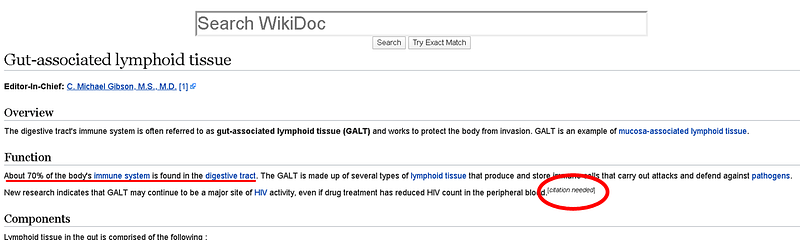
Source: Adapted from Wikipedia as of 5th May 2020

Even Wikidoc (medical wiki encyclopedia oriented more to medical experts) demands citation for this statement, “About 70% of the body’s immune system is found in the digestive tract.”

70% of the immune system resides in the gut is, thus, subjective. It’s more accurate to say GALT comprises the majority of the immune system. As Dan Peterson, assistant professor of pathology at the Johns Hopkins University School of Medicine, said, “A huge proportion of your immune system is actually in your gastrointestinal tract.”

How huge? Probably around 70%; could be less or more.

But Still a Warranted Statement

The gastrointestinal tract is the largest area where the body meets the outside environment. It makes sense that more immunological resources are dedicated to the gut, where it encounters a huge source of foreign antigens — from the food eaten or the trillions of gut microbes.

GALT has to distinguish if an immune response has to be mounted against any of those foreign antigens, whose number is perhaps unimaginable.

This means GALT is responsible for homeostasis —optimal physiological balance — during nutrient absorbance, be it from food or metabolites produced by the gut microbiota. GALT decides if the host has any food sensitivities (or allergic reactions), either directly from food proteins or indirectly from the food metabolism of gut microbes.

Given the gut barrier that is leaky to some extent, immune cells in the gut have to be on constant vigilance to deal with any leaked microbes or microbial toxins. Otherwise, these foreign antigens continue to leak into the blood circulation and cause systemic inflammation in distant organs or tissues. Likewise, GALT also determines whether the gut microbiota confers anti-inflammatory benefits for the host.
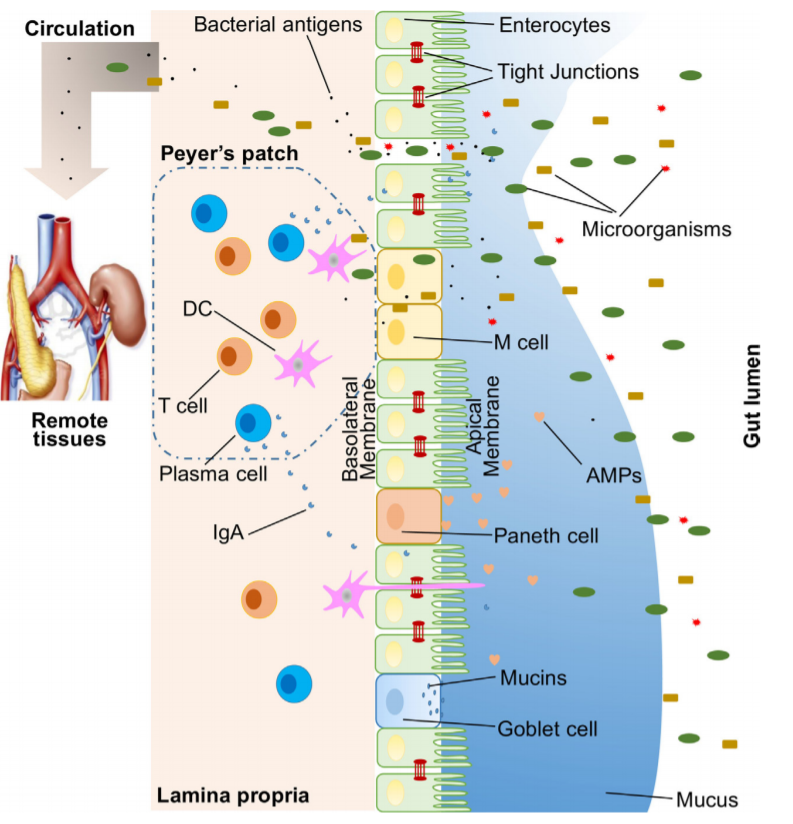
Open-access source: Mu, Q., Kirby, J., Reilly, C. M., & Luo, X. M. (2017). Leaky Gut As a Danger Signal for Autoimmune Diseases. Frontiers in immunology, 8, 598. https://doi.org/10.3389/fimmu.2017.00598

“The GALT is necessary for preventing acute pro-inflammatory immune responses against the microbiota resulting in inflammatory bowel diseases or against food protein causing food allergy and celiac disease,” explained Dimitry A. Chistiakov, professor of genetics at Pirogov Russian State Medical University, and colleagues in Frontiers of Microbiology.

If the gut microbiota is integral to health, then GALT that watches over the gut microbiota is of equal, if not greater, importance. Does 70% of the immune system reside in the gut? There’s no direct quantitative evidence but it is certainly a warranted statement.

Health
Science
Life
Ideas
Food
Recommended from ReadMedium