
70,000 Czechs Protest the Government, Inflation, and Energy Prices
Europe is screwed — And the city I call home finally hit the front pages of the Western press
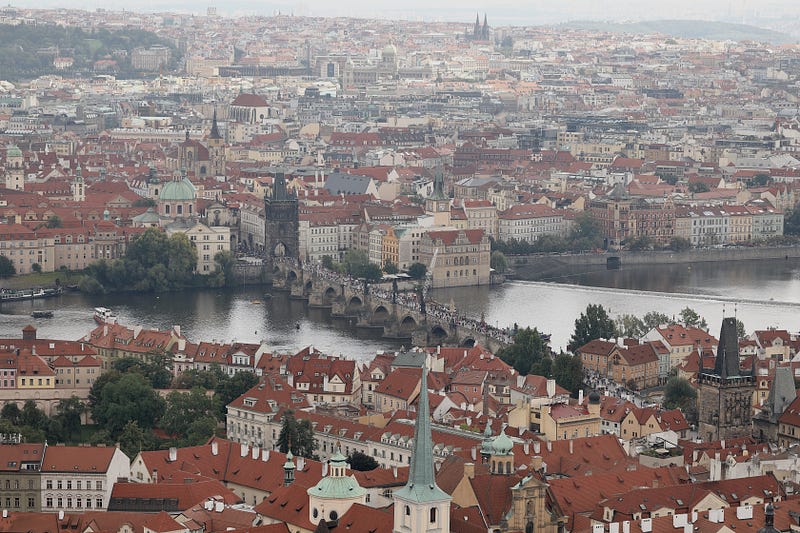
When it comes to the news and global affairs, the Czech Republic usually flies way under the radar. It is a small country in Central Europe, doesn’t have much of a population — Italy is 6X bigger — and has an economy around the size of Alabama, but overall satisfaction and the standard of living punch well above their weight when compared to salary size and GDP per capita.
I’ve been living here for over three years and am often told that, due to the history of oppression, Czechs are not the first to go on strike or hit the streets in protest — as opposed to the Italian, French, or Spanish stereotypes. Czechs are more of a ‘suffer in silence’ population.
But being a small economy in the EU and — very importantly — still having its own currency, it is very vulnerable to the changing economic winds of Europe. If things are bad in Brussels, Paris, and Berlin, chances are they’re much worse here.
And that’s what we’re seeing now as the EU is experiencing around 9% inflation while the Czech Republic is battling with a rate in the high teens, and the rating agency Moody’s just downgraded the economic outlook from stable to negative.
Add to that the COVID shocks and the boomerang effects of sanctions on Russian energy, and Czechs have paid the highest prices for energy in all of Europe this summer and are rightfully quite nervous about the coming winter.
It’s at a level that — even on a warm September Saturday — around 70,000 took to Wenceslas Square in the heart of Prague to show their anger at current government policy and inaction.
The newly appointed center-right Prime Minister Petr Fiala has initially brushed off the protesters as being ‘pro-Russian,’ but if something isn’t done to materially assist Czech workers, I don’t think his tenure as PM will last very long.
Even before the invasion, there were only two countries on Moscow’s shit list: the USA and the Czech Republic.
Despite having hundreds of years of cultural history, the Czech Republic has been controlling its own destiny for mere decades. It lost its first short-lived republic when the Nazis came and then fell behind the Iron Curtain post-WWII. There was a flash of hope in 1968 until Soviet tanks converged on the streets of Prague to quell the rising push for independence.
That history is very fresh in the minds of Czechs.
For that reason, they’re a very Western-facing, pro-EU, and pro-NATO nation that has little nostalgia for the pre-Velvet Revolution days and is typically one of the first to raise their hand in support of whatever EU geopolitical policy or to condemn their former oppressors to the East.
Even before the invasion, there were only two countries on Moscow’s shit list: the USA and the Czech Republic.
As an adult ESL teacher, I read about and speak on economics and political issues with dozens of professionals every week and am always the most anti-American-intervention voice in the boardroom or Zoom call — I’m usually the only one. They are aware the US has too many guns, bibles, and Trump fans but still believe Uncle Sam is a force for good in geopolitics — an idea that is hard for me to only give gentle teacher-we’re-here-to-learn-English pushback.
For the Czech Republic, when the Ukraine invasion happened, kicking out Russian banks and businesses, implementing sanctions, and sending aid was a no-brainer. They’re also one of the countries in Europe now pushing for a ban on Russian tourist visas.
A shocking number I speak to are convinced that without these measures Russian tanks would soon be rolling across Slovakia and into the eastern Moravian region — another point I would normally debate in the pub but let slide in class, and that’s a whole other topic.
After going along with most of Europe on policies of sanctions and aid, this small nation also took in 400,000 refugees — making headlines for not integrating those of Romani descent and having a bit of a humanitarian crisis at the train station.
Again, it’s very rare to see anything relating to Czechia when I go onto the Guardian, CNN, or the Financial Times. The refugees at Hlavní Nádraží was an embarrassing episode to have in the Western media and not much has popped off since.
That is until last Saturday.
One of the organizers, Jiří Havel told iDNES.cz news, “The aim of our demonstration is to demand change, mainly in solving the issue of energy prices, especially electricity and gas, which will destroy our economy this autumn.”
I honestly didn’t even know it happened. I had walked by the bottom of the square in the early evening on my way to the gym and noticed some commotion, but had missed the peak of the protest and saw a group of people with athletic clothes and numbers pinned to their chests, so assumed some sort of marathon or fun run had just ended.
Then on Sunday morning, my Twitter was going gangbusters with American journalists posting photos of a massive protest in Prague.
Bloomberg, the NY Post, DW, Reuters, and others reported on the rally.
There had been much larger protests in recent years against the former prime minister and billionaire Andrej Babiš, but these recent demonstrations caught a lot of attention because of the general social unrest in Europe.
Most governments had been bracing themselves for a winter of anger, so I think many — myself included — were surprised to see a protest of this scale in early September.
It was quite a mix of political parties from the far-right to the far-left communists, brought together in anger at current government policy, the inflation rate, and energy prices.
They called for the resignation of Prime Minister Fiala and new elections, and the PM and his coalition government had just survived a parliamentary vote of no confidence the day before.
The protesters were demanding the Czech Republic stay militarily neutral and guarantee contracts with gas suppliers, including Russian.
One of the organizers, Jiří Havel told iDNES.cz news, “The aim of our demonstration is to demand change, mainly in solving the issue of energy prices, especially electricity and gas, which will destroy our economy this autumn.”
The response from Prime Minister Fiala was, in my opinion, short-sighted to say the least.
He said, “The protest on Wenceslas Square was called by forces that are pro-Russian, are close to extreme positions and are against the interests of the Czech Republic. It is clear that Russian propaganda and disinformation campaigns are present on our territory and some people simply listen to them.”
With the current levels of inflation, sky-high energy prices, and extremely negative economic outlook, to brush off tens of thousands in the center of Prague demanding action as fake-news-dupes is not going to win any favors.
But it does fall in line with the attitudes of current EU leaders.
Rather than rethink the strategy, politicians like German Foreign Minister Annalena Baerbock are saying they will continue the current path forward “No matter what Germans think.”
As I’ve written before, there’s been shockingly little pragmatic debate regarding the economic sanctions. While I would never wish to change places with any political leader in Europe at the moment, more has to be done to ease the financial angst of European citizens.
Germany has recently announced a sixty-five billion euro plan to try and address the problem, giving small payments to households, pensioners, and students among other energy-related policies like a windfall tax. The French government has frozen gas prices at October 2021 levels and capped electricity price increases at 4% until the end of the year, and given €100 to low and middle-income households to help pay energy bills. And Spain, a country not nearly as reliant on Russian energy, will cut VAT on gas from 21% to 5% from October until the end of the year.
Small relief payments have been made to citizens in the Czech Republic, and the government has promised to keep housing costs at 30% of citizens’ income, including water and energy payments while discussing further measures, but the protesters feel there is a lack of urgency and initiative.
Again, I see zero debate on the effectiveness of the sanctions. There is no adult conversation nor questions being asked as to what they were trying to achieve, did they work, and whether this is the correct path forward.
Of course, there needed to be a response to the invasion. The unprecedented sanctions were rolled out with the thought that they’d destroy the Russian economy. That clearly didn’t happen; instead, they’ve swung back and smashed working Europeans in the wallet.
Now governments across the EU are continuing full steam ahead with the same failed strategy. With no short-term energy solutions, European leaders made the call to sanction their own crucial energy supplies in hopes of getting a swift victory. They clearly misplayed their hand. And now while energy bills are tripling, European governments are saying, ‘here’s a hundred bucks, now shut up.’
The continent is in for a cold, dark, and politically unstable winter.
Rather than rethink the strategy, politicians like German Foreign Minister Annalena Baerbock are saying they will continue the current path forward “No matter what Germans think” — sounds exactly like Western democracy to me.
Prime Minister Petr Fiala appears to have the same intention; stay the course.
The EU will try to implement price caps but doesn’t have the clout to truly affect suppliers like OPEC, buyers like China, or move the needle much on an essential and globally traded commodity that most of the planet is still purchasing from Moscow.
The euro is at a twenty-year low. The Czech Republic is closing in on freaking twenty percent inflation. And normally chill Europeans are demanding real relief.
With rising interest rates and a cost of living crisis across the continent, millions of Europeans, through no fault of their own, are going to be struggling to keep the heat on, food on the table, and even the roof over their heads.
They’re right to be protesting. Their representatives should be having open discussions with all solutions on the table.
Instead, the ‘rational West,’ in a very selective principled stand, seems to be content with destroying their own economies just to spite their face.
And now Russia officially stopped gas shipments to Europe until Western sanctions are lifted.
So everything is about to get a lot worse.
PMs Johnson and Draghi already resigned, UK rail workers are having a massive strike, Dutch farmers are going hog wild, Italians are burning their energy bills, the German union head said they’re in for economic collapse as cities turn off hot water in public buildings, and even 70,000 Czechs hit the streets before the weather has even cooled.
Sorry, Prime Minster Fiala, they’re not suffering from ‘Russian propaganda.’ They have apathetic leaders who are consciously keeping the solutions debate ideologically limited while completely tanking the entire EU economy.
We’ll see which European leader will be the next to step down.
Are there betting markets on this stuff?