
7 Weird and Wonderful Operating Systems
Discover the stranger side of computer hardware management
Operating systems are one of those things that everyone uses and depends on but do not often think about all that much. Whether you use Windows, Mac, or even Linux, chances are, you only give them much thought when something goes wrong.
But beyond the world of mainstream systems are some weird and wonderful creations that refuse to be ignored. There are operating systems that will alter your computer till it seems unrecognizable, obsolete systems fans refuse to let die, and ones built to aid us during the apocalypse. There are even operating systems whose developers claim will let you talk to God.
Hannah Montana Linux
Linux is a family of popular operating systems that are open-source in nature, meaning anyone with a bit of tech know-how can take the Linux source code and modify it to their liking to create their own operating system or “distro.” The result has been a lot of creative, fascinating, and cutting-edge software. But it has also resulted in a lot of bizarre creations. And one of the most wonderfully ridiculous is Hannah Montana Linux.
With a Montana-themed boot screen, icon set wallpapers, color schemes, and software, Hannah Montana Linux boasts everything a 2000s pre-teen could ever want from an OS. And developers hoped that it would “attract young users to Linux.”
Developers pitched Hannah Montanna Linux as “fast, stable, and powerful.” But unsurprisingly, the OS has not been updated in over a decade and would pose a security risk to anyone using it today. And no, nobody has tried to make a Miley Cyrus version (yet).
Red Star OS
We may live in an era of globalization, but national operating systems not only exist but are becoming increasingly common. The reasons behind such systems vary from increasing cyber-security, promoting open-source software, or making it easier to spy on citizens. Some examples include the FreeBSD and later Ubuntu-based Kylin in China, Nova in Cuba, BOSS (Bharat Operating System Solutions) in India, and Astra Linux and M OS in Russia. But the most fascinating of all these systems is Red Star. That is the operating system installed on every home computer in North Korea.
So what exactly is Red Star? Well, it is another system based on Linux. However, in appearance, it more closely resembles a Mac clone, believed to be the direct result of North Korean dictator Kim Jong Un getting his hands on a Mac many years ago. One of its most notable features is the Firefox-like browser known as Naenara. Of course, you can not use Naenara to access the internet. Instead, it only allows users to browse the North Korean Intranet known as Kwangmyong.
Beyond that, there are some of the usual features you would expect from any operating system, including a text editor, office suite, audio players, video players, and even some video games. And then, there are some “features” that you hopefully would not typically expect to find on your computer. That is because Red Star OS enables all sorts of backdoor access and tracking implementations allowing the North Korean secret service to see what users are doing.
React OS
Okay, so enough about Ubuntu Linux clones. Instead, here is an operating system that tries to clone something more people are familiar with: Microsoft Windows.
React OS is a free and open source operating that has been in development since 1996. And the entire purpose of its existence is to replicate and eventually replace (or at least serve as a drop-in for) Windows. The project was known as FreeWin95 before morphing into React OS after initial efforts stalled. Twenty-five years later, the project remains in alpha stage. But it does work and can run all sorts of programs. And since the developers are building the thing from the ground up, the React team has so far managed to avoid being sued out of existence.
AROS
Commodore’s line of personal computers were a cult favorite of the late 80s and early 90s. So too, was the operating system that ran these computers known as Amiga. But while you would be forgiven for thinking Amiga had disappeared with the rest of Commodore in 1994, you would be somewhat mistaken. That is because a whole wave of third-party operating systems based on and inspired by Amiga has since emerged.
There is Amiga OS 4, created by a company called Hyperion which runs on PowerPC microprocessors. There is also MorphOS, which also runs on Power PCs. But perhaps the most interesting, and certainly the most accessible, is the AROS research operating system (better known by its recursive acronym AROS). Started in 1995, AROS is a fully-functional operating system based on Amiga that has the distinction of being able to run on modern hardware. Meaning you can, if you want, experience all the joys of running an Amiga system on your personal computer without shelling out for a PowerPC.
Visopsys
Creating an OS requires a fair deal of technical know-how. And even big tech companies rarely try to build such things from the ground up. Instead, nearly every operating system today is forked from a previous creation. But apparently, rehashing an old system was not enough for tech hobbyist Andy McLaughin who, in 1997, decided to build an operating system from the ground up. By himself, that is. The result is Visposys (Visual Operating System).
It took a year for Andy to get Visopsys to read Hello World. But today, it is a fully-functioning and highly compatible OS with a desktop interface and a small community of fascinated users. And if nothing else, it is an incredible technical achievement that shows just how much one person can achieve when they set their mind to something.
Collapse OS
Are you of the opinion that the end times are nigh and are worried about how you will operate software in the post-apocalyptic wasteland? Something has got to run those Fallout pip boys, right? Well, perhaps it is time you had a look at Collapse OS. Jokes aside, Collapse OS is a fascinating piece of software that will hopefully never be needed.
Collapse OS is the brainchild of software developer Virgil Dupras, who envisions the possibility of a near-future supply chain collapse leading to the end of mass-produced electronics. In this “medium-apocalypse” scenario, current computers will inevitably break down, requiring people to get creative with computer manufacturing. Collapse OS, which is designed to work with 8-bit microprocessors, aims to solve this issue by allowing people to program microcontrollers with spare parts they can scavenge.
To be clear, Collapse will not run resource-heavy software. So your chances of playing a game like fallout in real fallout are still unlikely. But Dupras hopes the final product will be able to “edit text files, compile assembler source files for a wide range of MCUs and CPUs, read and write from a wide range of storage devices, and replicate itself.”
Temple OS
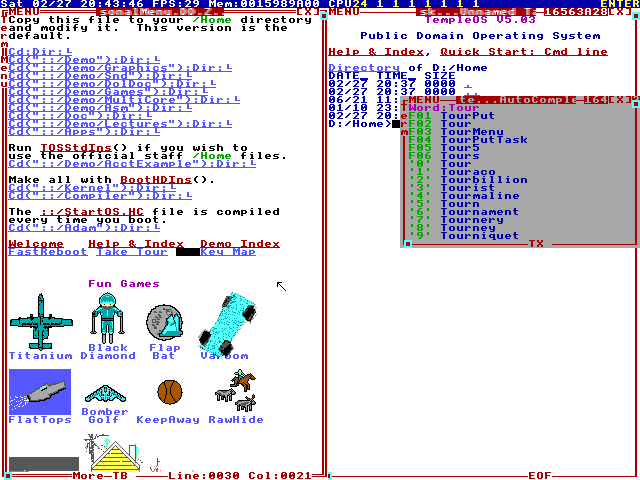
In 2003, Terry Davis, a talented programmer diagnosed with schizophrenia, began work on an operating system based on what he believed to be instructions from God. Over the next decade and beyond, Davis continued to work on this system, initially releasing it in 2005 as J Operating System before re-releasing it in 2013 as Temple OS, a bizarre but impressive achievement that Terry described as “God’s thirds temple”.
With its 640x480 resolution, and single-voice audio, Temple OS is minimalist and retro in design. And the interface is anything but chaotic. But beneath the hood is a technical marvel. Written in a unique programming language called Holy C, Temple OS features a bootloader, kernel, compiler, window manager, a graphical library and games, financial management tools, music composition software, and more.
Unfortunately, the life of Terry Davis became marred in controversies and ended in tragedy in 2018. But while few likely shared his vision for Temple OS, there is no denying that he left behind a fascinating piece of software.
Thanks for reading
If you’d to support my writing you can do so by connecting with me here on Medium or reaching out through my website.


