
7 Useful Python Audio Libraries You Should Use in Your Next Project
Power up your Python development

There is a proverb “You don’t have to reinvent the wheel”. Libraries are the best example of that. It helps you to write complex and time-consuming functionality in an easy way. According to me, a good project uses some of the best libraries available
I do not think Python needs any introduction. It is one of the most used programming languages for almost every purpose. Here I have compiled 7 useful Python Audio libraries that will help you in your development journey.
1. pyAudioAnalysis

This library provides a wide range of audio-related functionalities focusing on feature extraction, classification, segmentation, and visualization issues. It includes lots of other features like classifying unknown sounds, detecting audio events, and exclude silence periods from long recordings, applying dimensionality reduction to visualize audio data and content similarities, and many more. It has more than 5k stars on GitHub.
2. pydub

This library will let you manipulate audio with a simple and easy high-level interface. It includes lots of features like Signal Processing (compression, EQ, normalize, speed change, etc), signal generators (Sine, Square, Sawtooth, Whitenoise, etc), playback, effect registration system, and many more. This library has more than 6.5k stars on GitHub.
3. librosa

This is another good resource for music and audio analysis. It includes lots of features like estimating tempo and detecting beat events, computing various spectrogram representations, visualization, and display routines using
4. dejavu

Though this is exactly a library, this project can help you with audio fingerprinting and recognition. It can memorize audio by listening to it once and fingerprinting it. Then by playing a song and recording microphone input or reading from a disk, it attempts to match the audio against the fingerprints held in the database, returning the song being played. It has more than 5.5k stars on GitHub.
5. mutagen

If you want to handle audio metadata then this is a good resource for you. It supports ASF, FLAC, MP4, Monkey’s Audio, MP3, Musepack, Ogg Opus, Ogg FLAC, Ogg Speex, Ogg Theora, Ogg Vorbis, True Audio, WavPack, OptimFROG, and AIFF audio files. It can read Xing headers to accurately calculate the bitrate and length of MP3s. ID3 and APEv2 tags can be edited regardless of audio format. It can also manipulate Ogg streams on an individual packet/page level. It has more than 1k stars on GitHub.
6. tinytag

This library will help you to read audio and music metadata and the duration of the audio. It supportsMP3, OGG, OPUS, MP4, M4A, FLAC, WMA, Wave, and AIFF files. This library also can determine track number, total tracks, title, artist, album, year, duration, and more.
7. kapre
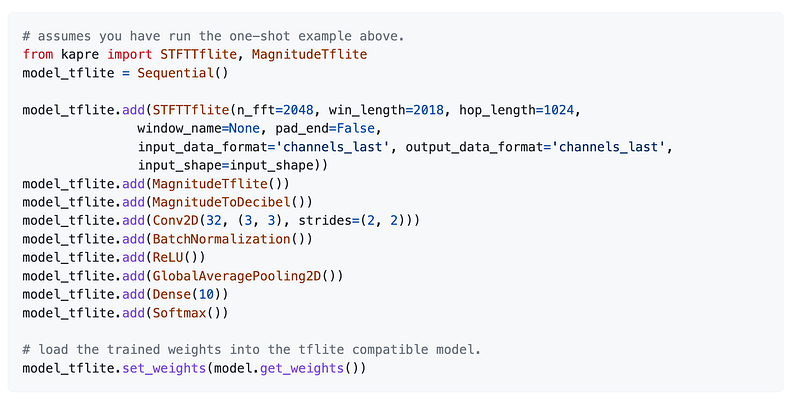
This library provides Keras audio preprocessors. It will help you to compute STFT, ISTFT, Melspectrogram, and others on GPU in real time. It includes features like consistency with 1D/2D Tensorflow batch shapes, data format agnostic, etc.
Where are some other awesome resources?
There are always new things to learn. If you want to learn more about awesome resources on Python please check out the below link.
That’s all for today. I believe these libraries will help you a lot in your development journey.
If you know of any other beautiful Python libraries, please share them in the comments. Until we meet again. Cheers!
Want to Connect?If you want to,you can connect with me on Twitter


