
7 Ukraine Lessons for Singapore and Other Countries
The Proper Practice of International Relations
It has been 30 years in the making. Towards the end, the obvious signs and omens were all but ignored. On 24 February 2022, Russia launched a multi-prong land, sea, and air attack on Ukraine. European and US leaders have condemned the many months of the build-up of Russian forces along Ukrainian borders. The rest is now history in progress.
Let it be known at the onset that the unilateral attack on an independent sovereign country is a clear and unambiguous violation of international law, regardless of the history of its origins. For Singapore, our recognised legitimacy and territorial integrity are sacrosanct and jealously safeguarded.
Here are 7 lessons to further understand why and how the troubles in Ukraine are shaped by international forces motivated by their respective self-interests to finally erupt to dominate the world’s attention.
1] History is Important — Things don’t Happen Out of The Blue
The historicity of events is important to provide the background to otherwise irrational actions by state actors. We began with the breakup of the former USSR. Ukraine became independent on 24 August 1991. On 8 December 1991, Ukraine, Russia, and Belarus, as the 3 largest states in the former Soviet Union, decided officially to abolish the Soviet Union. They declared the formation of the Commonwealth of Independent States (CIS).
Ukraine was the third-largest nuclear power globally with 1800 nuclear warheads when the Soviet Union collapsed. This led to the Budapest Memorandum on 5 December 1994 on Security Assurances for Ukraine. It called for the denuclearization of Ukraine in exchange for security assurance against territorial threats and promised political independence. The Budapest Memorandum was signed by the United States, the United Kingdom, and Russia.
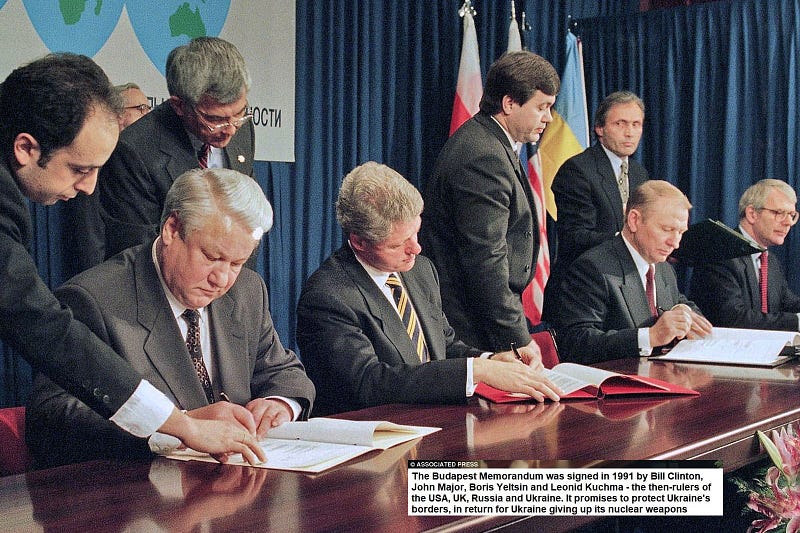
Following the Memorandum, Ukraine gave up all nuclear warheads to Russia, with the assurance that it (Russia) would recognize its territorial integrity and not exert commercial and political pressure while giving up its nuclear weapons.
With the collapse of the Soviet Union, the Baltic Republics of Lithuania, Latvia, and Estonia, joined NATO. They were once parts of the Soviet Union, followed in steps by Poland, Romania, and others. NATO expanded eastward, eventually taking in most of the European nations that had been in the Communist sphere. The result was NATO moving much closer to Moscow, and directly bordering Russia. And in 2008, it stated its intention to eventually include Ukraine.
Russia watched NATO’s expansion as a direct threat to its own security. The prospect of Ukraine, bordering Russia, joining NATO was seen as a major existential threat. Russian complaints became more strident as it grew stronger militarily and economically stronger.
Russia has many strategic interests in Ukraine. Not least is its huge naval base in the Crimea Peninsula which was a part of Russia before Russian President Nikita Krushchev gave it to Ukraine as a gift on the 300th unification anniversary with Russia in 1954.
Fearing the fall of Crimea into the hands of Western powers should Ukraine join NATO, Russia decided to annex Crimea in 2014, making it an autonomous and independent Republic of Crimea, and argued that it, therefore, did not contravene the Budapest Memorandum on Security Assurances.
In any case, the Supreme Council of Russia ruled in 1992 that the Crimean region was transferred to Ukraine illegitimately in 1954 without the quorum-based approval of the Supreme Council then.
2] Words Have Power — Treaties and Agreements Matter
In 2014, the US stood with the world alongside the feckless United Nations in abject impotence and inept incompetence to watch Russia invade and annex Crimea, a province of Ukraine. The United States’ failure to honor the Budapest Memorandum clearly emboldened Russia as she proceeded to instigate and support military aggression in the Ukrainian Donbas region, resulting in over a million Ukrainians displaced with more than 15,000 killed and thousands wounded.
No less than US Presidents Clinton, Bush, and Obama had also reiterated absolute US guarantee of these assurances over the 20+ years following the Budapest Memorandum.
The undermining of the Budapest Memorandum is especially significant because this treaty solemnised and formalised Ukraine’s decision to give up its nuclear arsenal in exchange for territorial guarantees from major powers.
Russia could also recall that earlier, on 9 February 1990, US President George Bush and US Secretary of State James Baker told Russian President Mikhail Gorbachev, in their words:
“Not only for the Soviet Union but for other European countries as well, it is important to have guarantees that if the United States keeps its presence in Germany within the framework of NATO, not an inch of NATO’s present military jurisdiction will spread in an eastern direction.”
In the same conversation, James Baker also affirmed repeatedly that “a broadening of the NATO zone is not acceptable”. Again, these words spoken by the US President and his Secretary of State to the Russian President were neither respected nor followed through, as seen by the following illustration:
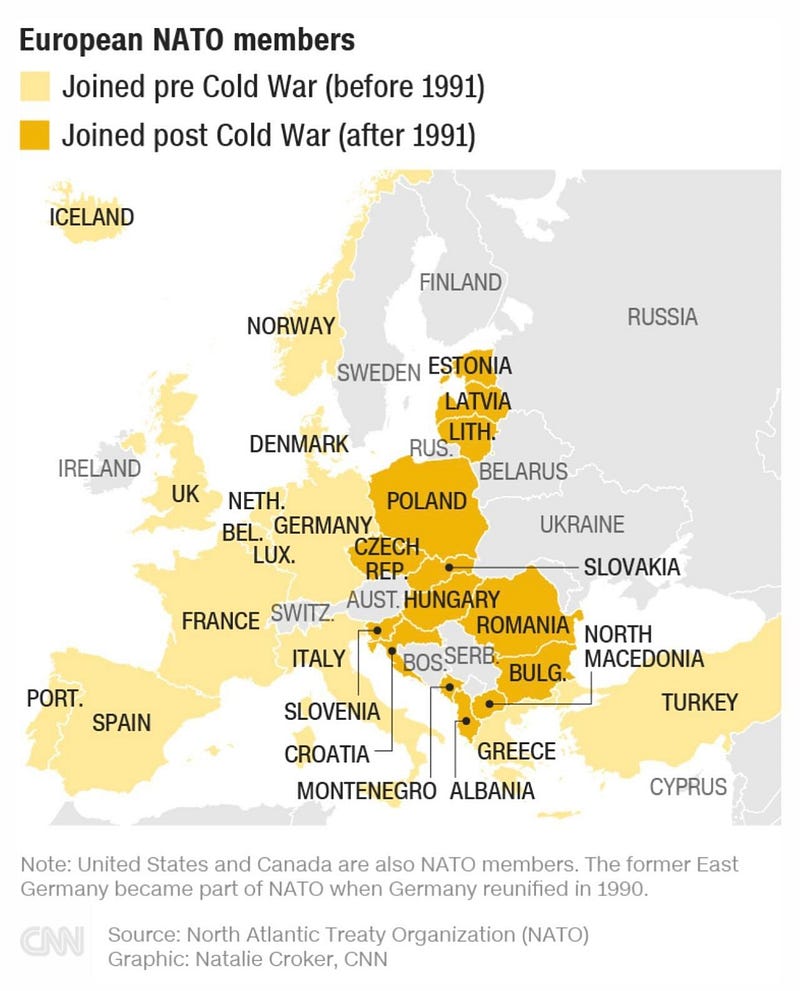
In the light of the above events, Brad Blakeman, a former adviser to US President George W. Bush and the former president of the national security group Freedom’s Watch asked: “The US has no credibility. Why would anyone enter into an agreement with us now?”.
Treaties and Agreements are valid and meaningful only if the parties have the integrity to respect their words and enforce appropriate behaviors to abide by them. US Presidents and the US Congress must restore credibility and trust in American promises of security assurances at the international level. And their promises must go beyond mere words of diplomatic declaration and statement.
3] Security Assurance is Paramount to Every Nation
In 1962, Cuba wanted to install ballistic missiles capable of reaching the US. The US mounted a sea blockade to prevent the delivery of the weapons, in clear violation of international maritime law by disrupting commercial shipping.
Concerned over its national security, then US President John F. Kennedy (JFK) escalated its terrorist war against Cuba to a threat of invasion. Soviet leader Nikita Khrushchev’s decision to provide Cuba with missiles threatened US security assurance, just as NATO’s eastward expansion threatened Russia. The USSR’s objective was an effort to rectify the enormous US preponderance of military force after JFK had responded to Khrushchev’s offer of mutual reduction of offensive weapons with the largest military buildup in peacetime history, though the U.S. was already far ahead. The world was brought to the brink of a war between the 2 super nuclear powers. Both sides eventually backed down.
Ukraine faces increased Russian threats as a result of its avowed intention to join the NATO military alliance that is hostile to Russia.
The US should understand well Russia’s national sentiments when its security assurance was threatened, from its own Cuban Missile crisis.
The Russian position was stated clearly by Foreign Minister Sergei Lavrov at a United Nations press conference: “The main issue is our clear position on the inadmissibility of further expansion of NATO to the East and the deployment of strike weapons that could threaten the territory of the Russian Federation.”
Lavrov explained that the US and NATO had previously agreed within the context of the Organization for Security and Cooperation in Europe (OSCE) not to expand at the expense of Russia’s safety. He said:
“We present non-verbal promises, written documents signed by the leaders of all the OSCE countries, including the President of the United States (Istanbul Declaration of 1999, Astana Declaration of 2010), our Western partners have to get out from a more serious situation”. “This principle is clearly stated. It has two main interrelated approaches. First, the right of every state to freely choose military alliances is recognized. Second: the obligation of each state not to strengthen its security at the expense of the security of others.”
“In other words, the right to choose alliances is clearly conditioned by the need to take into account the security interests of any other OSCE state, including the Russian Federation”.
4] Provocation will Invite Response — The Limits of Patience and Tolerance
NATO's active support for Ukraine with weapon supply and military training constitutes a growing security threat to Russia. For Russia, the issue was simple: “NATO promised not to expand but did not keep its promise”. NATO denied ever giving such promises: “we did not sign anything”, which is not true. In the meantime, according to Russia’s Security Council Deputy Chairman Dmitry Medvedev, NATO not only failed to keep its non-expansion “promise,” but has moved closer to Russian borders.
Notes from a 1991 meeting proved that the US, UK, France, and Germany assured the Soviet Union that NATO would not expand east. It’s part of a growing body of evidence that the West broke its promises to Russia which explains in part why Ukraine was invaded today.
In full knowledge of the Russian position, as well as the US promises not to expand NATO, US President Clinton admitted Poland, Hungary, and the Czech Republic in 1999 on the 50th anniversary of NATO. And in 2008, US President George Bush wanted to invite Ukraine to join NATO but was vetoed by Germany and France, even though the invitation remains open.
NATO has added 14 member states east of Germany since the end of the Cold War.
Since the end of the First Cold War and the overthrow of the Soviet Union,14 countries in Central and Eastern Europe have joined the US-led NATO military alliance — all countries east of Germany, in flagrant violation of the promise not to expand.
In 1999, the Czech Republic, Hungary, and Poland joined NATO.
In 2004, Bulgaria, Estonia, Latvia, Lithuania, Romania, Slovakia, and Slovenia joined as well.
In 2009, Albania and Croatia joined.
In 2017, Montenegro joined.
In 2020, North Macedonia joined.
NATO has also discussed the possibility of Bosnia and Herzegovina, Georgia, and Ukraine joining in the future.
The limits of Russian patience and tolerance were apparently reached on 24 February 2022 when Russian troops marched into Ukraine. It is common sense that when you poke the (Russian) bear in the eyes repeatedly, it will soon hit back furiously at its tormentors.
For too long, the warnings and many predictions that NATO expansion would lead to tragedy and war with Russia were ignored. The US, NATO countries, and Europe, as well as the world, are now paying the price for ignoring the legitimate concerns of independent sovereign countries that are directly involved.
5] No One will Come — We Are Always Alone in a Crisis
Ukraine’s President said on Friday (25 Feb 2022) that his country had been left on its own to fight Russia after the Kremlin launched a large-scale invasion that killed 130 Ukrainians on the first day. “We have been left alone to defend our state,” President Volodymyr Zelensky said in a video address to the nation after midnight.
“Who is ready to fight alongside us? I don’t see anyone. Who is ready to give Ukraine a guarantee of NATO membership? Everyone is afraid,” he added.
No NATO countries, who had actively courted Ukraine to join the Alliance would commit any of their forces to come to the aid of Ukraine. Nothing actually stops any NATO country on its own to render manpower and resources. The USA who has repeatedly provided security “assurance” promises to Ukraine currently lacks the political leadership to even dare to take on Russia, especially after its disastrous retreat from Afghanistan just a few months ago.
The core lesson for Singapore and other countries that depend on others is that “no one is coming”.
This reminds me of my own military service in the 1970s for 2½ years. The Army instructors repeatedly emphasised that as a young nation, achieving independence only in 1965, we had to be ready to fight and sacrifice for this fledgling nation. He was crystal-clear that in times of trouble, Singapore would be fighting alone to determine our own fate.
When asked about the 1971’s 5-Power Defence Arrangements (FPDA), a non-binding defense treaty, whereby it commits the 5 members (Singapore, Malaysia, UK, Australia, and New Zealand) to consult in the event of an armed attack on Malaysia or Singapore, the instructor gave an honest straightforward answer: “no one will come” … “until they see who’s winning and side with the victor”.
The FPDA turns 50 years old last year. Singaporeans should note that the FPDA is not a binding defense treaty like the NATO model, but commits the five members only “to consult” in case of an armed attack on Malaysia or Singapore.
Dependence on foreign military forces like the FPDA is more of social membership in military collegiality for the occasional military exercise or sports events or sharing of facilities.
The most important lesson from Ukraine for Singapore is to never ever become dependent on foreign military forces to fight our own battles. The truth is “that which we cannot defend by ourselves do not belong to us”.
6] Nuclear Weapons are Best Deterrence — MAD as an Effective Defense Strategy
In 1994, Following the Budapest Memorandum, Ukraine gave up all nuclear warheads to Russia, in exchange for security assurance and territory integrity. In February 2022, it must surely have come to regret not holding on to a few of the nuclear weapons. Would Russia have invaded Ukraine if it had possessed nuclear weapons? Quick unlikely.
For other countries, the lessons are clear — nuclear weapons are a great deterrence, especially when your neighbours have them. Pakistan and India discovered that strategic truth some years ago. So did Israel. In fact, both Russia and the USA have long believed in the Mutually Assured Destruction (MAD) deterrent effect of nuclear weapons.
Both Iran and the Democratic People’s Republic of Korea (DPRK) are developing their own nuclear capability. For the DPRK, the US had also proposed security guarantees and assurance during a meeting but the North Koreans are probably understandably skeptical regarding its sincerity, given the American history in Ukraine (and other instances).
7] Conduct of Nations — Every Nation Should Behave Properly
Ukraine is the largest European country, next to Russia. The population of Ukraine is just 44 million as compared to Russia’s 145 million. Big or small, every sovereign and independent nation indeed enjoys the natural rights to sovereignty and territorial integrity, and the right of states to choose their own security arrangements and alliances. And every nation reserves the absolute right to fiercely defend and uphold these rights.
However, these rights accrued to independent national sovereignty do not exist in a vacuum. They are constrained by the degree and extent to which the exercise of sovereign rights would impact similar rights and security interests of neighbouring countries.
According to ancient Chinese wisdom:
“国小而不处卑, 力少而不畏强,无礼而侮大邻, 贪愎而拙交者,可亡也。” -韩非子 亡徵
“Being small but not humble; being weak but not dodging; being rude and irritating the big neighbor; being headstrong and not diplomatic, (this country) may be doomed. “ Hanfei, China, 240 B.C.
This wisdom is also applicable to both small and large nations. After the Russians invaded Ukraine, Singapore Prime Minister Lee Hsien Loong reiterated the perennial lessons for countries like Singapore:
“The lessons for us, then and now, are stark. When treaties and diplomacy fail, we cannot rely on others to protect us. We must never lose the capability to defend ourselves. National Service and a strong, operationally ready SAF is our best deterrent against aggressors. As a small country, we strive to maintain good relations with all countries big and small. We do not choose sides, but chart our own course based on consistent principles and long-term national interests. Finally, we must remain a united and cohesive nation. Domestic politics must stop at our shores. We have been lucky to enjoy peace and stability now for more than 50 years. Russia’s attack on Ukraine reminds us how precious this is, and how important it is for all of us who call Singapore home to work together to preserve this happy state of affairs.”
SUMMARY OF UKRAINE LESSONS
The 7 important lessons from the current Ukraine conflicts are as follows:
1] History is Important — Things don’t Happen Out of The Blue
2] Words Have Power — Treaties and Agreements Matter
3] Security Assurance is Paramount to Every Nation
4] Provocation will Invite Response — The Limits of Patience and Tolerance
5] No One will Come — We Are Always Alone in a Crisis
6] Nuclear Weapons are The Best Deterrence — MAD as an Effective Défense Strategy
7] Conduct of Nations — Every Nation Should Behave Properly
Please enjoy my recent Articles.
You can also subscribe to my stories and social media posts via your email. Enjoy more interesting Articles by signing up to Medium here: https://thefuturistoracle.medium.com/membership