avatarSinem Günel

Free AI web copilot to create summaries, insights and extended knowledge, download it at here

3912

Abstract

ision in mind</h1><p id="7d23">This one might sound banal, yet it is super powerful.</p><p id="45ee"><i>Be aware of your big vision.</i></p><p id="bc25">Whatever you do, think if that task supports you to get one step closer to your life goals and to your big vision.</p><p id="b8af">Too often, we try to get a lot done without even thinking if doing those things benefits us in any way.</p><p id="a892">Stop letting external factors putting a pressure on you.</p><p id="364f">Create a huge vision board and reflect on it every day.</p><p id="2cd5">Be aware of your life goals and never spend a minute on something that doesn’t support your big vision.</p><h1 id="3ee5">4.) Make use of the Eisenhower Matrix</h1><figure id="f3e9"><img src="https://cdn-images-1.readmedium.com/v2/resize:fit:800/1*ZHEO1d-Ivx6abTtNNYXVmw.png"><figcaption></figcaption></figure><p id="b584">The <a href="https://www.eisenhower.me/eisenhower-matrix/">Eisenhower Matrix</a> is a simple way to decide whether to do or skip tasks.</p><p id="4cfb">On the X axis, you define the urgency of the task.</p><p id="cc84">Is a deadline approaching? Is the task needed to further develop a project?</p><p id="15b2">On the Y-axis, however, you define the importance of the task.</p><p id="9fb5">Does it bring you closer to your big goals? Is the task in accordance with your vision?</p><p id="b73b">Based on those two factors you can decide whether to do, decide, delegate or delete a task.</p><p id="d63a"><b>DO — </b>if the task is important and urgent.</p><p id="a6ab"><b>DECIDE — </b>if a task is important but not urgent, you might want to decide on when to do it by collecting further information.</p><p id="705d"><b>DELEGATE — </b>if you are faced with an unimportant task that is urgent, simply delegate it and use your time wiser.</p><p id="b0ce"><b>DELETE — </b>unimportant and non-urgent tasks are simply deleted!</p><p id="1bad">The more you work with this matrix, the quicker and more efficient your decision making will get.</p><h1 id="3068">5.) The Pareto Principle</h1><p id="526d">If you are into personal development, you have for sure heard about the <a href="https://betterexplained.com/articles/understanding-the-pareto-principle-the-8020-rule/">Pareto Principle</a>.</p><p id="3516">In short: 20% of your input is responsible for 80% of the output.</p><p id="e7c4">Meaning 80% of what we do results in only 20% of the success that we aim.</p><p id="e141">Therefore, obviously, the goal is to find out what the powerful 20% are and focus on them.</p><p id="02ce">Find out what your 20% is.</p><p id="70ec">What part of your work delivers the most output?</p><p id="b646">The downside of the Pareto Principle, however, is, that a new path will never look like the most effective option in the beginning.</p><h1 id="e0f7">6.) Have specific slots reserved during your day for e-mails</h1><p id="5f0e">Your ability to check emails as few times as possible might depend on your job, but you should definitely try to reduce it.</p><p id="8bef">Through constantly checking emails and having the tab with your emails open you can never be in a real flow mode of working.</p><p id="31e6">Constant destruction through notifications destroy our productivity heavily.</p><p id="0a60">The biggest problem, however, is, that it takes quite a long time to be able to completely focus again after being disturbed.</p><p id="61a4">Research <a href="http://www.fastcompany.com/944128/worker-interrupted-cost-task-switching">claims that the time-cost of a single distraction</a> can be up to <b>23 minutes.</b></p><p id="1760">This simply means that a distraction through a notification on your phone or desktop, or a colleague asking a question can end up in you losing 23 minutes of productivity <b>on top of the time of completing the task that disturbed you.</b></p><p id="8a69">Those 23 minutes is the time it takes us to get back on track

Options

and into deep focus.</p><h1 id="43fc">7.) Build routines and habit chains</h1><p id="a285"><a href="https://readmedium.com/how-to-create-habits-that-will-push-you-towards-your-life-goals-de1699ef2279">Habits</a> are the number one secret of highly successful people.</p><p id="8a2a">Every decision you make throughout your day increases your willpower and energy.</p><p id="6903">Through building daily routines and habits we can save our energy for the important decisions instead of overwhelming ourselves.</p><p id="ed99">The easiest way to create new habits is to build <b>habit chains.</b></p><p id="15a3">Simply chose a regular habit that you already have and link the next new habit to it. That way you can make sure to never skip the new habit.</p><p id="4fcb">For example, to reduce stress in the morning by choosing what to wear, you could create the habit to prepare your clothes in the evening right after brushing your teeth.</p><figure id="6a59"><img src="https://cdn-images-1.readmedium.com/v2/resize:fit:800/1*E6pDBnidw8JaumzlnCdUiw.png"><figcaption></figcaption></figure><h1 id="10b7">Bottom line</h1><p id="5e67">Success doesn’t come from feeling productive but from completing the important tasks efficiently.</p><p id="d966">There is always room for improvement but those 7 tips can be the beginning to start being productive on the right things:</p><h2 id="4d65">✔️ Work on micro goals</h2><p id="9b7a">Set achievable short times goals to stay motivated and focused on the important.</p><h2 id="6252">✔️Regularly ask yourself if there is another way to complete a certain task</h2><p id="7624">Be aware if there is a possibility to automate or delegate certain tasks to focus on more important ones.</p><h2 id="afd2">✔️Keep your vision in mind</h2><p id="78ed">Keep your life goals and vision in mind to be able to decide whether a task is worth doing it or not.</p><h2 id="7f65">✔️ Make use of the Eisenhower Matrix</h2><p id="040a">The Eisenhower Matrix might help you with decision making to save your energy for more important tasks.</p><h2 id="5a55">✔️ The Pareto Principle</h2><p id="4e70">Try to focus on the 20% of your tasks bringing 80% of the results</p><h2 id="0564">✔️Have specific slots reserved during your day for e-mails</h2><p id="5a0e">Distributions through e-mail notifications can harm your productivity in a massive way, mute your devices and have specific time slots for reactive tasks like checking e-mails.</p><h2 id="2144">✔️Build routines and habit chains</h2><p id="ea6a">Habits will enable you to save your power for the really important decisions, build habit chains to create space for the important decisions of your day.</p><figure id="5fd6"><img src="https://cdn-images-1.readmedium.com/v2/resize:fit:800/1*E6pDBnidw8JaumzlnCdUiw.png"><figcaption></figcaption></figure><figure id="ba86"><img src="https://cdn-images-1.readmedium.com/v2/resize:fit:800/1*opKmMmLub43JI1r1jO259w.png"><figcaption></figcaption></figure><figure id="af5f"><img src="https://cdn-images-1.readmedium.com/v2/resize:fit:800/1*ZCLsxuWX7l2HfMdii1AUSw.png"><figcaption></figcaption></figure><figure id="d52b"><img src="https://cdn-images-1.readmedium.com/v2/resize:fit:800/1*ZyeRAl-hC4mBQ9leINverQ.png"><figcaption></figcaption></figure><figure id="3f08"><img src="https://cdn-images-1.readmedium.com/v2/resize:fit:800/1*bKM-ltEllqnqAJ6SZTiA3A.png"><figcaption></figcaption></figure><figure id="a23d"><img src="https://cdn-images-1.readmedium.com/v2/resize:fit:800/1*YqDjlKFwScoQYQ62DWEdig.png"><figcaption></figcaption></figure><h2 id="c148">This story is published in The Startup, Medium’s largest entrepreneurship publication followed by + 378,529 people.</h2><h2 id="9478">Subscribe to receive our top stories here.</h2><figure id="2d04"><img src="https://cdn-images-1.readmedium.com/v2/resize:fit:800/1*ouK9XR4xuNWtCes-TIUNAw.png"><figcaption></figcaption></figure></article></body>

7 Tips to Start being Productive on the right Things

“flat-lay photo of laptop near mug with liquid” by Christine Donaldson on Unsplash

Do you know these moments when you feel super productive because you have been sitting on your desk for a couple of hours?

Or do you know this feeling of getting exhausted and feeling like you were productive but actually most of the time you were only switching between tabs on your laptop and checking things instead of actually creating something?

Unfortunately, I know those feelings just too well.

I spent so many full days at the university library, not knowing what I have actually done the whole day.

Even if you do nothing, time is passing super fast and in my opinion, when it comes to working, one should try to be as effective and efficient as possible.

Why?

Simply to make use of every second that we have on this planet.

There is no point in doing something for a much longer time than actually needed.

An unimportant task will never become important because you did it very well.

At the same time the fact that a task takes a lot of time doesn’t mean that it is important or relevant.

The key is being productive on the right things.

Progress can only be made through being productive on the right things, at the right time.

Peter Drucker once said: ,,There is nothing so useless as doing efficiently that which shouldn’t be done at all.’’

So to shorten it up: It’s about doing the right things efficiently.

This means that you will continuously have to make choices between several options about how to spend your time wisely.

1.) Work on micro goals

To be able to focus on the important stuff, you have to set micro goals.

This will help you in being aware of where your time flows.

Instead of writing down ‘’finish xy’’ as a big task, break the tasks down.

Set goals for every day, or better for every hour that you spend working.

This will help you in getting a great picture on which tasks take the most time.

A great way to work on micro goals is to make use of the Pomodoro Technique.

2.) Regularly ask yourself if there is another way to complete a certain task

In most cases, tasks can be completed in a more effective and efficient way than we are used to doing it.

However, we often stick to our established habits.

But if you want to increase your productivity, regularly step back and look if there are things that you could do differently.

Could you automate some processes? Are there new programs and software that might support you? Does it make sense to outsource some tasks?

If so, make use of new processes to enable yourself to focus on the really important tasks, which can not be automated.

3.) Keep your vision in mind

This one might sound banal, yet it is super powerful.

Be aware of your big vision.

Whatever you do, think if that task supports you to get one step closer to your life goals and to your big vision.

Too often, we try to get a lot done without even thinking if doing those things benefits us in any way.

Stop letting external factors putting a pressure on you.

Create a huge vision board and reflect on it every day.

Be aware of your life goals and never spend a minute on something that doesn’t support your big vision.

4.) Make use of the Eisenhower Matrix
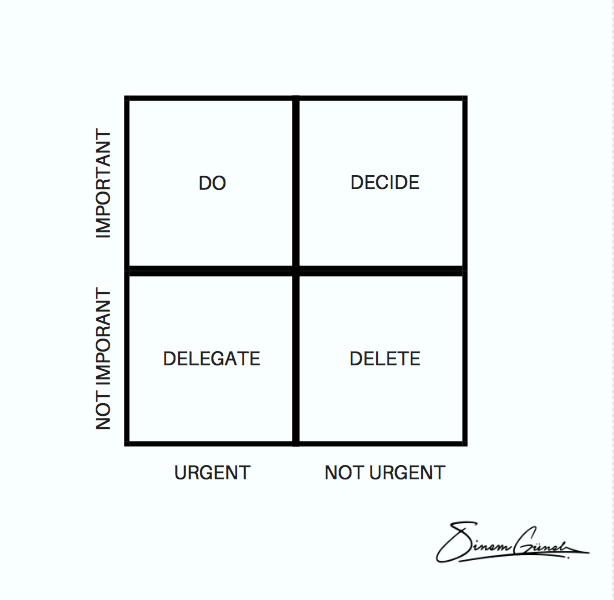
The Eisenhower Matrix is a simple way to decide whether to do or skip tasks.

On the X axis, you define the urgency of the task.

Is a deadline approaching? Is the task needed to further develop a project?

On the Y-axis, however, you define the importance of the task.

Does it bring you closer to your big goals? Is the task in accordance with your vision?

Based on those two factors you can decide whether to do, decide, delegate or delete a task.

DO — if the task is important and urgent.

DECIDE — if a task is important but not urgent, you might want to decide on when to do it by collecting further information.

DELEGATE — if you are faced with an unimportant task that is urgent, simply delegate it and use your time wiser.

DELETE — unimportant and non-urgent tasks are simply deleted!

The more you work with this matrix, the quicker and more efficient your decision making will get.

5.) The Pareto Principle

If you are into personal development, you have for sure heard about the Pareto Principle.

In short: 20% of your input is responsible for 80% of the output.

Meaning 80% of what we do results in only 20% of the success that we aim.

Therefore, obviously, the goal is to find out what the powerful 20% are and focus on them.

Find out what your 20% is.

What part of your work delivers the most output?

The downside of the Pareto Principle, however, is, that a new path will never look like the most effective option in the beginning.

6.) Have specific slots reserved during your day for e-mails

Your ability to check emails as few times as possible might depend on your job, but you should definitely try to reduce it.

Through constantly checking emails and having the tab with your emails open you can never be in a real flow mode of working.

Constant destruction through notifications destroy our productivity heavily.

The biggest problem, however, is, that it takes quite a long time to be able to completely focus again after being disturbed.

Research claims that the time-cost of a single distraction can be up to 23 minutes.

This simply means that a distraction through a notification on your phone or desktop, or a colleague asking a question can end up in you losing 23 minutes of productivity on top of the time of completing the task that disturbed you.

Those 23 minutes is the time it takes us to get back on track and into deep focus.

7.) Build routines and habit chains

Habits are the number one secret of highly successful people.

Every decision you make throughout your day increases your willpower and energy.

Through building daily routines and habits we can save our energy for the important decisions instead of overwhelming ourselves.

The easiest way to create new habits is to build habit chains.

Simply chose a regular habit that you already have and link the next new habit to it. That way you can make sure to never skip the new habit.

For example, to reduce stress in the morning by choosing what to wear, you could create the habit to prepare your clothes in the evening right after brushing your teeth.

Bottom line

Success doesn’t come from feeling productive but from completing the important tasks efficiently.

There is always room for improvement but those 7 tips can be the beginning to start being productive on the right things:

✔️ Work on micro goals

Set achievable short times goals to stay motivated and focused on the important.

✔️Regularly ask yourself if there is another way to complete a certain task

Be aware if there is a possibility to automate or delegate certain tasks to focus on more important ones.

✔️Keep your vision in mind

Keep your life goals and vision in mind to be able to decide whether a task is worth doing it or not.

✔️ Make use of the Eisenhower Matrix

The Eisenhower Matrix might help you with decision making to save your energy for more important tasks.

✔️ The Pareto Principle

Try to focus on the 20% of your tasks bringing 80% of the results

✔️Have specific slots reserved during your day for e-mails

Distributions through e-mail notifications can harm your productivity in a massive way, mute your devices and have specific time slots for reactive tasks like checking e-mails.

✔️Build routines and habit chains

Habits will enable you to save your power for the really important decisions, build habit chains to create space for the important decisions of your day.

This story is published in The Startup, Medium’s largest entrepreneurship publication followed by + 378,529 people.

Subscribe to receive our top stories here.

Productivity
Self Improvement
Life Lessons
Personal Development
Success
Recommended from ReadMedium