
7 Things you Need to Know About Dogecoin (DOGE)
Founders, Nodes, Wallets, Max Supply, and more!
Dogecoin is a MEME token, initially created as a fork of Litecoin in 2013. The coders of the project developed Dogecoin as a joke. Later on, the community around the coin and Elon musk (CEO of Tesla) helped DOGE to gain popularity.
In this story, I am going to explain 6 things you better know about this project. Unfortunately, Dogecoin does not have an official whitepaper. Moreover, the official website does not share lots of technical details about the project. Therefore, I am going to share the highlights of the project extracted across the whole web.
#1 — Dogecoin Founders

Dogecoin was created by software engineers Billy Markus and Jackson Palmer, who decided to create a payment system as a “joke”, making fun of the wild speculation in cryptocurrencies at the time.
Originally formed as a “joke”, Dogecoin was created by IBM software engineer Billy Markus and Adobe software engineer Jackson Palmer. They wanted to create a peer-to-peer digital currency that could reach a broader demographic than Bitcoin. In addition, they wanted to distance it from the controversial history of other coins. Dogecoin was officially launched on December 6, 2013, and within the first 30 days, there were over a million visitors to Dogecoin.com.
Palmer is credited with making the idea a reality. At the time, he was a member of the Adobe Systems marketing department in Sydney. Palmer had purchased the domain Dogecoin.com and added a splash screen, which featured the coin’s logo and scattered Comic Sans text. Markus reached out to Palmer after seeing the site, and started efforts to develop the currency. Markus had designed Dogecoin’s protocol based on existing cryptocurrencies Luckycoin and Litecoin, which use scrypt technology in their proof-of-work algorithm.
Co-founder Jackson Palmer left the cryptocurrency community in 2015 and has no plans to return, having come to the belief that cryptocurrency, originally conceived as a libertarian alternative to money, is fundamentally exploitative and built to enrich its top proponents. His co-founder, Billy Markus, agreed that Palmer’s position was generally valid.
#2 — Proof of Work using a simplified variant of scrypt
Dogecoin does not use SHA256 as its proof of work (POW). Taking development cues from Tenebrix and Litecoin, Dogecoin currently employs a simplified variant of scrypt with a target time of one minute per block and difficulty readjustment after every block. The block rewards are fixed and halve every 100,000 blocks. Starting with the 600,000th block, a permanent reward of 10,000 Dogecoin per block will be paid.
The use of scrypt means that miners cannot use SHA-256 bitcoin mining equipment, and instead must use dedicated FPGA and ASIC devices for mining which are known to be more complex to produce.
Originally, a different payout scheme was envisioned with block rewards being determined by taking the maximum reward as per the block schedule and applying the result of a Mersenne Twister pseudo-random number generator to arrive at a number between 0 and the maximum reward. This was changed, starting with block 145,000, to prevent large pools from gaming the system and mining only high reward blocks. At the same time, the difficulty retargeting was also changed from four hours to once per block (every minute), implementing an algorithm courtesy of the DigiByte Coin development team, to lessen the impact of sudden increases and decreases of network hashing rate.
#3 — Block Reward
Here is the schedule for distributing the block reward to DOGE miners:
- 1–99,999: 0–1,000,000 Dogecoin
- 100,000–144,999: 0–500,000 Dogecoin
- 145,000–199,999: 250,000 Dogecoin
- 200,000–299,999: 125,000 Dogecoin
- 300,000–399,999: 62,500 Dogecoin
- 400,000–499,999: 31,250 Dogecoin
- 500,000–599,999: 15,625 Dogecoin
- 600,000+: 10,000 Dogecoin
#4 — Wallets
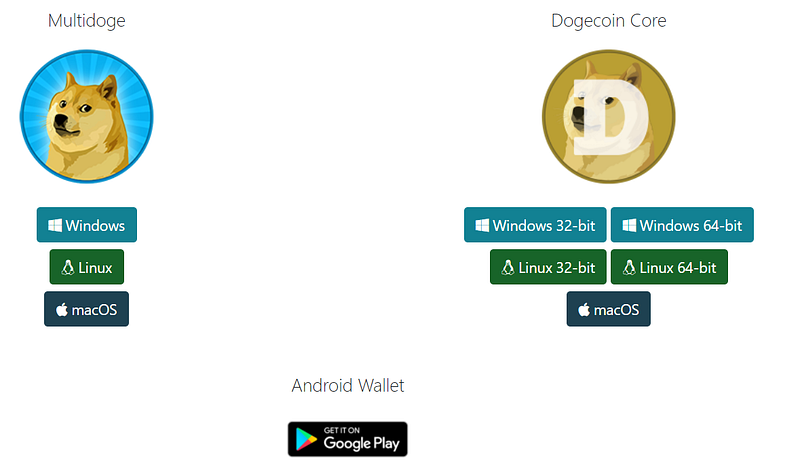
You have to sync with the blockchain to use Dogecoin. MultiDoge is a “light” wallet. It syncs with the blockchain by “skimming” through the blockchain, providing fast sync times. Dogecoin Core, on the other hand, is a “full” wallet. It syncs by downloading it, providing a solid-working Dogecoin wallet.
#5 — Dogecoin Nodes
A full node is a program that validates transactions on the Dogecoin blockchain. Since Dogecoin claims to be fully decentralized, meaning there is no central authority that owns or operates it, the network has to be supported and maintained entirely by individual computers running full nodes.
Here are the steps to run a dogecoin node:
- Download the Dogecoin Core wallet from the Dogecoin website or straight from the official GitHub.
- Allow your node to be externally accessed. In technical terms, this means doing port forwarding on your router to allow connections to the Dogecoin port (:22556) to be forwarded from your router (which receives the connections) to your computer. If you don’t have access to your router settings (e.g. you’re on a university, work, or other public networks), you won’t be able to do this.
- Let your node perform an initial sync of the blockchain to catch up — this may take a few days.
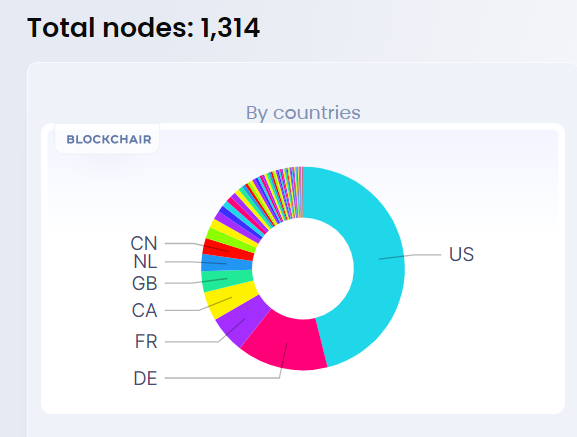
According to the blockchain, currently, there are 1314 active nodes in the network. Most of these nodes are situated in the US, Germany, France, Canada, and Great Britain.
#6 — Transaction Fees and Dust Limits
The Dogecoin chain has a relatively low block interval (1 megabyte blockspace) and aims to provide a cheap means for people to transact. Therefore, the biggest threat to the Dogecoin chain as a whole is spam and in 2014, a transaction fee and dust disincentive were introduced, to combat on-chain spam.
Dogecoin Core implements a number of defaults into the software that reflect the developers’ recommendations towards fees and dust limits, that at the moment of release represent the developers best estimate of how these limits should be parametrized. The recommended defaults, as implemented in the Dogecoin Core wallet, are:
- 0.01 DOGE per kilobyte transaction fee
- 1.00 DOGE dust limit (discard threshold)
- 0.001 DOGE replace-by-fee increments
The wallet rejects transactions that have outputs under the dust limit, and discards change to fee if it falls under this limit.
Note: The recommended dust limit is expected to be lowered in a follow-up release, once enough miners and relay nodes have adopted newly introduced relay dust limits touched upon below.
Note: In the past, Dogecoin has enforced a rounding function in the fee mechanism. As of version 1.14.5, this is no longer the case, and fees are calculated over the exact size of a transaction. For example, a 192 byte transaction only has to pay 0.01 / 1000 * 192 = 0.00192 DOGE fee.
#7 — Max Supply
Dogecoin started with a supply limit of 100 billion coins, which would have been far more coins than the top digital currencies were then allowing. By mid-2015 the 100 billionth Dogecoin had been mined with an additional 5 billion coins put into circulation every year thereafter. Although there is no theoretical supply limit, at this rate, the number of Dogecoins put into circulation will only double in 20 years (the next doubling will occur in the year 2075). There is no implemented hard cap on the total supply of Dogecoins.
Nonetheless, in February 2014, Dogecoin founder Jackson Palmer announced that the limit would be removed in an effort to create a consistent reduction of its inflation rate over time. In other words, the inflation rate improves over time starting at 5% in 2015 to less than 4% by 2019, 3% by 2027, and 2% by 2035.
Dogecoin on Social Media
To keep up with the latest news and articles about the Dogecoin project, you can check the following platforms:
This article is for informational purposes only. It should not be considered Financial or Legal Advice. Not all information will be accurate. Consult a financial professional before making any major financial decisions.
If you enjoyed this content and feel generous, please consider supporting me by donating to my ETH wallet:
0x1779c21F79D3F1e63960990818B5bF03e89CbfFE
If you are interested in reading my similar posts in the future, please consider joining medium with my referral link. If you sign up using my link, I’ll earn a small commission and you will have unlimited access to the content from all medium writers. That way, you will support me and your other favorite writers on the platform. Thanks.
Join Coinmonks Telegram Channel and Youtube Channel learn about crypto trading and investing
Also, Read
- How to buy Ethereum in India? | How to buy Bitcoin on Binance
- How to use BitMEX in the USA? | BitMEX Review | Buy Solana
- Best Crypto Exchanges in Germany | Arbitrum: A Layer 2 Solution
- Binomo Review | Stoic vs 3Commas vs TradeSanta
- Capital.com Review | Crypto Lending Platforms in Hong Kong
- Uphold Card Review | Trust Wallet vs MetaMask


