7 Steps to Become an Avid Reader
Sick of scrolling away your evenings? Here’s how I trained my brain to pick up a book instead.
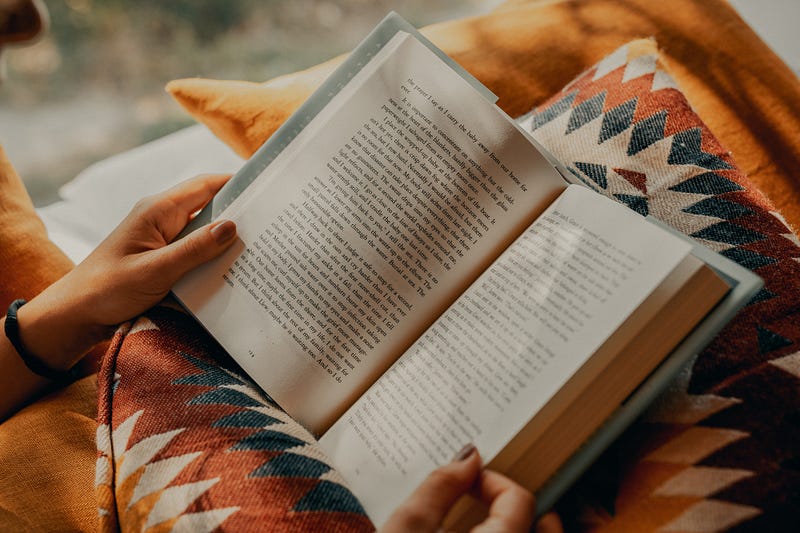
As a kid, I was a voracious reader.
But by my teenage years, the busyness of high school squandered the mental energy I’d formerly spent on reading. Still, I pursued a career as an English teacher.
Yet halfway through undergrad, I’d completely stopped reading for pleasure — there was too much required reading for that. Then, when I pursued a master’s in British lit, Dickens and his Victorian cronies made me despise having to crack open a book.
Years went by, and while I mourned my broken relationship with reading, I never took the time to repair it, opting to scroll on my phone instead.
But in recent months, I’ve rekindled my love for reading.
Here’s how you can, too:
1. Accept that the internet has short-circuited your brain.
Most of us can admit that a book just doesn’t hold our attention like our phones can.
In his compelling and terrifying book The Shallows: What the Internet is Doing to Our Brains, Nicholas Carr explains why:
“As the time we spend scanning Web pages crowds out the time we spend reading books, as the time we spend exchanging bite-sized text messages crowds out the time we spend composing sentences and paragraphs, as the time we spend hopping across links crowds out the time we devote to quite reflections and contemplation, the circuits [in our brains] that support those old intellectual functions and pursuits weaken and begin to break apart.”
When I first read that, I knew it was true. My 10-year-old self would have smoked my 20-year-old self in a focused reading competition.
If you’re like me, whenever you read something mildly boring, you reach for your phone for a boost of engagement…and then an hour goes by, the book forgotten.
But thank goodness for the science of neuroplasticity. If we can wire our brains to prefer the constant (but shallow) engagement of our phones, we can rewire it to tolerate (and eventually enjoy) the slower, more fulfilling engagement of a book.
But rewiring our brains takes time and patience. I’ve heard of neural pathways compared to forest paths. Paths walked over and over again become worn and established, but paths that go unused gradually become overgrown.
To reaccess these overgrown trails, you have to trudge back through them over and over again.
Naturally, it’s slow-going at first.
You won’t be able to go from hardly reading to reading hours of Tolkien’s The Fellowship of the Ring.
You’ll need to start small, start easy. Which brings us to tip 2:
2. Read books you want to read, not books you “should” read.
For me, the machete I took to the overgrown reader neural pathways of my brain was Sophie Kinsella’s novel The Party Crasher.
The lighthearted material, short paragraphs, and simple plot were the perfect stepping stones to get me back into my long-lost hobby.
But as I giggled at Kinsella’s protagonist, my Master’s-in-English shoulder demon snickered.
Because all the books I should read, according to my Master’s-in-English shoulder demon — Dante’s Divine Comedy, Emily Dickinson’s collection of poetry — were the better, more sophisticated books I should spend my free time reading, all waiting on my bookshelf.
The problem? I didn’t want to read those books — it’s why they had a layer of dust on them, after all.
So forget the books that you feel like you should read. If you dread reading that self-help book everyone at work is raving about, don’t try to force yourself to read it. It’s a surefire way to continue opting for your phone.
Instead, find a book that entices you. Not sure where to start? Consider what you watch on YouTube or TV for a clue on what you’ll enjoy reading.
3. Experiment to find your favorite platform(s) to read/listen on.
Remember when Kindles came out and all the book snobs insisted that physical books were better?
Or when audiobooks took off and the same people scoffed, saying listening isn’t the same as reading?
Ignore them. Audiobooks, eReaders, reading a book on your phone, physical books — it’s all reading.
When I was training myself to love reading again, I committed to trying every platform: Kindle, iPad, phone, audiobooks, and physical books.
I found that for different books and different times, I like different platforms. For more complex reads, I prefer a physical book or eReader (which makes sense considering I’m a visual learner), but light reads can be on audiobooks.
So experiment with what you like, and as you try different modes of reading, consider the best way you can…
4. Make it easy.
If you have a long drive to work, audiobooks may make reading easier for you. Or maybe you hate keeping up with the bulk of a book — a Kindle or phone may be the better choice.
Personally, I’m the worst about charging my Kindle or iPad, and I never take the time to place holds for audiobooks on Libby.
So for me, making reading easy means physical books most of the time. Then, I purposefully place books I want to read (see tip 2) in places that are easy to say yes to, like my nightstand.
However you go about reading, remember that your brain looks for the path of least resistance — so make reading an easy choice.
Oh — and delete or set time limits on your social media apps to make saying no to your phone easy.
5. Get rid of books you don’t like or will never read.
As a former English teacher with two English degrees, I’d acquired a lot of books.
And to be honest, some books were just for show — for status.
But to quote Marie Kondo, those status-y books didn’t bring me joy. So I did a book purge through three categories of “problem books”:
- The “Look at me, I have a degree in _________” books. From Dickens’ Bleak House to Faulkner’s As I Lay Dying, my bookshelf held books I would never crack open again. While there’s some pride that comes from saying, “Yes, I trudged through that,” if it didn’t bring me joy, I gave it away.
- The “I hope to one day have the mental fortitude to read that” books. Those books sneered down their spines at me for years until I realized I’d rather fill their spots with books I couldn’t wait to read (or reread). Thus, The Iliad and Ulysses were replaced with C.S. Lewis’s Narnia books and my Jane Austen favorites.
- The “That was good, but I won’t be reading that again” books. I was keeping some books just because I’d enjoyed them, but not necessarily because I’d reread them. The Kite Runner was wonderful but heart-wrenching. The Road was unputdownable but left me as a puddle on the floor. So I said goodbye to these books in order to make room for new books or books I knew I’d enjoy again.
Take a look at the books in your home: do they inspire you to read, or do they fill you with guilt or make you dread reading?
Don’t worry about how your bookshelf makes you look. Focus on how your bookshelf makes you feel.
6. Utilize the reading-snack method instead of striving for a reading goal.
Many of my friends set (and meet) yearly reading goals, but these are friends who already have an established love for reading.
I knew that if I were to set a reading goal of a certain number of pages a day or books in a year, it would be like someone who hated running saying she wanted to run a marathon in three months.
I needed to recultivate my love for reading first.
So I’ve adopted Jackie Hill Perry’s approach to reading: look at reading like snacking.
Each day, pick up a book you know you’ll like and read just a few pages. You’re not sitting down for a full meal, but just a quick snack or dessert (and if it turns into a three-course cheese and wine tasting, well then, cheers!).
7. Remember the long-term effects of being a reader.
Have you ever stood in a circle of people who are all gushing about a book that you’ve meant to read, but you haven’t yet?
For me, getting back into reading meant I could join those conversations.
It also meant a mood boost each time I read (especially compared to the gradual decline in mood I felt while mindlessly scrolling on my phone).
Finally, I wanted to treat my brain right, undo all the short-circuiting my phone had created…and give my heart the joy I experienced from reading when I was a little girl.
Whether you’re rekindling a lost love of reading or want to enjoy reading for the first time, my main tip is to ditch the big goals and just dip your toes in the water.
Start with what you love, and start small: reread Harry Potter, listen to a juicy true crime audiobook, and commit to just ten minutes of reading a day.
Then enjoy all the payoffs of curling up with a book instead of scrolling. There’s no way you’ll regret it.


