
My 7-Step Strategy to Overcome Chronic Procrastination and Realize Your Dreams
Use my step-by-step plan to stay productive while you figure out the real reason why you’re putting things off.

Procrastination: we all indulge in it from time to time, some of us more than others. We avoid or delay doing something that we know we need to do but don’t want to right now. In fact, a total of 20% of the US population are chronic procrastinators.
Delaying starting a new business, taking an online course, or finishing a book are all examples that might resonate with you.
Chronic procrastination may lead to you feeling unfulfilled at the end of the day. In the moment, putting things off may make you feel good, but not too long after, that feeling turns into disappointment in yourself.
It may even reinforce the belief that you’re not a disciplined person, which will hurt your self-esteem in the long run.
You might be thinking, “Yes, I am painfully familiar with procrastination. But what should I do about it?” Don’t worry — I’m not going to pretend I’ve “solved” procrastination in a blog post.
But I do want to share with you a solution that has worked wonders for me recently, after years of battling this habit: a combination of virtual coworking and having an accountability buddy.
Behind the scenes of procrastination
Researchers believe that people who procrastinate tend to overlook the long-term benefits of completing a task that causes them pain in the short term at the expense of resolving the immediate pain that that task might cause them.
“Your limbic system is an older part of the brain that is automatic and seeks out pleasure and/or avoids things that cause distress […] Your prefrontal cortex is a newer part of the brain that helps with planning, decision-making, and long-term goals. We all suffer at times from procrastination due to these fighting structures in our brains.” Sharon Greene, LCSW, in an interview for Medical News Today
Maybe you’re working on a writing project that is triggering for you — perhaps because you didn’t do a good job in the past on a similar project — and now just sitting at the laptop trying to work on it makes you tense.
In this scenario, your brain prioritizes resolving the immediate problem (the present pain caused by the project) instead of pushing through that problem to reap the long-term benefits, such as becoming a skillful writer. You fail to recognize that these are just growing pains, which are necessary for you to become better at anything that is complex and worthwhile.
When putting things off becomes a problem
I first noticed that my procrastination habit was becoming chronic when I began working freelance from home. I didn’t have a boss, which I was really excited about in the beginning: no one to check in on me all the time or micromanage me.
But then, months and years went by, and I noticed that I had not been as
productive as I would have wanted to be. So I started looking more closely
at why people procrastinate and how I could tackle this issue.
Chronic procrastination can persist in people who work from home, are their own bosses, and don’t have someone to keep them accountable. This lack of supervision is very conducive to procrastination.
When there are no immediate negative consequences if you do your work now or later, you become vulnerable to the obstacles you encounter.
The reasons people procrastinate are incredibly complex. The psychological reasons vary from person to person based on past experiences and triggers.
As everyone already knows by now, procrastination seems to be correlated with low self-esteem, and some studies suggest it is also moderately genetic. Perfectionism and procrastination also go hand in hand.
The benefits of overcoming procrastination
Can you imagine a world where you’re staying on task, and at the end of the day, you’ve accomplished everything that you planned? That after years of feeling lost, confused, and unproductive, you are measurably closer to your goals?
I can tell you from experience that it’s both possible and achievable. In my case, after a few months of planning my days in advance, “reporting” on my progress to my accountability buddy, and using virtual coworking to accomplish my tasks throughout the day, I was on a roll.
For weeks on end, everything had been checked off my planner, and I was consistently feeling super accomplished at the end of each day.
In all honesty, the whole situation felt out of place for a while. Getting what you want after wanting it for so long may have surprising effects! But that is a topic for another post.
The benefits were, of course, numerous: I was finally building a precedent and was changing the limiting belief that I’m not a disciplined person.
Your self-esteem will go up, you will become more reliable and feel more
in control of your days, and you’ll have more free time.
With your newly found self-confidence, you will feel more able to take on more responsibility, which will also positively impact your relationship with your family and friends.
Getting rid of chronic procrastination will improve your life in ways unique to your own situation that you can’t even predict before living procrastination-free for a while.
Here is a 7-step plan I came up with based on my experience:
- Go to Fiverr, Upwork, or another platform on which you can access freelance services. Search for “accountability coach” or “accountability buddy.”
- Contact a freelancer that has good reviews and schedule a call.
- Make a shared Google Doc in which you set some SMART (specific, measurable, achievable, relevant, and time-bound) goals related to what you want to accomplish in your professional life. Ask your coach/buddy to look it over. You might need a couple of iterations to make sure that your goals are actually SMART.
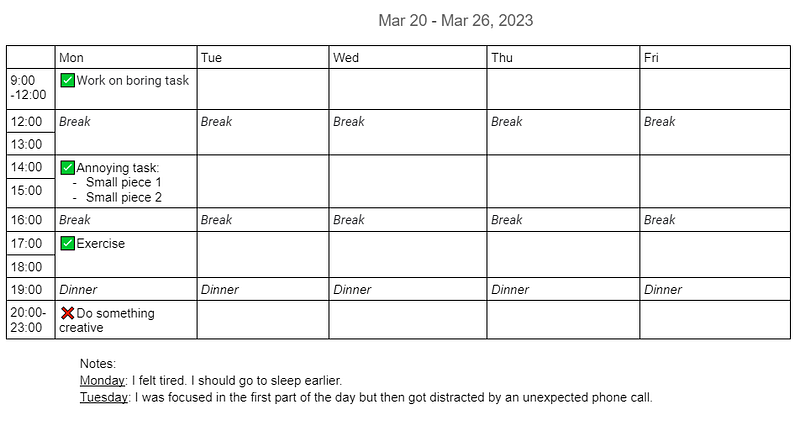
- Make a weekly plan, and over time, try to plan a whole month in advance. Make a table with columns for each day of the week and rows representing the hours of the day. Schedule 3 things you want to accomplish in 2-hour time blocks. These tasks should align with your SMART goals. Try not to overschedule, although this is inevitable in the beginning. Over time, you will get a better sense of how long tasks take, so don’t worry too much about it at this step.
- In the morning, share your plan for the day with your accountability coach, and in the evening, report back to them: did you complete the tasks you promised to?
- Every day, take note of the things that helped you accomplish your goals and those that deterred you from doing so. Maybe there were distractions, such as not knowing what to eat for lunch and then taking the entire afternoon to cook. That means that meal planning in advance could be a solution. Over time, you’ll notice your own patterns emerge.
- Sign up for Focusmate (this post is not sponsored — I genuinely love and recommend the service). This is a video-based, virtual coworking platform where you can schedule coworking sessions, and an algorithm matches you with another person who wants to do focused work at the same time of the day. The platform has a free plan, which gives you 3 sessions per week for free, forever. I strongly recommend you try it! Read more here about how it works.
I cannot overemphasize how much Focusmate has helped me. Once you get clear on what you want to accomplish, it’s extremely useful to have an accountability buddy for a work session.
In the beginning, each person states their goals for the session; you keep your video on (the mic can be on or off), and at the end, you report back on whether you completed your tasks or not.
I guarantee that stating your purpose for the session, which can be 25, 50, or 75 minutes long, and the peer pressure will motivate you to push on and complete tasks that you may find annoying or unpleasant.
Fighting procrastination in the long term
There are generally two camps out there about how to combat procrastination: one is full of tips and advice on how to trick your brain, while the other says that these shortcuts don’t work in the long term and that you have to address the underlying issues. I agree with both!
You do need to spend time getting to know yourself. That might mean
therapy, self-development exercises, and digging through any relevant past
experiences to find the root cause of your procrastination habits and
build intrinsic motivation.
However, the truth is that these things take time, and not everyone has the luxury to explore their inner world. This is why I believe that “tricking” your brain in the meantime can be valuable.
The roots of chronic procrastination are wildly different between people, so the method I outlined above may not work for everyone.
Some people respond better to more rigid schedules, others to more flexible plans for the day; some people may find that routine stifles their creativity, while others can’t function at all without one.
I do encourage you to play and experiment with it!
Conclusion
Procrastination is a complex subject, and its root causes are numerous and interrelated. Unfortunately, there is no quick, universal solution for it.
Self-help articles out there fall into two camps: “tips and tricks” and “figure out why you’re procrastinating.” Is it childhood trauma or something that happened to you in the past? From my experience, both approaches are valid and should be used together.
I shared with you a step-by-step plan that combines planning, coworking, and having an accountability buddy. Designing and applying this method has felt like a breakthrough for me after years of trying to stop putting things off, and I hope it will help you as well.
In the meantime, I wish you good luck in finding the root causes of your procrastination habit, and let me know in the comments what strategies you use to stay on top of your work and long-term goals.
Thank you for reading! To gain unlimited access to stories like this, you may want to become a Medium member. It’s $5/month, and if you use my link, I will receive a small commission at no cost to you.