
7 Reasons Beginner Programmers Should Push Through the Pain
Chin up — better days are on the way

Learning to code is hard. It’s really hard, especially so if you’re a self-taught programmer with no mentor to help you through the rough patches. You will have moments of elation when you understand a new concept and a new piece of the puzzle slots into place in your mind. But then there is the pain. Unfortunately, when you first begin, there is mostly pain.
The question you probably keep asking yourself is: “Should I continue with the self-torture, will it be worth it in the end?”
When the going gets tough as a beginner, you have to constantly remind yourself why you chose to go down this road. If you don’t keep your eye on the prize you will easily lose motivation and throw in the towel.
Here are the top reasons you should push through the pain and keep going.
1. It Gets Easier With Each Puzzle Piece
The more you learn, the easier it is to learn. Your mental picture of coding is like a puzzle. When you begin, no pieces are in place. As you begin to put pieces in place, it’s easier to find the next piece because you begin to see the form of the image you are building, and also because there are fewer pieces left to find a place for.
The more pieces you put in place, the faster the learning progresses and the more confident you get. Eventually, you’ve got one more piece left, and it’s the easiest piece to place.
I understand — filling knowledge gaps is very painful. I remember the first time I started reading programming articles (before I knew there were YouTube videos I could watch). I read an article and it said “Open a terminal, cd to your project folder, and enter this.” What?! A terminal, what’s that? How do you cd? The only cd I knew was a compact disc, and a terminal was at the airport.
I had to Google the answers for hours before I could continue. I nearly gave up when it took so long to find out what a terminal was. The lessons took really long and were very frustrating. It was painful because I could have been doing something else more enjoyable with my weekends.
I had other pressing questions, like “what if I delete my hard drive?” Sounds funny now, haha, but to a beginner, all the coding stuff can be terrifying, sending your cortisol levels through the roof.
To make matters worse, I also didn’t have a roadmap — I didn’t know exactly where I was going. I didn’t have a mentor and I didn’t know about courses on Udemy. But, I eventually found my way.
The learning gradually got easier for me as I pieced together the puzzle. This experience is real, and you also will begin to feel the learning becoming less and less demanding on your thinking faculties as time passes. So stick with it a little longer, it will get easier!
2.Coding Can Give You Hope and Change Your Life
Coding can change your life and give you a feeling of achievement. Knowing that you are taking steps to learn something that you can use to earn a living will give you hope and something to look forward to. Even if you are qualified for some other job, isn’t it better to have two options to choose from? You can even do both. Work a full-time job and earn a small side income as well while you’re learning and building a portfolio.
A web developer’s median salary in 2018 was $69,430 with the lowest-paid 25 percent making $50,990. So, the lowest-paid make $50k. Is that more than you’re making now? If you could make even $40k after learning for 6 months, would you be happy with that? The best-paid 25 percent make $95k. Do you want a shot at that or not? If you’re not in the game, you can’t win.
How does it look for the future? Employment for web developers is projected to grow much faster than the average for all occupations. According to U.S. News, web developers rank #3 in Best Technology Jobs and #23 in All Jobs. You’re not guaranteed a job, but if you can’t get a job immediately you can freelance from home and earn a small side income. You can do mini-projects and deploy them so that you have something to point to when you’re looking for work.
If you don’t learn to code your chances of earning money as a developer are zero. If you learn to code your chances are not zero. Do you want a chance, or do you want zero chance?
3. Low Barrier to Entry vs Other Careers
The resources to learn programming are all over the internet, a lot are free, some are very low cost. What other high paying careers can you think of that you can learn from your bedroom for free, or from as little as $10 per month. Not many or none, I’m sure.
Ask yourself some more questions:
- How many other careers can you think of that will get you a job without a college certificate? And, is there another career that you can teach yourself from home in 6 months, then get a job?
- If you don’t want to learn to code, what other career option do you have that is easier and cheaper to take up?
- If you choose to go to college to learn some other profession, how much time and money do you waste traveling to and from college, and how much does college cost? Have you got the money? Are you guaranteed a job after all that? Will you be qualified to get a job in 6 months? Can you get your qualification in this other profession by only learning at home?
- How many resources do you need to learn some other profession? For coding, you need a $200 laptop and about 5GB of data per month, plus maybe $10 to $20 for some paid courses. How do they compare?
By asking yourself these questions you will put your pain into perspective. You will probably come to the conclusion that there are not very many other easier options out there if you want to earn a decent living without doling out cash you may not have.
If you’re employed, learning a new profession is hard, and needs careful planning and rock-solid determination. This is what I had to do. It’s not easy. Don’t just quit your current job and hope to hell you will get a coding job. Think through it carefully and make a smooth transition. But don’t just write it off as too hard.
I keep saying that you can get a job without a formal qualification. Is it true? It is. Companies are increasingly not asking for formal education requirements. Even Google is following this trend. Below is a screenshot from this page, where Google offers courses to “Become job-ready for in-demand, high-paying roles.”
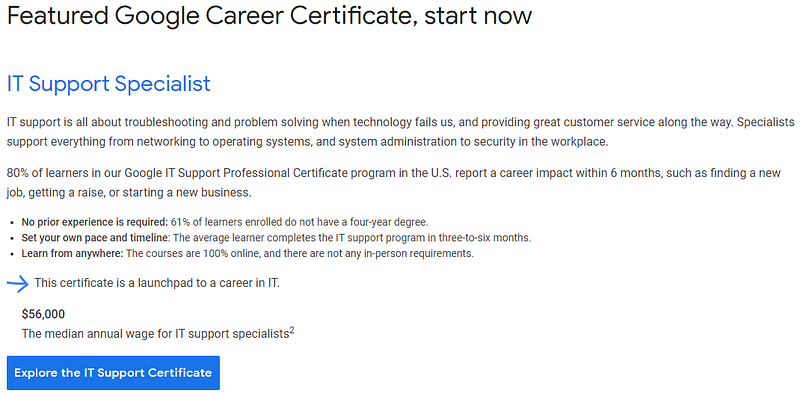
As you can see, no prior experience is required to enter, the course takes between 3–6 months, and the wage for qualified persons is $56k. Sound good? Here are two courses offered by Google on Coursera:
Google IT Support Professional Certificate Google IT Automation with Python Professional Certificate
You are not guaranteed a job, but you definitely can’t get a job without learning to code.
4. You Can Work From Home If You Want
Think about what happened during the pandemic. Developers just moved from the office to home. How many people do you know who can work from home? Any job where you had to produce a physical product at some location or come into direct contact with another person was in jeopardy.
If you decide to start your own business as a developer this means you can work right from your home. No fancy office or equipment needed. Just your laptop and an internet connection. You can have all the coffee to yourself.
To be more accurate, as long as you have an internet connection you can work from anywhere on the planet, even when you’re on ‘holiday’.
5. You Don’t Need to Be an Expert to Get a Job
If you’re wondering if you need to be an expert to get a job, the answer is no. Employers are, most of the time, not looking for experts. You only need to be proficient with the basics. So, don’t look at the thousands of things that you don’t know, and feel dejected, or wonder if you have what it takes.
Employers will understand that you’re not familiar with the nuances because you have only recently learned to code. If you had the tenacity to teach yourself and your attitude is good, they will overlook the areas you don’t know.
They will be confident that you will learn new things quickly because you had the temperament to teach yourself. The hard part is done — you’ve pushed through the pain and learned the basics.
They know that learning to code is hard, so when they find a self-taught programmer with a good attitude to learning, they view you as a valuable asset.
The fact that you stuck with teaching yourself to code will get you that job. Don’t give up!
6. You’re Staying Out of Trouble
This is not just a frivolous conjecture or mockery. To some people, this is happiness vs misery, life or death. Take for instance Brad Traversy, from YouTube’s Traversy Media. He is very open about how learning to code changed his life (I hope he doesn’t mind me mentioning). He was in a lot of trouble with drugs until he started putting his head down to learn to code. Today he has a YouTube channel with 1.37M+ followers and has a happy family life. You should check out his channel if you are interested in web development. I’ve been following his channel for 3 years.
I’m not saying you’re a drug addict, trouble maker, or serial killer, but what will you do if you’re not learning to code? Drink at that bar and get into fights? Go to the club and get smashed? Race your car? Watch Netflix? Spend money at the mall? Play video games?
You can’t get into much trouble hunched over your computer in your bedroom, basement, or attic (Just don’t hack peoples’ computers).
7. You Are Not Alone
I’m not talking about aliens here, they’re not coming to help you. I’m talking about the other people spread across the world, each walking his own path, but all of them united in the quest to learn. When you Google some error or question, what do you see? You see footsteps left in the burning sand where others have gone before. They are all over the internet. Stackoverflow, GitHub, YouTube, and all the forums and articles, are records of the journeys that others have traveled.
You can send an SOS into the world of coding, and amazingly, someone will usually reach out and help, for free. What other professions can claim to have so many people online to help you? You can join online forums and participate by leaving your own footsteps that will help the next traveler and ease their pain.
And Now It’s Over to You
You have two choices, either gather your resources and courage and continue your journey or make a strategic withdrawal. The decision is in your hands — do you want to live in hope or not?
If you give up you will have nothing to look forward to. Why not make an investment of temporary sacrifice in return for the rewards that come with learning to code?
Many new programmers are traveling down this road of hope. You won’t be alone. Follow the footsteps in the sand left by those before you. They are signposts along the way — use them to guide you on your journey, and keep on pushing through the pain. After the pain comes the reward.
Thanks for reading. If you enjoyed this article, consider subscribing here to Medium membership to get access to thousands of other articles.
You might like one of my other articles:


