
7 Quiet Ways To Promote Your Old Content (Without Being Sleazy)
Make more money and gain respect by using these 7 tips

Writers create a vast library of content then lock the doors and hide the key.
Why would anyone do that?
That’s exactly what you do by not sharing your old posts with new readers. Your content took a crazy amount of effort to write. So you want to squeeze the maximum value from it. It can earn you extra money, more followers and deep respect. Most writers waste it though.
And I know what the issue is.
You fear being a sleazy sales person that turns people off. Or the creator so desperate for attention they repel everyone. You are a writer, not a loud market trader.
Don’t worry I’ve got you. It’s simple to promote your content. And you can do it in a way that increases the reader’s respect for you.
Here’s 7 approaches I use:
1. Reply to comments (but not straight away)
When happens when you reply to a comment on your writing?
It triggers a notification next time a reader comes onto Medium. This draws a reader back to your content. It reminds them of who you are. They’ve come to Medium to read. A notification from you makes it likely they’ll give your stuff another look.
Make your comments interesting. Ask a question or provide some extra value. At the very least come across as a nice person.
Remember the people most likely to read another article is someone who has already read one.
A comment could draw them back in.
2. Link with no comment
This tactic is subtle but works.
Add a link to a word or phrase. And that’s it. You don’t mention it. People know what it means. Link to the word edit and readers will click if they are interested in editing. Otherwise they’ll ignore it. And you’ve caused no harm.
This avoids interrupting the flow for your reader so is easy to add in. Don’t overdo it though. Having lots of words with links makes your writing look untidy.
Before you publish check how you can add a link to 1 or 2 words.
3. Pin the right articles to your profile
On Medium and most blogs you get to choose which posts readers see first.
Which should you choose?
Don’t use what you think are the best. Look at your stats and pick what is most popular at the moment. I look at my earnings for the current month and use the 5 best performers (excluding new stories).
Medium lets you pin 5 stories to the top of your profile. You can do this by clicking the 3 dots at the top right of the article. This will give you the option to ‘pin this story to your profile’.
Keep your pinned stories updated.
4. Summarise a key point from a old article
This is an indirect approach that works really well.
Point to your old content. But don’t ask people to click. Instead, summarise something from it. It’s surprisingly effective.
For example:
I recently wrote about how you can find your niche, the key point is understanding the 3 things readers want. There are…
The clever bit here is you are still giving value in this article. You are explaining the main point(s). And if it’s valuable the reader will click. But it is not salesy because you don’t ask them to click.
Don’t use this tactic in every article. It’ll become obvious and annoying. But regularly find a way to make a passing reference to your old content.
5. How to promote yourself at the end
The bottom of your article is the acceptable place to promote yourself.
But many writers do this badly.
Here’s what I used to do:
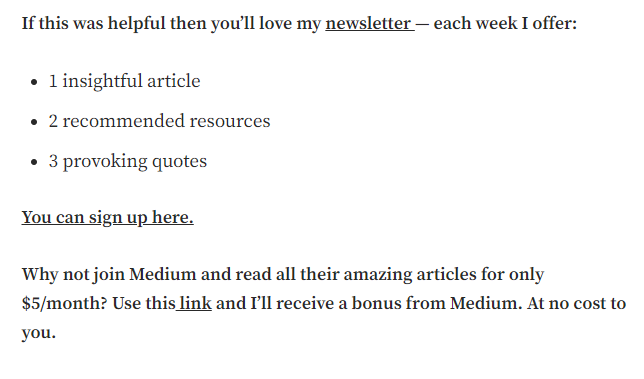
This is awful.
Who is going to read an extra 8 lines at the end of an article?
No-one.
In a supermarket sales experiment. They discovered providing more flavours of jam reduced sales. More options paralyses thinking. Causing people to choose nothing.
You can point a reader in many directions at the end of your article:
- sign up for email notifications
- point to your newsletter
- subscription referral
- embed article link
- ask for a follow
Which should you choose?
In a sense it doesn’t matter. But choose only one.
Attention span is at its lowest at the end. They are about to leave. Anything that takes energy. Like a complicated sentence or 2/3 choices. Will send them fleeing to the hills.
Pick whichever matters to you most. Then write one sharp sentence with a link and a reason.
(You’ll see my improved approach at the bottom of this article)
6. Use your writing as an illustration
Raise awareness by using your writing as an example.
In this tactic, you don’t discuss the content of the older article. But use it as an illustration. And as a byproduct make your reader aware of a previous article.
For example:
When I’m writing about titles I’ll use my titles as a good example (with a link to the article).
Or if you are writing about stress. Talk about the stress you experienced when you were writing an older article.
When I was researching positive mindset I was overwhelmed and stressed by all the research I had to do.
Link to your postive mindset article on the words ‘researching positive mindsets’.
7. Offer your article as a resource
This is a risky direct tactic.
So needs to done sensitively. It has the danger of turning your readers off. But done carefully it can enhance your reputation.
The tactic is to offer your content as a help your reader.
For example:
If you are struggling to find the time to write click here for my 4 best tips.
Only do this if:
- your link is relevant to the current article
- you are confident this link provides a ton of value
- it feels like you are trying to help rather than promote yourself
This powerful technique showcases what you offer.
But use it rarely.
Combine these 7 approaches to gently point readers to your content. And you’ll reap the rewards your writing deserves.
If you liked this, you’ll love my newsletter. One writing tip every week that has worked for me:


