
7 powerful lessons to be a master in influencing - Daniel Pink Masterclass.
And why everyone should care.

Daniel Pink is the author of several New York Times bestselling books on business, creativity, and behavioral science including my favorite ‘Drive- The surprising Truth about what motivates us’. He has a prolific career including chief speechwriter for Vice President Al Gore.
In his Masterclass “Sales and Persuasion” he is a master persuader.
Lesson 1 — No matter what people do and what their job title is, at the core people are selling and influencing every day.
Dan illustrates this point through research where the data shows “40% of work in all walks of life involves selling, persuading & influencing”.
Think hard about that — You spend 40% of every hour, day, week, and month on selling and influencing someone.
There is no particular personality suited for selling. The art and skills of selling and persuasion are for everyone, not only for the dreaded car salesmen.
Let’s break a myth. Which personality type performs better in sales — Introvert, Extrovert, or Ambivert?
Research conducted by the University of Pennsylvania found the best performers are in fact “Ambivert”. Ambiverts are people whose personalities lie somewhere on the spectrum of introvert and extrovert.
The research looked at the sales performance of a large software company over a period of 6 months. And then mapped the sales performance to the personality type of the sales professionals.
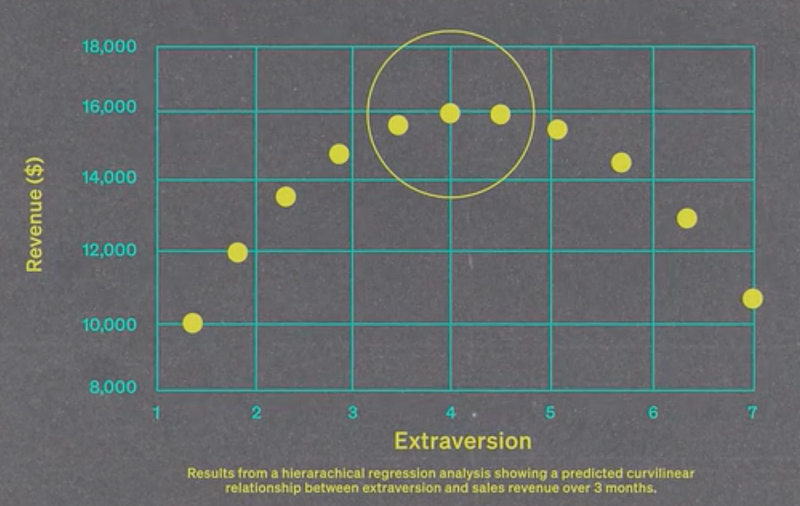
The good news is when you consider general populations, excluding a small percentage, the majority of us are ambiverts.
How to develop your ambivert skills?
There is a fundamental truth that our core personality traits remain mostly unchanged. They define who we are. Yet you can be deliberate and make subtle changes.
If you are an introvert, you can try to make a shift to the center, by being more open to engaging in a conversation. Better if you can start a conversation.
If you are an extrovert, you can try to make a shift to the center, by being a better listener. Be curious, and ask more questions to seek understanding.
Lesson 2 — Selling and persuasion need a paradigm shift in mindset from selling to serving.
“My biggest lesson to be the best persuader is to be a decent human being “ — Dan Pink.
To move from selling to serving you have to make the experience
- Personal
- Purposeful
Ask yourself when you are in your persuasive encounter -
First, If the other person does what I am asking them to do, will they be better off?
Second, If the other person does what I am asking them to do, will the world be better off?
You have to move beyond the traditional thinking of “What’s in it for you”. The best outcome is a positive-sum game, not a zero-sum game when both parties are better off in the end.
Lesson 3 — Selling and persuasion need a deep understanding of human nature. How people think and reason.
While we sweat to find reasons for how we are different, there is a universality to how we all think and reason.
Once you realize that, the most important insight is -
“When people have their own reasons to do something, they are more likely to act and change their behaviors.” — Dan Pink.
Persuasion is a lot about summoning the reasons for someone to find their own motivation for doing something. If you are selling or persuading someone your job is to help people reach your conclusions on their own.
Give what people need for motivation — Autonomy to reason.
Dan provides insight into a technique from the book ‘ Instant influence’ by Michael Pantalon. How to move people with two irrational questions? Here is a video with a detailed explanation.
https://www.youtube.com/watch?v=WAL7Pz1i1jU
Lesson 4 — Beware of universal cognitive biases to craft a clear message.
Cognitive biases are mental shortcuts to making decisions. We take shortcuts due to cognitive overload in this information-rich context poor age.
“We cannot underestimate how cognitive overload impairs judgment” — Dan Pink.
The key is to recognize the biases and craft a clear message using a technique called “Persuasive Framing”. These are a few in the masterclass worth mentioning.
Experience frame.
People tend to value and remember experience rather than the goods and services. And we value a universal set of experiences — travel, a vacation, a challenge, etc.
There is no better way to say this than Jon Hamm in the Television series ‘Mad men’. One of the best marketing lessons ever. Check this video.
https://www.youtube.com/watch?v=suRDUFpsHus&t=12s
If you are selling a product or service, go beyond the function and features. Provide clarity on the experiential value of using the product or service.
Choice overload. Less is more frame.
Choice overload or the paradox of choice describes how people get overwhelmed when presented with a large number of options to choose from.
The key is ‘choice is valuable, but it has a ceiling’. We find this in many realms of our lives. Car companies and brands are notorious for choice overload. And we see disruptors like Tesla among other things, simplifying their product lines with fewer options.
As Scott Galloway says “The biggest mistake we make in marketing is believing choice is a benefit.No.It’s a tax. Consumers don’t want more choices, they want more confidence in the choices presented”.
“Your job as a persuader is to narrow the options in a way that is useful and enlightening to the person making the choice.” — Dan Pink.
The Contrast Frame.
I kept the best for the last. Here is the insight: Humans think in “Relative terms, not in absolute terms”.
What that means:
Is this product or service expensive? Compared to what…
Is this a good option to choose? Compared to what…
Is this a good quality product with a fair price? Compared to what…
The single most important question in sales and persuasion is NOT “What’s in it for me”. That’s what we have been taught in sales. It is the second most important question. The most important question is “Compared to what…”- Dan Pink.
Your job is to make things clear by contrasting your position with something else, not by sitting on its own.
Here are other insights to craft a clear message and address cognitive overloads.
Make it easy for people to act.
“Many time we think the only way for someone to act and do something is to convince them. The dirty little secret is sometimes you just have to make it easy for them to act”.- Dan Pink.
Find the 1% that matters.
Don’t get lost in the weeds. What is the 1% that makes the rest 99% understandable? — Dan Pink.
Lesson 5 — Understand the interplay of power that comes with position and persuasion.
There is an important skill in persuasion called “Perspective-taking”. It is the ability to get out of your head and into the head of the person you’re attempting to persuade. It’s not about coercion; it’s about seeing the situation through their eyes. It’s about finding common ground.
The key insight for people with a position of power: There is a power-distorting effect on perspective-taking.
“There is an inverse relationship between power and understanding other perspectives. The more powerful you feel in general, the less perspective-taking you are “- Dan Pink.
Imagine the last time you proposed an idea to your team. Maybe you didn’t get the response or action you expected from that idea. Based on the team's psychological safety, some expressed their opinions about your idea. OR nobody spoke anything. Some didn’t like the rationale of the idea. Did you exert your power in that scenario to push the idea? Do you hear without judgment other’s perspectives?
Think Power as a dial. When threatened, we tend to increase that power.
The suggestion is to decrease the positional power in the situation. Increase your perspective-taking, and increase your effectiveness.
What about people trying to persuade people in a position of power?
This is illustrated through an example where a high-performing waiter in a restaurant is asking for raise from his boss. The first conversation doesn’t go well and the boss hustles the waiter against the raise. Dan provides these key principles on how to lead the conversation for a better outcome for the waiter.
First, concentrate on your boss’s and company’s best interests.
Second, don’t focus too much on emotions, focus on the reasons.
Third, help realizes problems that you can help solve that serve the interest of your boss and company.
Fourth, appeal to fairness.
The final one, make it work for both of you.
Bottom line, you have to be super strategic and intentional. You cannot wake up one morning and think that I need a raise. Follow the above guiding principles to lead the conversation in your favor.
Lesson 6 — Be an expert in your domain. Here is the key — The premium has shifted from problem-solving to problem-finding.
Sales have shifted more in the last 10 years; compared to 1000 years. There is a fundamental shift — from information asymmetry to information parity. This shift changes the rule in all walks of life and industry.
In the past, sellers had more information than buyers. That is not true anymore, everyone has access to the same information. In the information age, access to information is not a differentiator.
In fact, we have too much information, we need the ability to curate and make sense of the information. Making effective decisions from that information, separating the signal from the noise.
The other domain of expertise is finding hidden problems.
Many people don’t know their real problems, even before you can solve those problems.
Dan explains that through the case of someone shopping for a vacuum cleaner. A problem-solving approach would be research on google, amazon, and major retailers trying to find the best quality and priced vacuum cleaner. A problem-finding approach would be understanding the real problem, which is keeping the floor clean. In that case, you can provide a holistic solution to the problem. Maybe it needs more than a vacuum cleaner.
There are many user research and problem-finding techniques.
Dan talks about the “5 Why technique”. Below is a link to a detailed explanation of this technique and others from the IDEO design kit.
https://www.designkit.org/methods/66
Lesson 7 — The Purpose of a pitch is to evoke conversations and drive collaboration.
The Conventional wisdom about pitch is not relevant anymore.
The purpose of a pitch is not to get a yes right there, that doesn’t happen very often. The purpose of a pitch is to be compelling enough to start a conversation and collaboration. You know your pitch is working if it elicits questions and conversation, which leads to collaboration.
Three essential questions to ask yourself for a persuasive pitch:
What do you want the other side to know?
What do you want the other side to feel?
What do you want the other side to do?
The class offer insight on the below pitch techniques.
The Question Pitch:
Ask powerful questions and let people reason to conclude by themselves.
Dan illustrates this with one of the ingenious persuasive moves in the history of American politics by Ronald Reagan in the 1980 presidential election against Jimmy Carter. Ronald Reagan doesn’t make a statement about the state of the country and all the problems. He asks a question — “Are you better off than 4 years ago”. Jimmy Carter became the president 4 years ago.
https://www.youtube.com/watch?v=8EvFQLhqWPQ
This technique might backfire so choose wisely. Use this technique only when the facts are strongly on your side.
Rhyming Pitch:
Remember some of the powerful marketing slogans that have stood the test of time. Ads that Rhyme, Past their prime.
Dan talks about ‘See the USA in a Chevrolet’.
“There is a central lesson in linguistics and persuasion. There are certain things that increase processing fluency. Your message goes down a little more easily”.- Dan Pink.
We as kids learn through Rhymes. They have the unique characteristics of ‘Memorability, Pleasure, and Familiarity’.
For humor’s sake, how about — If you pay, I will stay.
Pixar Pitch:
Pixar is credited with some of the greatest animation movies and stories — Toy stories, Incredibles, etc.
Surprisingly, all their stories have a common narrative structure.
- Once upon a time…
- Every day…
- One day…
- Because of that…
- Because of that…
- Until finally…
We all know the power of storytelling in communication. You can use Pixar narrative style to provide a structure and tell a powerful story.
One-word Pitch. One word equity.
When you think of “search” which word comes to your mind? Google.
It is based on the fact that its mission and purpose are to organize the world’s information. That’s the power of one-word equity.
And one last thing.
When in doubt take the high road, and be a decent human being. It will serve you better in the long run.
Thank you for reading and supporting me.
It takes 1 Click to subscribe and get an email whenever I publish my next story.
You can support me and thousands of other writers by signing up to become a Medium member. It is $5 a month and gives you unlimited access to stories on Medium. If you will sign up using my link I’ll earn a tiny commission.


