
7 More Ridiculous Things Said by Deepak Chopra
More nonsense from the man who thinks he’s God
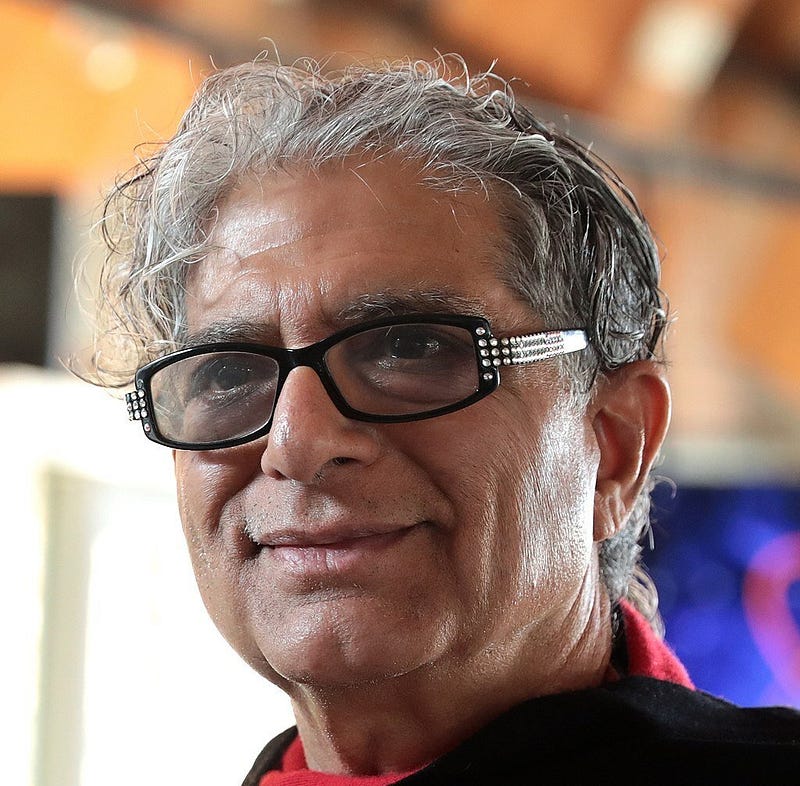

If a man told you he was God, would you trust him?
This follows on from 8 of the Most Ridiculous Things Said by Deepak Chopra.
Quotes are taken from QuoteFancy.com.
Please note: I have not read any of Deepak Chopra’s books, and I am not an expert on him. I am merely judging these quotes as quotes. But many people who believe them and share them have probably not read his books either.
“I used to be an atheist until I realized that I was God.”
I know this is one quote that I’m in serious danger of taking wildly out of context. But that just goes to show how careful we need to be about the kind of things we say in public about these topics.
Let’s consider what Deepak might have meant by this.
Was it a joke? I doubt it.
Was he referring to his own unique definition of God? Possibly. He might be saying that we are all part of God. If you define God as being everything, and we are part of everything, by definition we are all part of God.
But it’s so easy to misinterpret a statement like this. So why use the words “atheist” and “God” at all? Why not just say “We are all connected as part of the whole”?
If I type “God” into Google, I get these two definitions:
1. (in Christianity and other monotheistic religions) the creator and ruler of the universe and source of all moral authority; the supreme being.
2. (in certain other religions) a superhuman being or spirit worshipped as having power over nature or human fortunes; a deity.
Dictionaries are descriptive, not prescriptive. They don’t tell us what words should mean. Rather, they tell us what words commonly mean to people. So, most people will understand the term “God” to mean one of those two definitions.
So, when someone says they are God, they are likely to get laughed at. Because to most people, this quote is saying, “I used to believe the universe wasn’t created by a supreme being. Then I realised it was me that created the universe. I am the supreme being in charge of the universe.”
“DNA is a quantum computer that localizes a non local omnipresent consciousness or spirit into space time energy information and matter.”
No, it isn’t. Deoxyribonucleic acid is:
“a molecule composed of two polynucleotide chains that coil around each other to form a double helix carrying genetic instructions for the development, functioning, growth and reproduction of all known organisms and many viruses.”
“a type of computation that harnesses the collective properties of quantum states, such as superposition, interference, and entanglement, to perform calculations. The devices that perform quantum computations are known as quantum computers.”
DNA doesn’t make calculations, does it? Well, actually, it turns out that DNA can be used to make calculations.
But those scientists are deliberately using DNA to make calculations. That doesn’t mean that DNA normally acts as a calculator in our bodies.
The “localizes a non local omnipresent consciousness or spirit” seems to be saying that consciousness already exists before it is localised in a human. The “into space time energy information and matter” bit seems to just be a fancy way of saying not much at all really.
Okay, I’m going to have another go at trying to understand this. I’ll try to turn each part of the quote into a simpler version of what I think it means.
Quantum computer = performs calculations.
Localizes a non-local omnipresent consciousness or spirit = causes nonlocal consciousness to become localised.
Into space-time energy information and matter = become physical.
So, the quote means:
DNA performs calculations that cause nonlocal consciousness to become localised within physical objects.
We could simplify this further so that it says:
DNA causes things to become conscious.
Now I’m not sure whether that’s what he actually meant. I think I got myself lost. But that’s exactly why people shouldn’t be saying such difficult to understand things.
If you say complicated things, you will often get misunderstood. If you want people to understand you, try using plain English and simple words. It’s a great skill to be able to simplify complicated things so that many people can understand them.
Ask any successful writer on Medium. The key is to present information in words that are easy for most people to understand.
“Slip into the gap, have the desire, detach from the outcome, and let the universe take care of the details.”
Okay, let’s try to understand this one. I’ll try defining the individual bits of it again.
Slip into the gap = find a niche.
Have the desire = want something.
Detach from the outcome = not care about the end result.
Let the universe take care of the details = don’t take detailed, decisive action yourself.
So he’s saying:
Find a niche, decide what you want, don’t care about the end result, and don’t take detailed, decisive action yourself.
No, don’t take that advice.
Here’s some far better advice:
Decide what you want, figure out the steps you need to take to make it happen, then give it your best shot. But if you don’t succeed, feel satisfied that you did your best. Oh, and don’t forget to enjoy the journey too.
“An intention synchronistically organizes its own fulfilment.”
No, it doesn’t. This sounds like it came from The Secret. And writer Mark Manson has a few words to say about that:
It’s all about confirmation bias. What we focus on, we notice more of.
So, if you focus on positive things, you will notice those positive things more in your life. If you focus on negative things, you will notice more of the negative things. It doesn’t mean more or less of these positive or negative things is actually happening.
About this specific quote, what it seems to be saying is that if you want something to happen, it will happen. But we know that’s not true. The world is full of people who don’t have what they want.
Do you think all the starving people in the world just didn’t want food? Is it entirely their own fault they are starving?
“EVERYTHING that happens in the universe starts with an INTENTION.”
If everything that happens starts with an intention, who had the first intention?
It’s the same old God argument. If God created the universe, who created God? Maybe the current God is actually God 2, created by God 1.
But then who created God 1? Maybe God 1 is actually God 2 and God 2 is really God 3. But who created God 1?
Here is YouTuber Rationality Rules debunking every argument for God:
“Every day in every way, I am increasing my mental and physical capacity. I am reversing my biological age.”
Every day? And in every way?
So, you’re getting physically and mentally more powerful with each passing day? I doubt it. That’s not how human development works. Even an Olympic athlete in training will have plateaus and off-days.
But what about reversing your biological age?
Well, according to this, it is possible to reverse your age by three weeks in just eight weeks by making lifestyle changes.
But Deepak’s quote seems to imply that this is happening every day. He seems to be saying that he’s getting younger every day.
Let’s look at the evidence.
Here’s a photo of Deepak in 2001.
And here he is 20 years later in 2021.
“When you do one thing at a time, you’re guaranteed excellent results.”
Sure, doing one thing at a time is much better than multitasking. In fact, multitasking is bad for productivity.
But that doesn’t mean that avoiding multitasking will guarantee excellent results. You could spend all day working on something without any distractions, then the end result could be a disaster.
Sometimes that happens in life, but that’s okay. Try to understand what went wrong, then try again.
Deepak Chopra vs a quantum physicist
During a debate in front of an audience, a quantum physicist stood up to ask Deepak some questions:
As it turns out, they ended up collaborating on a book: War of the Worldviews: Science vs. Spirituality.
Notable responses from readers
M Arun Subash:
I have not heard any of Deepak’s speeches or read his books. Couple of things which is mentioned in your article align’s with Hindu Scriptures
“Until i realized that i was God” — Upanishad says “tat tvam asi” — You are that. It forms the core of Advaita. Start looking inward to realize the divinity inside.
“detach from the outcome” — This is nothing but Karma Yoga. Do your duty and not worry about the outcome and accept what you get as is.
These are very broad and not be taken literally
Read next: 8 Ridiculous Things Said by Eckhart Tolle Which Don’t Stand Up to Scrutiny