
7 examples of product-led growth in mobile apps
How the top 1% of apps grow through PLG (Duolingo, Bumble & more)
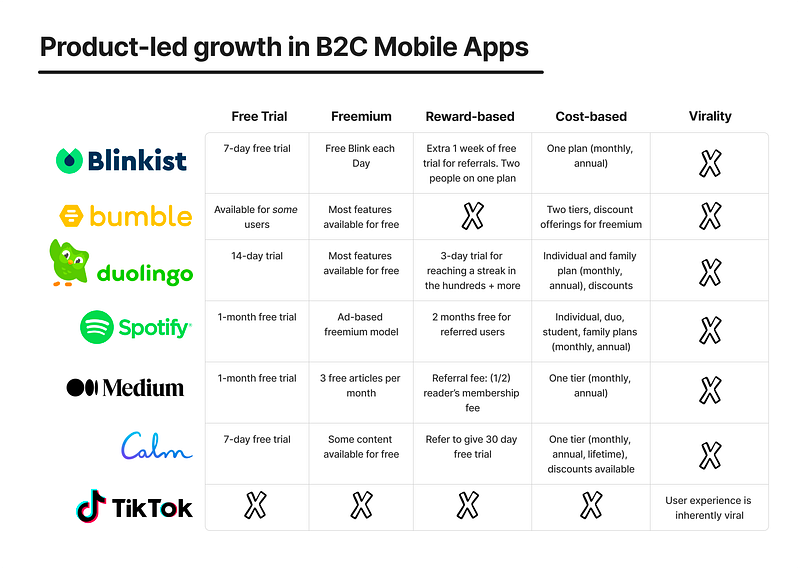
Whilst Product-Led Growth (PLG for short) is a hot ’n’ trendy topic right now, especially in B2B SaaS, we’ve been doing PLG for years over here in B2C.
Most people think that PLG for consumer products is one of two things:
- Going viral
- A free trial
It’s not surprising these two get so much attention. 60% of consumer apps have a free trial according to RevenueCat, and viral apps inherently get airtime due to their hockey-stick growth over a short period of time.
But there’s so much more depth to product-led growth in B2C.
Whilst there’s overlap, I’ve grouped PLG mechanisms for into four core areas:
- Try-before-you-buy PLG: Lowering the barrier to entry via a free trial or freemium model (access certain features or a set amount of content/features)
- Reward-based PLG: Rewarding users for engagement, retention or referrals (increasing acquisition or retention loops). Think referral programs, retention CRM etc.
- Cost-based PLG: Segmenting monetisation tiers to cater to different users (allowing a broader audience to access different feature sets and generating revenue that you can reinvest back into your marketing budget)
- Virality: The thing everyone wants, but no one has (unless you’ve built it into the core of your product)
These are essentially different variations of the same core principle: let people experience the product in order to grow it.
This is something Hila Qu, Executive in Residence at Reforge and former Director of Growth at GitLab, talks about extensively in her Ultimate Guide to PLG episode of Lenny’s Podcast (it is an amazing listen, highly recommend).
To debunk the ‘it’s just a free trial’ myth, let’s go into a few examples of the four types of PLG to see how broad you can go with consumer apps.
1) Blinkist
Blinkist has layers of PLG motions: no need for users to create an account during onboarding (you can enter the app without registering), a 7-day free trial, a usage-based freemium model and benefits for referring friends (a longer trial). You can even have two people on one subscription (sort of like a family / couple plan).
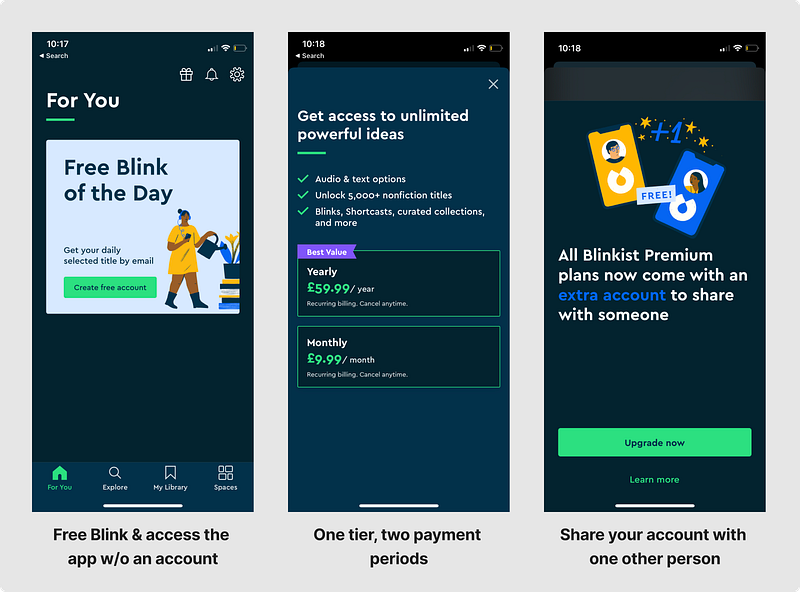
What I like is their usage-based freemium model: everyone gets a free blink (book summary) per day in the app (and via CRM with an email summarising your free blinks per week).
What’s missing for me is monetisation tiers that are personalised for different user cohorts (power readers versus average, for instance).
2) Bumble
A 10/10 example of PLG is Bumble: a strong freemium model, some features given once for free then paid for later, different plans targeting different user cohorts and discounts/trials to upsell non-paying users.
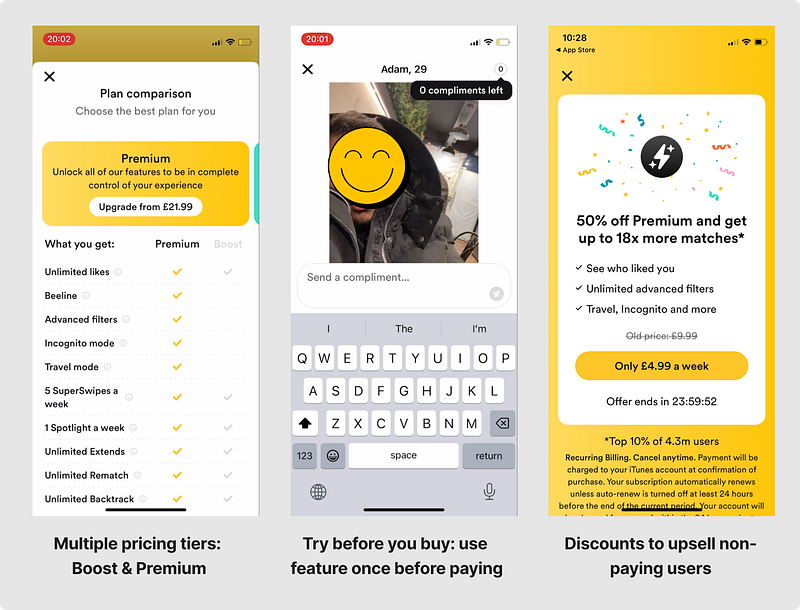
What’s interesting is their mixed trial strategy. 31% of consumer apps use a pure trial strategy, where the trial is offered to everyone across all products. However, Bumble (and Tinder) use a mixed trial strategy, where trials are only offered across some products & user cohorts.
3) Duolingo
Duo also has a free trial (interestingly longer than I’d expect at two weeks), multiple plans (family and individual) and various rewards for engagement in the app.
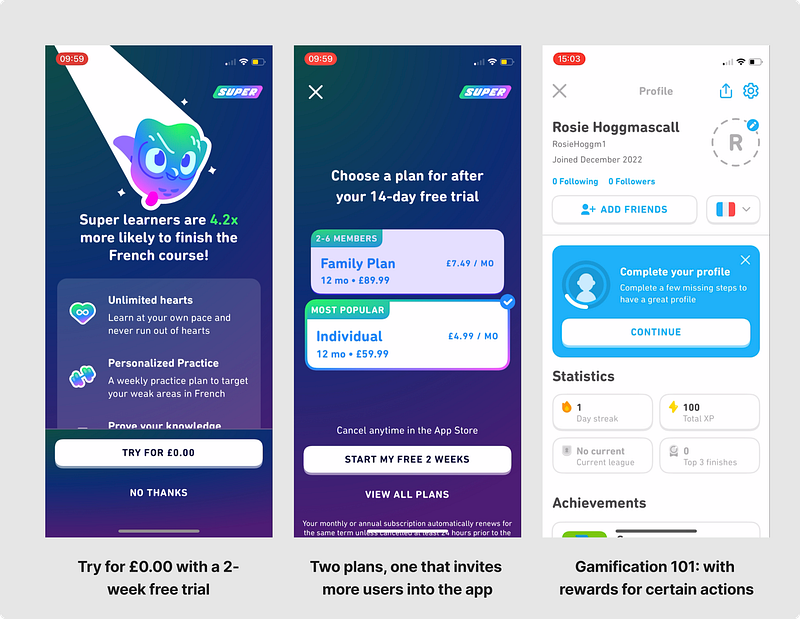
Word on the street is that they give you a special 3-day trial if you hit a certain streak count. Sadly I don’t have the patience to test that, so will have to believe this Reddit thread.
4) Spotify
Spotify is well-known for its ad-based freemium model (where the ads get so annoying you eventually buy). It also has a generous one-month free trial and a range of plans for student, family, duo and individuals. If someone signs up via your referral link, they also get a 2-month trial for free.
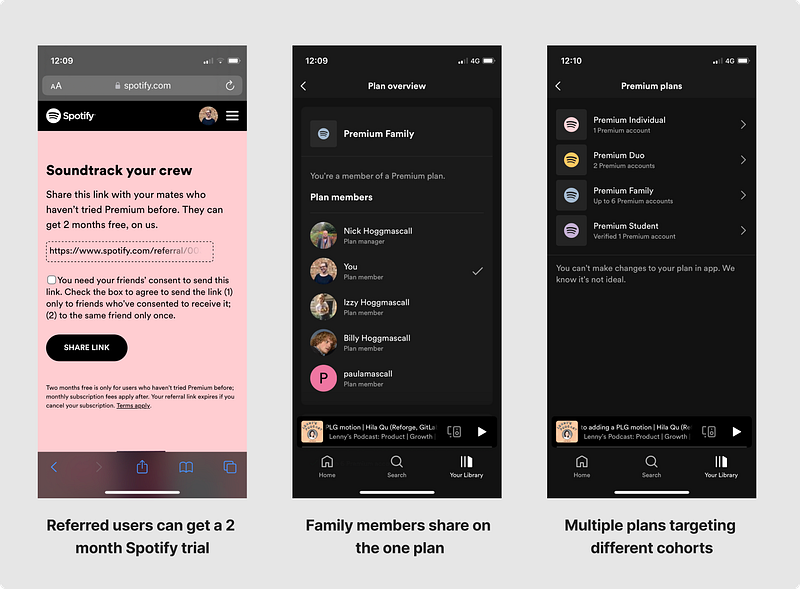
The longer the trial, generally the higher the conversion rate, according to RevenueCat, which is potentially why Spotify goes for 30-day (instead of the more common 3 or 7-day trial, adopted by 2/3 of apps).
I prefer shorter trials, as then your learnings cycle is quicker (unless there’s a significant difference in conversion).
5) Medium
Medium has…you guess it…a free trial too. It’s usage-based freemium model is stricter than the likes of Blinkist: only 3 articles per month. But it lets you choose which articles. As a writer, you’re also able to share your article link that lets anyone read your content (even if they’ve used up their allowance).
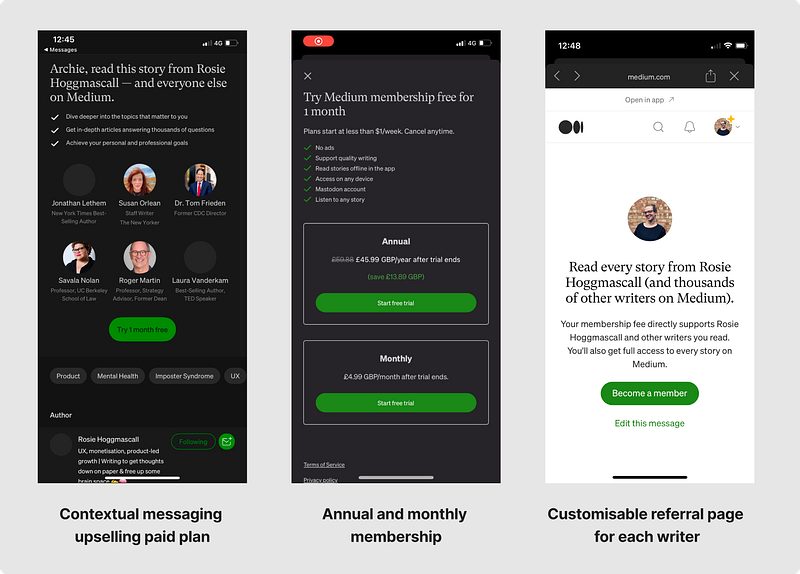
The payment model and the generous referral fee of 50% of any referees subscription mean that creators share their content widely (bringing in more readers, subscribers and ultimately leading to a win-win-win PLG mechanism for readers, writers and Medium).
6) Calm
By this point the trend is clear: consumer apps use a mix of try-before-you-buy, reward-based PLG motions and cost-based approaches. Calm is no different: a 7-day free trial, freemium model and benefits for referred users.
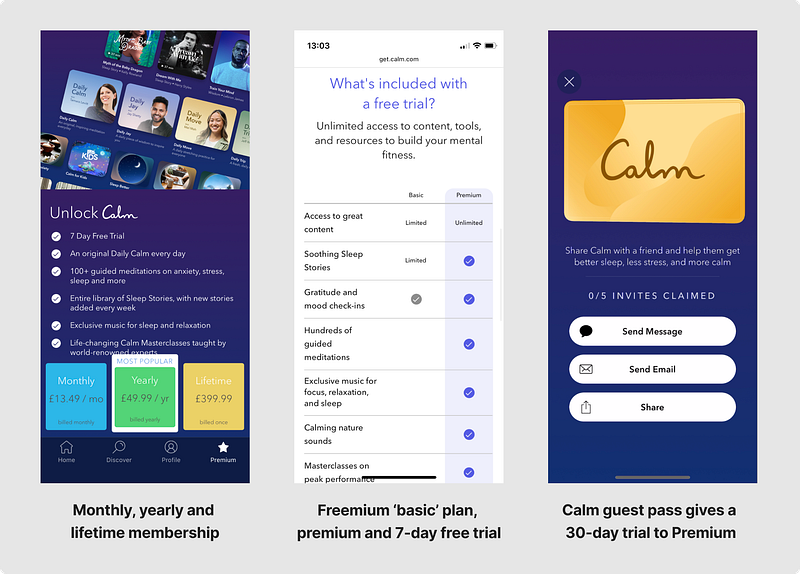
There’s also various B2B offers and deals that give access to meditation products, for instance for American Express cardholders used to get discounted Calm membership, and Headspace is included in some Vitality health insurance plans in the UK.
7) TikTok
Lastly, comes the poster child of PLG: Virality. What better example than TikTok.
Compared to the other examples I’ve listed, TikTok is in a different league all together.
The app was launched internationally in 2017, and has since been downloaded over 3 billion times. The main driver of its viral growth is the addictive for you page (FYP) with its distraction-free, full-screen content, the FYP is the default homepage and relies on the best-in-class recommendation engine. TikTok explains that the recommendations are based on a range of factors:
User interactions such as the videos you like or share, accounts you follow, comments you post, and content you create.
Video information, which might include details like captions, sounds, and hashtags.
Device and account settings like your language preference, country setting, and device type. These factors are included to make sure the system is optimized for performance, but they receive lower weight in the recommendation system relative to other data points we measure since users don’t actively express these as preferences.
Because of the scarily good recommendations, users become addicted, share content widely and come back often leading to viral acquisition loops and strong retention loops.
Their ad-based commercial model drives revenue without users having to pay/subscribe, meaning TikTok doesn’t need many other PLG mechanisms to succeed. Dreamy.
To end our consumer PLG tour…
If you’re to take away one thing, remember that PLG is not just a free trial. You also can’t just glue virality onto the side of an existing product and expect to see rocket-ship growth. It needs to be baked-in from the start.
Not to worry though, there’s a range of other PLG mechanisms you can layer into your product spanning try-before-you-buy, reward-based and cost-based. Try a generous referral scheme like Spotify or Medium, or maybe different trial options based on engagement, like Duolingo and Bumble.
Most B2C apps employ over three PLG mechanisms together to help their product grow, with a strong bias towards monetisation. The rarer, viral products (TikTok) can rely on fewer, stronger PLG motions to drive growth.
What now? As always, speak to your users, look at your data and decide where’s best to focus to drive your flavour of product-led growth.
What will you try?


