7 Essential Writing Lessons from Stephen King’s Million-copy Bestseller
These points might change your mind about writing.
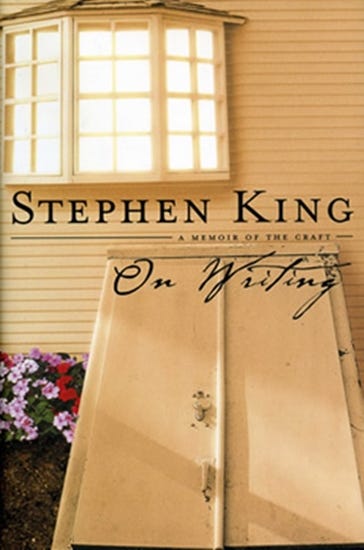
Renowned author Stephen King has published “at least 90 novels, more than 200 short stories,” and a few non-fiction books — “selling 350 million copies.”
In his million-copy bestseller “On Writing: A Memoir of the Craft,” King provides valuable lessons for aspiring writers. I found the following seven essential lessons which might help you become a good writer.
1. Don’t worry about “grammatical correctness”
— Myth: My grammar has to be perfect.
“Language does not always have to wear a tie and lace-up shoes.” -Stephen King
Whether you write fiction, or non-fiction, an academic paper, or a business letter, a journalistic piece, or an informal memo, you should not underestimate the importance of grammar. Poor grammar can change the meaning of a sentence — it’s also bad for your reputation. Although grammar is essential, getting obsessed with perfect grammar isn’t.
If you don’t write for fear of “grammatical correctness,” it might undermine your confidence to become an aspiring or a good writer. Instead, focus on simple sentences, as King writes: “…all those simple sentences worked for Hemingway […] Even when he was drunk…” Hemingway won Pulitzer Prize for Fiction and Noble Prize in 1953 and 1954, respectively.
Grammar shouldn’t hinder your passion for writing, but do not confuse it with punctuation. Bill Murphy Jr., Inc’s contributing editor, writes about crucial punctuation mistakes:
2. Don’t try to sound more knowledgeable than you are
— Myth: If I use big words, people might think I am knowledgeable.
“One of the really bad things you can do to your writing is to dress up the vocabulary, looking for long words because you’re maybe a little bit ashamed of your short ones. This is like dressing up a household pet in evening clothes.” -Stephen King
If you use big words to sound more knowledgeable, stop it now — especially after you come across those words when you prepare for the SAT, MAT, GRE, GMAT, TOEFL, and IELTS tests or any other standardized ones. If you come across those big words in that last novel you read or that “jargon” business book you order for $2 or that scientific paper you read online, you shouldn’t use them in your next writing. It’s better to have simplicity in writing, mainly when it is for a general audience. It might be okay for a specific audience, though.
Let’s have a look at these two examples to help you understand this.
a) At no time, set out to sound more erudite than you eminently are.
b) Don’t try to sound more knowledgeable than you really are.
Which one is easier to understand for a typical reader? You decide!
Your ego as a writer is not as important as the readers’ ego. As Negin Safdari writes in her piece: “Good writers write for their ego, great writers write for yours.”

3. Three things are bad for your writing: Adverbs, the Passive voice, & long paragraphs
— Myth: a) Adverbs add power to the sentence. b) We have to use active and passive voices equally. c) A longer paragraph means I can get into the tiny details.
“The road to hell is paved with Adverbs.” -Stephen King
“Easy books contain lots of short paragraphs …” -Stephen King
“Two pages of the passive voice — just about any business document ever written,… make me want to scream.” -Stephen King
I remember writing my first essay back in 2009 — thinking it might be “a piece of gold” as I put much effort into it. I got this piece of advice from my instructor: “Your writing is not bad, but it’s flowery, and the paragraphs are so long.” I couldn’t change that style of writing in a matter of weeks or months — until I read King’s book.
Let’s have a look at these sentences:
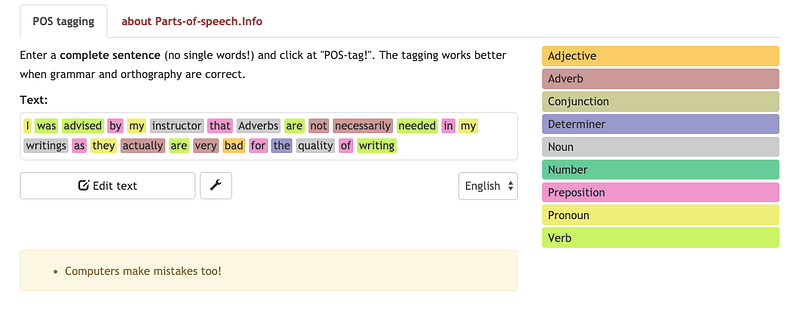
a) I was advised by my instructor that adverbs are not necessarily needed in my writing — as they are actually very bad for the quality of my writing.
b) My instructor told me not to use many adverbs.
See how I changed the passive voice to active, shortened the sentence, and omitted the adverbs. King suggests that we need to use fewer adverbs, write passive free, and be concise.
The passive voice is not terrible for writing. It “is not grammatically incorrect, and you are not ‘wrong’ if you use it.” It’s just that the active voice delivers the message much better.
If you want to identify any parts of speech in your writing, use this website:
4. Read more than you write; Write more than you read
— Myth: Good reading is not a prerequisite for good writing or vice versa.
“If you want to be a writer, you must do two things above all others: read a lot and write a lot.” -Stephen King
I read a lot — not only to get to know things but also to improve my writing skills. That’s how King’s advice on reading and writing helped me. One comes across the various forms of writing through reading. If your business writing is above-average, it doesn’t mean you are good at other forms of writing, namely creative, academic, or journalistic. You not only need to think outside the box of “writing has only one form” but also get rid of that box. Make it a habit to read from crosscutting sources to get to know multiple forms and styles of writing.
If you think you have to read more to learn or write better, you also need to write more to write better. Sounds puzzling? — but you need to write more to make use of those readings. It’s like you learn in theory but never apply it in real life.
If you don’t write, you never know what needs to improve. For this reason, reading and writing are equally important — but some might argue that reading comes first. You have to read first to be able to write, as “Good writers make Good readers.”
For me, writing is like slow-thinking, and reading is like fast-thinking. I learn more about writing from writing than from reading.

5. Edit and rewrite
— Myth: If I can write it in a single sitting, why should I edit or even rewrite it?
“To write is human, to edit is divine.” -Stephen King
If you procrastinate until the deadline, or if you think writing is about write-it-all-in-one-sitting just like this jargon word — you are NOT RIGHT.
Writing is not about one-sitting. Things before and after writing are essential. You might be in the kitchen washing the dishes and remember a shred of supporting evidence for your topic sentence or a neat example for your article. That’s when you need to jot down the idea. Otherwise, you will not have it when you sit and write.
I had to rewrite this article. I edited the sentences many times, including this one. I didn’t want to sound like a person who writes a book on “How to Earn Money,” but at the end of the day, he or she doesn’t have the money to publish it.

6. Appreciate or ignore criticisms, and avoid self-doubt
— Myth: I don’t want anyone to criticize my writing.
“I’m convinced that fear is at the root of most bad writing.” -Stephen King
Writing is a complicated work of art. Just as an artist paints like no other artist, a writer also writes like no other writer. The same way our thumbprints do not match, our writing styles also do not match. If you just wrote your first essay, your fifth article, your seventh story, your third book, or your second volume, don’t let critics stop you — keep going. Seek perfection, but who has attained it yet?
Follow the basic writing rules and view criticism as a way to improve your advanced writing skills. Any form of criticism from others often leads to self-doubt. It’s self-doubt that makes us stop doing things.
Not only yourself but also others will doubt you. Don’t compare your chapter 3 with someone else’s chapter 5, or your page 62 to someone else’s page 301.

7. Write only about things you know
— Myth: I can write about anything as my writing is above average or excellent.
“Write what you know.” -Stephen King
Consider this: Can a Software Engineer with no prior knowledge or experience of astronomy write about it at all? Yes, of course — but he or she shouldn’t do it. He or she can write about hundreds of things in software engineering and related fields.
You might broaden your knowledge by reading more — not by writing about the things you never heard of or had any prior expertise. We should not underestimate the role of passion, but it doesn’t play any part if you are not knowledgeable about what you write. How is that plausible to write on something you have no clue?
Make sure you have some expertise in playing the piano if you want to write on “How to Play Piano?” Your writing skills might be excellent, but that doesn’t add value to the readers who might want to learn to play the piano — especially when you want them to learn based on your writing.
A good writer is knowledgeable and passionate about what he or she writes — and might also have above-average writing skills.
If you haven't read King’s On Writing yet, read it. Maybe you uncover several other lessons that might help you and other writers.