
7 Easy Steps to Rock Your End of Year Performance Review
How to get the grade you deserve
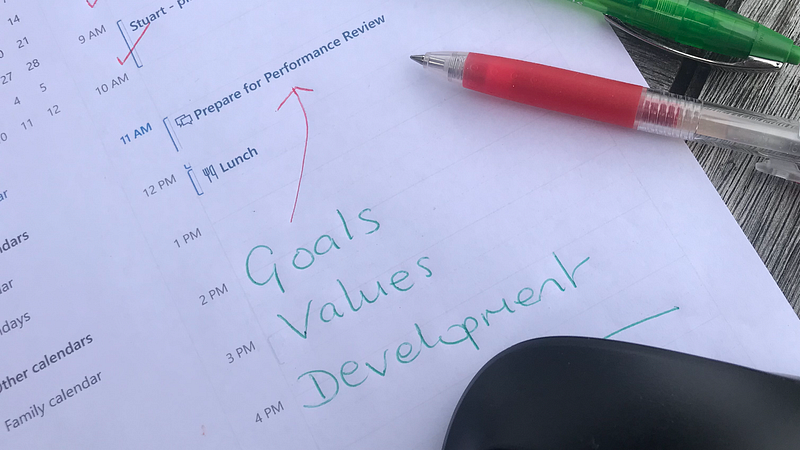
End of year performance reviews can be the bane of many of our lives. Thinking about them, prepping for them, writing them and attending them is torture for most people. Not to mention the anxiety generating grade at the end of it all.
For years, in my day job, I bribed people with sweets to make sure they completed on time as managing the performance review system was my responsibility. Chocolate fish always worked well.
During my wanderings around the office to chivy people along, I would get many a panicked request for help. From the Managing Directors to school leavers, most people found the performance review process a trial.
I write about leadership, learning & development and training. Subscribe to my free weekly newsletter here.
Performance reviews are a mechanism to get leaders to talk to their team members about goals and development. Back in the day, performance reviews were on paper forms.
A good manager can do a performance review and manage goals on the back of an envelope but we are not all blessed with instinctive leadership skills. A formal process gives some guidance.
These days, larger organisations are likely to have an on-line system rather than paper. An on-line system can bring it’s own problems when the gremlins inside the program come out to play, usually the day before the deadline for completion.
There is much discussion about whether performance reviews are fit for purpose in our modern world, however if your organisation still has a formal review, you must comply.
Many organisations finalize employee reviews at the end of the year. Ratings which affect pay and promotion prospects are allocated and, in my experience, anxiety around the whole process can be high.
Believe it or not, managers can be more stressed out by performance reviews than their staff. Every manager has to prepare for their own personal review plus reviews for several team members, which is time-consuming.
Remote working may make the review process even more challenging though we are all much more proficient at Zoom or Skype than this time last year.
The key to making the whole process easier is to prepare well in good time and have as much detail as possible ready to share with your manager.
1. Block out time to prepare
If there is a regular review cycle, you should have an idea when the end of year reviews falls due. Start getting organised before the performance reviews fall due.
Schedule plenty of one-hour slots in your calendar to update an account of what you have achieved. One-hour slots provide enough time to get some substantial up-dates done without being so trying that you want to give up. Space the time-slots out to allow yourself time to think.
Much better to have everything prepared than be running around in a panic, or heaven forbid, having to spend evenings and weekends hurriedly slamming together some content.
If you leave all your prep until the last minute, you can bet on it that the review program will fall over just as you sit down to start. Don’t be the person who has to ask for an extension because you didn’t prepare in time.
“Every minute you spend in planning saves 10 minutes in execution; this gives you a 1,000 percent return on energy!” ― Brian Tracy, author and motivational speaker
2. Showcase what you have achieved
Give your manager as much proof as possible that you have achieved your goals.
Your boss is only human. It is hard to remember what several team members did eight or ten months ago.
If you have a new boss who was not present at the beginning of the year this is even more important. Take some time explaining the original goals and how you have achieved them.
If you can quantify any results, do so. Use dates to prove you met deadlines and numbers to prove you hit goals.
Get this information by going back over any documentation you have from one-to-one meetings, emails, your calendar or files on your computer.
Evidence that you have done the task makes it easier for your manager to give you a good grade.
Online systems usually have a way to upload documents. If you are still using paper, you can either print the evidence out or compile it into a document to view with your manager in your review meeting.
Completed word documentation, excel documents, confirmation of activities by a client are all good evidence. Some systems do not upload emails so you can copy the email onto a word document and use that.
“Setting goals is the first step in turning the invisible into the visible.” — Tony Robbins
If you have done a good job, this is the time to prove it with facts and prove that you have, indeed, turned the invisible into the visible.
3. Explain roadblocks
If there are any goals that you haven’t managed to complete, then you will need to explain why.
Document any roadblocks that have prevented you from achieving your goals. You may have achieved your goal later than the original deadline but as fast as possible given situations outside of your control. For example:
- Lack of information from other teams or outside agencies
- Key personnel not being available to liaise with you on a project
- Part of a project being cancelled or delayed by the company
- Covid 19 causing work to cease
- Absence of systems or tools
Extenuating circumstances, such as prolonged absence due to ill health, should also be considered.
Your manager should grade you on what you have been able to do. Things outside of your control should not result in a lower grade.
If you can’t remember why you didn’t achieve your goals, what chance does your manager have?
“I write goal lists! I set big goals, then break them down into small tasks that I need to accomplish to achieve the larger goal. If each task has smaller tasks, I bullet them down. The point is to keep breaking down larger tasks into small, easy ones and complete each task to prevent me from getting overwhelmed!” — Michael Wayne
If you have completed some steps towards your goals, map out what you have done and provide reasons for the steps you haven’t completed.
4. Ensure the goal weightings are still relevant
In the murky world of performance reviews, goals are weighted. If not, how would we know the difference between a small goal with not much impact and a large goal with massive impact?
The weighting of a goal can increase or decrease your final score so it’s worth making sure that the weightings that were allocated at the beginning of the year are still appropriate at the end.
Weightings can be based on percentages or numbers.
Percentage based — Project X is 20% of your overall tasks.
Number based — Each goal has a numerical weighting — 1 for not very important ranging to 5 for very important.
For example:
- Project X is 20% of overall goals at the beginning of the year.
- After three months Project X is cancelled.
- Project X is reviewed and is now worth 5% of overall goals.
- The 15% difference is distributed to other goals.
In this case, your grade is allocated regarding what you were able to do in the first three months.
If the numerical weighting system (1–5) is in place, the weighting may reduce from 5 to 2.
5. Get the rating you deserve
Most managers want to give good ratings to high performers, if only that it reflects well on them as a manager.
To do this, managers need proof that their people have performed well. In organisations where the results across all departments are calibrated your manager will have to make a case for your good grade.
Calibration generally means that senior managers sit in a room together and discuss whether ratings are accurate, sometimes fighting it out.
Your manager may have to prove that you deserve a high rating as other managers will not be aware of what you have achieved and perceptions can take the place of truth.
Make sure you give proof by collecting all the evidence, explaining roadblocks, making sure weightings are correct but above all, understanding your companies rating system and accurately mapping your performance to it.
There is usually a 1–5 rating system that goes something like this:
- Unacceptable
- Needs Improvement
- Meets Expectations
- Exceeds Expectations
- Outstanding
If you are asked to self-rate, be realistic or you will just annoy your manager.
I have had to help many a manager compose a response to team members who stubbornly give themselves the highest grade for every goal.
Responding to a team member, whether face-to-face or by email, takes time and the situation as a whole doesn’t reflect well on the critical thinking skills of people who do this.
If you believe you have done over and above what the goal demanded, make sure you provide evidence of what you have done.
State the goal and what you have done in addition. Use the same words as the rating system to make your case. Being specific makes it much easier for your manager to give you a higher grade.

6. Take time to show you have adhered to organizational values
Sometimes, ratings are given on how you have carried out your goals. In other words, have you demonstrated the company values?
Company values can be tricky to get your head around unless you have examples of what behaviours to map to what company value.
That you demonstrate teamwork is easy to prove but something vaguer, like innovation, may be harder to pin down.
In the case of innovation, think about any small changes you made or suggestions you have made. Use Google to full advantage by Googling ‘how can I demonstrate x’ to get some ideas.
Better still, ask for more information on the company values and examples of how they translate into what people say and do.
“The cultivation of human values alone is education.” — Sathya Sai Baba
7. Document how your development has made you more valuable
Most performance review systems will address development. Hopefully, you will have achieved what you set out to do.
You may not be rated for your development achievements as, after all, development is for your benefit. Having said that, continuing professional development shows that you can learn, keep up with new thinking and trends and show initiative.
It is worth reviewing your development over the last year and identifying any roadblocks. This way, you can either carry forward outstanding development goals or work out a better strategy for next year.
“The more that you read, the more things you will know. The more that you learn, the more places you’ll go.” — Dr Seuss
If you have learned new skills make sure you highlight that you are now more valuable as an employee and that these new skills can be put to use.
It is easy to dismiss performance reviews as a nuisance and not bother too much about preparation, however, if you can provide solid evidence of your achievements and make it easy for your manager to give you a good grade, the investment of time is well worth it.
The steps I’ve outlined above do take a little time, but it is worth preparing thoroughly. If your end of year rating affects your salary or future promotion prospects, it is especially important.
Summary
- Block out time to prepare
- Gather evidence that you achieved your goals
- Document anything that has prevented you from meeting your goals
- Make sure goal weightings have not changed
- Ensure you understand how your performance is rated and you provide evidence for any over achievement
- Prepare examples of times that you have adhered to the company values
- Review how you have done regarding your development
I hope this has helped. I’ve tried to include all the areas where people I’ve worked with have struggled over the years.
Good Luck!
I write about leadership & training, and I’ve designed The New Leader’s Starter Kit to help leaders better communicate with their teams. Get your free copy here.
The New Leader’s Starter Kit takes you through how to run One-to-Ones and Constructive Feedback sessions & develop effective listening skills — a printable one-to-one form, feedback form and listening skills checklist included.