
7 Common English Phrases and Their Historical Origins
A curated list of phrases “straight from the horse’s mouth”
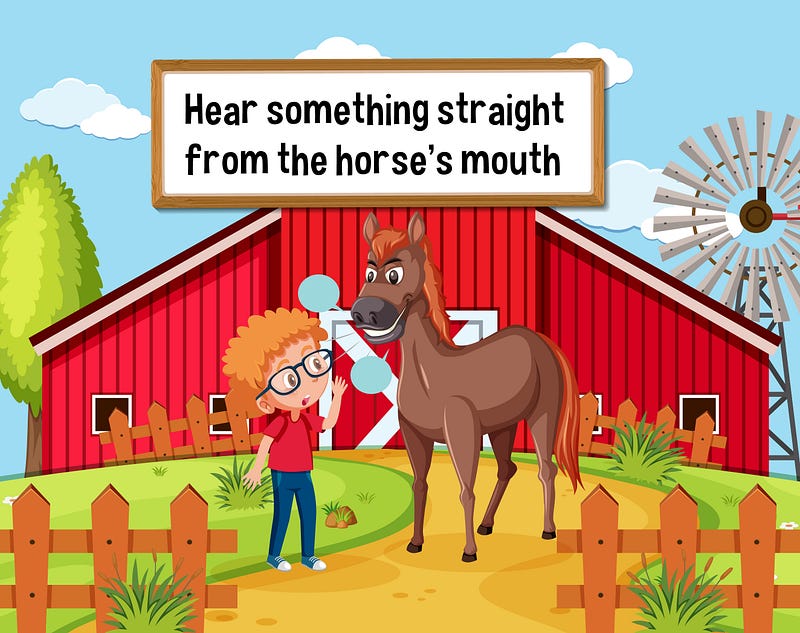
We’ve all grown up using certain idioms and phrases that don’t necessarily translate into their meaning but we’re taught to use them in a certain context.
Our education system does a great job of having us “learn” the meaning and context but doesn’t always care to tell us the origins of the phrase — a practice that would make the English language a lot of fun.
Thanks to the internet, the information is all out there — you just need to care to know. Well, since I know you can be lazy, I did some of the groundwork for you and put together a list of some of the common terms that we use and the interesting historical origins behind each of them.
#1 — Fit as a fiddle
It might just be me but I’ve always wanted to be as fit as a fiddle without really knowing what is the said “fiddle” we’re really talking about.
The origins of the term go back to the 17th century when this term was first used in a book entitled English-men for my Money by Haughton Williams.
Fiddle actually refers to stringed musical instruments, especially the violin which always need to be kept in good condition — i.e. fit.
So next time you call someone fit as a fiddle or desire to be in that perfect shape, you’re actually referring to a violin!
#2 — The rule of thumb
This one has multiple explanations — some “urban legends” that are actually not the true origin, while some more believable and perhaps more accurate origins.
Firstly, the common myth of the origin is that a British judge at some point in the 1800s passed a ruling that a man was allowed to beat his wife with a stick no thicker than his own thumb. While this is, unfortunately, a true incident, this sexist and ridiculous ruling is not the true origin of the term.
The true origin of the term possibly dates back to the 17th century when the phrase was first used. While there is no agreement on the exact usage — but it is believed that it refers to a non-scientific way of “estimating” things using your thumb. Some beliefs include the first use to be those of measuring the temperature of brews, judging the alignment or distance of an object by holding the thumb in one’s eye-line, and many similar estimations.
#3 — It ain’t over till the fat lady sings
There are some conflicting views on who actually first used this term — however it is probably well-accepted that the term was first used by some sports commentator when describing a tied game, saying “it ain’t over till the fat lady sings.”
The reference is to the fact that an Opera typically ends with a fat lady singing.
The first “usage” is attributed often to sports commentator Ralph Carpenter and dates back to 1976. I will admit, however, that I am not a fan of the “fat lady” connotation for an opera — after all opera singers, like all other artists, don’t have a specific body type, size, or shape.
#4 — To call a spade a spade
This one is often believed to be a phrase that has racial undertones and origins, which in fact, is a myth.
The original usage of the term had nothing to do with any sort of color or race. The meaning of the term is basically to “tell it like it is.”
As per this article on the origin of the term,
“To call a spade a spade” entered the English language when Nicholas Udall translated Erasmus in 1542. Famous authors who have used it in their works include Charles Dickens and W. Somerset Maugham, among others.
To be clear, the “spade” in the Erasmus translation has nothing to do with a deck of cards, but rather the gardening tool. In fact, one form of the expression that emerged later was “to call a spade a bloody shovel.” The early usages of the word “spade” did not refer to either race or skin color.
So while the 19th-century usage of the term “spade” started to get a racial undertone and colloquially stand for a black person — that was never the original intent, and should not be considered so in the modern English language.
#5 — Straight from the horse’s mouth
Here’s another one I use often and then recently wondered — can a horse even communicate with humans? What could be the real origin behind this phrase?
Why is a “horse” a reliable source of information?
The source, quite obviously in hindsight, comes from the field of horse racing. Horse racing and betting have been a part of various cultures for a long time, and “straight from the horse’s mouth” essentially refers to getting a tip to make the right bet from the horse itself!
I am not sure if a horse could know for sure that it’d beat the other horses in the race, but hey, maybe they do know their competition well!
#6 — Breaking the ice
We’ve all done ice-breaking sessions — whether at school, at work, or a networking event. We all commonly refer to things as good “ice-breakers” commonly used for a term to be conversation starters or increase the familiarity between strangers.
However, what does breaking ice have to do with getting to know someone better? I personally don’t recall calling strangers over and breaking some ice to kick off a party. Why, then, the phrase?
The phrase originally meant to make the beginning of an undertaking, especially a difficult circumstance. According to this article of the origin of the phrase,
The underlying image is to break the frozen surface of a river, lake, etc., in order to make a passage for boats, etc.* This is clear from post-classical Latin scindere glaciem (the probable origin of the English and French phrases) as used by the Dutch humanist and scholar Desiderius Erasmus (circa 1469–1536) in Adagiorum chiliades (Thousands of adages — 1508), an annotated collection of Greek and Latin proverbs
#7 — Barking up the wrong tree
This one’s quite simple in its implied meaning i.e. you’re pursuing a mistaken or wrong direction.
However, the origin is quite interesting.
The origin of the term dates back to the 1800s in written English. The expression comes from ancient hunting practices when the dogs would bark up a tree to indicate they’d cornered their prey.
However, sometimes, smart animals like raccoons would mislead the dog into believing that they were up a tree when they’d actually escaped. This is when a dog would be “barking up the wrong tree” under the false assumption of having its prey cornered.
I hope some of these phrases leave you a tad bit wiser in your grasp of the English language and can even act as “ice-breakers” in your next conversation with a stranger at that party. Of course, if your companion is as much a language geek like you and I are.