
7 Benefits of Writing by Hand
How to prioritize writing that is slow, thoughtful, and deep
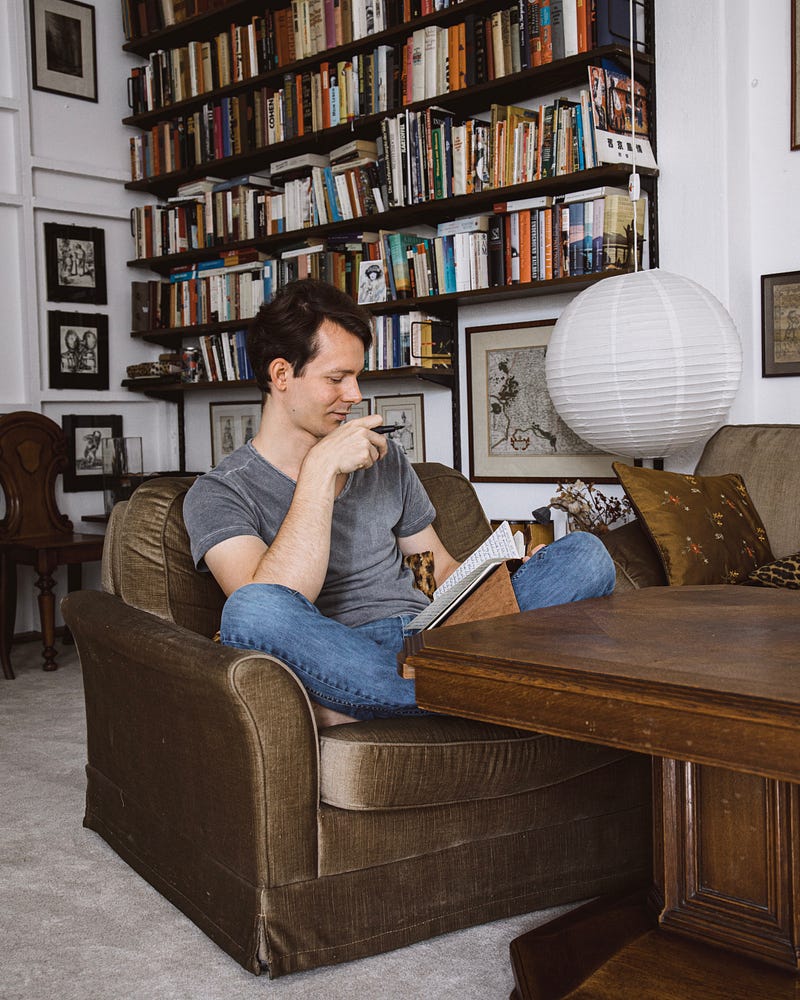
I write all my first drafts by hand. I also journal every morning — by hand. I attribute both of these approaches to my writing success: I consistently write 1.5–2k words per day.
This habit may seem charmingly old-fashioned in our digitized age. We have laptops, smartphones, desktop computers. For years now, typing has replaced the ancient art of writing-by-hand.
While typing is faster and more convenient, something is lost in the process. We lose a connection to our physical bodies. We type too fast, which does not allow our subconscious brain to catch up and redirect our conscious mind.
Handwriting has many unique advantages, seven of which I will detail in this article. If you’ve never written by hand (or have allowed that habit to deteriorate as soon as you left grade school), I invite you to pick up the habit again — at least for composing your first drafts.
#1 — It lets your subconscious play
Your brain has two distinct styles: one is logical and likes things to proceed in an orderly fashion. This is your active brain, and it loves the idea of typing things out on a computer. However, the other side of your brain is more creative; it’s unstructured and likes to make associate leaps. This mode, the diffuse or subconscious, prefers to write by hand.
When you type everything, you leave no room for the diffuse mind to play. Typing has a rationality built into it. Each key corresponds to a letter, which is relayed to your device. It’s mechanical; it’s quick.
Your diffuse mind, however, likes to wander, and there’s little room to do so when your fingers make the words march across the keyboard. When you write by hand, you let a bit more creativity sneak through the back door of your mind. You de-digitize the process. It’s more analog, like a record — where you can enjoy the (inefficient) but pleasing background noises: the hiss of static, the warm buzzing, the different textures.
On the other hand, typing has a cold sterility to it that tends to stifle your more creative leaps.
Writing is an abstract process. It doesn’t “exist” in the material plane. When you type on a computer, your writing has zero connection to anything physical. Your thoughts are transmuted onto the internet, where other people’s thoughts then interpret them.
When you write by hand, you re-introduce the physical into an abstract process. You hold the pen in your hand; you can feel the paper’s weight; the ink is flowing across the page like a stream.
Good writing is grounded in physical details. When you write by hand, you allow yourself to get closer to that physicality. You remember that you are not just a series of interrelated thoughts — you occupy a body in space, and it is with that body you write.
#2 — It frees you from distraction
Writing on your computer is dangerous — there are so many distractions that can pull you away from your writing. Sure, there are apps to block those, but honestly, how often do you use those?
There’s a strong tendency to write a paragraph or two and then “check-up” on something for a second. Before you realize it, you’ve fallen down the infinite rabbit-hole of the internet and have forgotten what you were working on. You can’t go back to your writing, and you’re done for the day — unfinished.
Mihaly Csikszentmihalyi’s work shows that the secret to success is tapping into a flow state. Flow is characterized by a feeling of pleasurable immersion — being fully immersed in a task. Time seems to fly by, and you emerge from flow with a deep sense of accomplishment and satisfaction.
It’s hard to get into flow when you type on a computer. A single distraction can pull you out of it — and once you’re out of flow, it’s hard to get back into it. Even the apparent benefits of computer writing — editing as you go, looking up the meaning of words, researching concepts — have a double-edged sword. Every time you stop writing to look up a definition, you risk falling into the internet-hole. You risk losing your flow, which is never worth it. You should save editing your work for later.
When you write by hand, you can keep yourself free of distractions. Put your phone and computer in another room and just write. Get into flow. Let the words come as you feel them.
#3 — It slows you down
Our current society prioritizes the fast, the efficient, and the shallow. We have little patience for anything that takes time. If a website fails to load in two seconds, we hit backspace. If a television show buffers, we reset the wi-fi. If our Amazon package is a day late, we complain.
We have little patience for things that take time. Unfortunately, good writing takes time. It takes time to develop a good concept, execute it, refine it, and more time for the public to appreciate it.
Your writing career is going to take years to get off the ground. There’s no sense rushing things — might as well enjoy the process. And writing by hand is more pleasurable! Because it forces you to slow down and enjoy the journey.
When you type, you are impelled to get through your writing as quickly as possible. This leaves no time for your brain to catch up to your fingers. It leaves little time for thought.
Writing by hand slows you down, and slower thoughts are better thoughts. Slower thoughts have a depth to them. Slower thoughts are inefficient — which gives them character, which makes them more individual, which leads to a writer’s voice.
A unique insight, delivered through a distinctive voice, carefully thought out over a long period, is far more valuable to readers than quickly conceived, quickly delivered, and quickly processed writing.
Slow down. What are you in such a rush for?
#4 — It doesn’t “look” like published writing
Writing is a strange beast — transmitting your private thoughts to an invisible audience. And there’s a weird irony to this process: the more personal, the more specific your writing, the greater its appeal.
To reach a wide readership, you have to go deeply into yourself. You have to let your writing marinate in the juices of your soul. If you rush this process, your writing will come out half-baked.
This is why writing by hand is so useful: it doesn’t look anything like finished writing. It looks like a mess! Which is a tremendous benefit to your brain. When you complete a task, your brain stops thinking about it; it disappears from your mind. Conversely, when a task lingers, your brain will continually come back to it.
When you write something by hand, it appears unfinished (because it is), and your brain will pick up on that. Your subconscious will spend more time thinking about what you’ve written, mulling it over. When you come back to edit, you’ll have flashes of insight. You’ll know exactly what was missing, what you need to remove, what needs changing.
When you write on the computer, you shortchange this valuable process. Your writing looks finished as you compose it, and so your brain drops it. It checks it off as “done” and moves off to other things. When you come back to edit, you make minimal changes — a few small things here and there — and the work suffers for it.
#5 — It takes up physical space
One of Dan Sullivan’s key concepts in his entrepreneurial coaching program is the idea of the gain vs. the gap. According to Sullivan, most of us are miserable because we fixate too much on the gap — where we fail to measure up to an idealized standard we’ve set for ourselves.
To Sullivan, the key is to shift our mindset away from the gap (it’s always going to be there) to the gain — focusing instead of what we’ve accomplished. If you keep thinking about what you still need to do, you never give yourself a moment to appreciate how far you’ve come. Instead, it’s essential to look back and count up your past achievements.
When all of your writing is digital, it’s hard to get a sense of how much you’ve produced. It doesn’t take up any space — your computer is the same no matter if you’ve written a single article or five thousand. It’s hard to measure, to feel the gain when your accomplishments are just numbers on a screen.
When you write by hand, though, your writing takes up physical space. You fill up one journal and then another, followed by another. Soon, you need to buy a second bookshelf to hold all your notebooks. The progress is real; it’s tangible. You can pick it up, run your hands over it, drop it on your foot.
I’ll never forget the time an old friend came to visit. He saw my shelf of notebooks and remarked at how much I had written. It’s funny because, at the time, I’d been feeling down at how little I’d seem to have accomplished with my writing — but the evidence to the contrary was right there, plain for everyone to see.
There are many benefits to a digital repository, especially when you’re young and moving around a lot — you can take everything with you quickly and easily. But you lose something in the process, too — a physical presence that grows beyond your body, tangible proof that you are changing and growing beyond your current limitations.
#6 — It improves your memory
Writing by hand also improves your short and long-term memory. You were probably encouraged to take notes in school, and for a good reason: writing something down improves your ability to recall it later.
Since handwriting is physical, you create a spatial connection between the information you’re writing because it takes up space. We evolved to remember physical places in our environment and develop rich associations to navigate strange and unpredictable worlds. If our ancestors discovered a grove of berries in a new valley, they needed to remember how to find their way back.
For this reason, our memories are highly spatial-dependent. You can easily recall the layout of an old house, the road you lived on as a childhood, and directions to places familiar to you, even long after you’ve left.
Moving pen across paper allows you to tap into this memory-storing superpower. The writing becomes part of your physical environment, and you can remember far more of what you’ve written for much longer.
#7 — It keeps you from writing too much
Writing by hand is hard. It’s fatiguing. The allure of typing is not only that it lets you write more quickly, but it also allows you to write for longer. But as I’ve argued, speed is a hindrance, as is writing too much.
Ernest Hemingway liked to stop his daily writing as soon as he knew what would happen next. It made it easier for him to pick up again the next day. Other writers have advocated stopping at the height of flow.
Why? Two reasons: first, as I mentioned earlier, when you keep a task open in your brain, your subconscious works on the problem while you’re doing other things, offering new insights when you return to work on it.
And second: it keeps you from burning yourself out. I’ve said it before, and I’ll say it again and again — writing is a long game — a marathon, not a sprint. Too many fledgling writers, hot off an idea, sit down and write for hours on end. They come back the next day and write a little bit less, and the next day, lesser still. Soon, they stop writing altogether.
They burned themselves out. For writing, you must go slow and steady. Far better to write 200 words per day for a week than 1,000 words in one sitting. Find out what your daily maximum is, and stop before you hit it. Of course, as you write more, you’ll be able to withstand longer writing periods, but never, ever write yourself out. Leave enough in the tank to come at it the next day.
Writing by hand keeps you from burning out. Your hand will cramp far before your brain does, and this is to your benefit. You leave enough to come back the next day, and the day after that, and the day after that.
Writing by hand flies in the face of everything we hold dear as a society. It’s slow, inefficient, ponderous, and painful. It takes up space. But that’s precisely why it’s so valuable — it taps into something we’ve forgotten: how to be thoughtful, careful, and deep. How to take up space in a meaningful way; how to have a presence in every sense of that word.
Try writing by hand and see how it works for you. Try slowing down. There’s no rush: you’re going to be writing for a while. You might as well slow down and enjoy the scenery. That’s what I intend to do, at least. And when I see you on the road, I’ll stop and say hello, and then continue on my way, slowly, with no real destination in sight.
Ready to build a bullet-proof writing routine? Starting a blog means starting a daily writing habit. The good news: I’ve created a checklist for just that. Follow this every day, and your writing will improve quickly. Get the checklist here!