
What if some things were designed to be sustainably short-lived?
How to work with sustainable planned obsolescence.

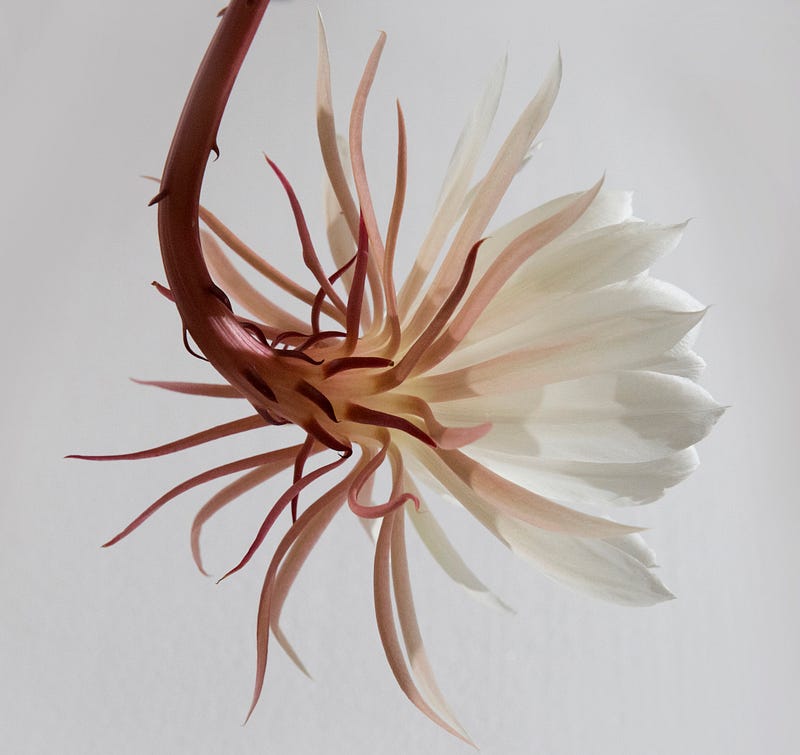
I saw this amazing cactus with huge fragrant flowers the other night when I was going for an evening stroll, and I could immediately sense that it was something extraordinary. When I got home, I did a bit of research and I found out that the cactus is called “The Queen of the Night.” It appears to be a rare kind of orchid-cactus that only blossoms one night a year, after which it withers. I felt fortunate to have experienced its short-lived fragrant flowers. I realised that this amazing plant is the perfect metaphor for the short-lived sustainable design-object.
The most sustainable behavior is to reduce consumption radically and to only buy things that are durable and continuously aesthetically nourishing. However, the reality is that sometimes we get blown away by an intriguing, trendy thing that isn’t meant to last forever, and we buy it and discard it after a short while.
Maybe the most sustainable design strategy is to embrace that some things are not meant to last forever. Short-lived products should ideally be made out of materials that deteriorate a little bit every time they are worn or used until they finally disappear.
Or maybe short-lived products could be made of materials that when thrown in soil vanish and even provide the ground with nutrition.
Or perhaps they could be like the aromatic “Queen of the Night” and wither after just one night.
By embracing the human need to be seduced and to sometimes act impulsively and “irresponsibly,” making irresponsible behavior sustainable might be a more humane way of encouraging sustainable habits than pointing fingers and acting like the sustainability police. Furthermore, it is likely a much more effective way.
Ideally, we would all be wearing the same garments every single day of the year, and mend these and take care of them and only replace them when they fall apart.
Ideally, we would buy one sofa and one table in a lifetime, but we don’t. Now, this might be either because the long-term options we have are unmendable, because they decay unaesthetically and cannot continuously provide us with aesthetic nourishment, or because they are designed to be overly bland and neutral in order to fit in to multiple contexts and segments making them too boring to spice up our daily lives.
Designers can encourage sustainable consumer behavior in two ways:
- by creating core products that are long lasting, in the sense that they are hard-wearing, alterable, and aesthetically sustainable
- by designing fleeting, colourful short-lived items as additions to these core-items.
These two ways are meant as correlative, not as incompatible. Designing for short product-life is a way of avoiding—or at least minimising—things perceived as obsolete long before their “expiration date” ending up in landfills or being downcycled for some insignificant purpose.
Sustainable planned obsolescence involves working with perishable materials or with inherent recyclability.

When it comes to sustainable living, overconsumption and a buy-and-throw-away mentality is at the one end of the scale of the golden mean, whereas nihilistic refusal and turning away from society altogether is at the other end.
A balance is needed. Objects that can satisfy our human need for transient, flamboyant, garnish and long-term nourishing aesthetic experiences are needed. Getting swept away by seductive patterns, colours, or shapes — potentially only providing a short-term pleasure meant for situational decoration — is a part of being human.
Unfortunately, designing short-term decor in a sustainable manner is not common practice. But the beauty is that this poses an intriguing challenge for the sustainable designer.
Want to connect? https://www.instagram.com/the_immaterialist/


