avatarGutbloom

Free AI web copilot to create summaries, insights and extended knowledge, download it at here

5582

Abstract

alcoholics, for reasons yet obscure, have lost the power of choice in drink. Our so-called will power becomes practically nonexistent. We are unable, at certain times, to bring into our consciousness with sufficient force the memory of the suffering and humiliation of even a week or a month ago. We are without defense against the first drink.</p></blockquote><blockquote id="b97c"><p>~ The Big Book, page 24.</p></blockquote><p id="2733">I mumbled something about doing more therapy sessions to stay in touch with my baseline feelings, but my new sponsor was having none of it.</p><p id="e1c9">‘This isn’t an emotional issue!’ he said, cutting in. ‘This is a memory issue that no amount of therapy you chose to throw money at will solve.’</p><p id="1800">He even suggested that the mental blank spot could be similar to a form of amnesia or dementia that science hasn’t picked up on yet.</p><p id="4ad6">‘But why hasn’t science picked up on it?’ I asked, holding the phone tightly.</p><p id="26fb">‘Probably because this blank spot only happens at certain times. Most of the time, it lays dormant.’ he replied before warning,</p><p id="337a">‘And unfortunately, this dormancy feature gives us an illusion of power. We think we’ve got sobriety now because our memory and willpower function normally again. Until, the condition randomly comes back online, and we relapse, leaving us totally baffled as to why it happened.’</p><p id="a3e9">My new sponsor sighed deeply.</p><p id="f455">‘It’s heartbreaking,’ he said softly. ‘Especially if you’ve relapsed after being multiple years clean. But it is sadly needed to show you that you are genuinely powerless, regardless of how much you desire and want to be sober.’</p><p id="969d">My head was spinning. Every sentence felt like the jolt of an electric cattle prod.</p><p id="8e0a">Later that day, I looked back at my recent relapses. I found no real conscious memory of consequences before any of them.</p><p id="352f">It appeared relapse was happening to me, not by me.</p><blockquote id="8aba"><p>As soon as I regained my ability to think, I went carefully over that evening in Washington. Not only had I been off guard, I had made no fight whatever against the first drink. This time I had not thought of the consequences at all. I had commenced to drink as carelessly as though the cocktails were ginger ale. I now remembered what my alcoholic friends had told me, how they prophesied that if I had an alcoholic mind, the time and place would come — I would drink again. They had said that though I did raise a defense, it would one day give way before some trivial reason for having a drink. Well, just that did happen and more, for what I had learned of alcoholism did not occur to me at all. I knew from that moment that I had an alcoholic mind. I saw that will power and self-knowledge would not help in those strange mental blank spots. I had never been able to understand people who said that a problem had them hopelessly defeated. I knew then. It was a crushing blow.</p></blockquote><blockquote id="93f7"><p>~ The Big Book, page 41.</p></blockquote><figure id="7922"><img src="https://cdn-images-1.readmedium.com/v2/resize:fit:800/0*n4r4HuNFWSnCD_WU"><figcaption>Photo by <a href="https://unsplash.com/@alicealinari?utm_source=medium&amp;utm_medium=referral">Alice Alinari</a> on <a href="https://unsplash.com?utm_source=medium&amp;utm_medium=referral">Unsplash</a></figcaption></figure><h2 id="287c">A Belief That It Will All Be Alright.</h2><p id="baea">Sadly, the ‘blank spot’ wasn’t all that was happening.</p><p id="7c3e">My new sponsor later explained that something else was happening in my mind, a kind of twisting of my thinking that I couldn’t see either.</p><p id="02a0">This is the other main feature of the relapse condition.</p><p id="da70">The Big Book explains it as follows:</p><blockquote id="f067"><p>But there was always the curious mental phenomenon that parallel with our sound reasoning, there inevitably ran some insanely trivial excuse for taking the first drink. Our sound reasoning failed to hold us in check. The insane idea won out.</p></blockquote><blockquote id="4ad8"><p>~ The Big Book, page 37.</p></blockquote><p id="da58">Anytime the ‘good idea’ of relapsing suddenly popped into my head, part of me would start to minimise the lunacy of this thought.</p><p id="e2c7">I would begin to rationalise this catastrophic idea with excuses and reasons why it would be, in fact, okay to relapse despite being in recovery.</p><p id="432a">No matter how insignificant and non-sensical those reasons were, they quickly became plausible and seemingly rational.</p><p id="6997">At the same time, the urge to want to relapse would start to surge.</p><p id="cdc4">A fear of missing out would relentlessly come crashing in like waves rolling in and out of my consciousness.</p><p id="b225">Thoughts and narratives of why it would be okay this time would dominate my thinking.</p><p id="fe2d">Finally, a tidal wave of justification would smother me into deep unconsciousness.</p><p id="c65b">Convinced of my rationale, I would carry out my plan, only to revert back to type and do everything I said I wouldn’t do, and again, find myself powerless to stop once I started.</p><p id="34a2">This twisted thinking was nothing more than a lie, but I believed the lie and didn’t see the flaw in the logic in light of my track record with partying.</p><p id="888a">To any average person, this kind of thinking and decision-making would be termed irrational, unsound, or even insa

Options

ne.</p><p id="d880">The Big Book calls this thinking an <i>‘obsession to beat the game’</i>.</p><p id="9087">Whether it’s a vague idea that this time it would be different, that I would do it differently and party like a gentleman.</p><p id="b075">Or the well-loved excuse that this will be my last relapse. After this final time, I’ll be done for good. I’ll get on with my life.</p><p id="be67">But, it never was different and that last time never did happen.</p><p id="149d">My new sponsor would remind me often,</p><p id="a62b" type="7">‘You aren’t changing your mind when you’ve decided to give in and party; your mind has been changed for you.’</p><h2 id="4c19">It Centers In Our Minds</h2><p id="f0e7">Of course, there is a body element for the addict.</p><p id="86b6">Naturally, as a consequence of the constant extreme usage of powerfully addictive substances and processes that are designed by their very nature to make you want more and more, addicts have developed a sky-high tolerance.</p><p id="2d70">But there’s this annihilation approach to our acting out and using once we start, which the Big Book describes as the <i>‘phenomenon of craving’</i>.</p><p id="01c2">In the Doctor’s opinion in the Big Book, Dr. Silkworth calls the phenomenon of craving an ‘allergy’, but my new sponsor wasn’t too keen on that idea.</p><p id="10af" type="7">‘If it’s an allergy, then why doesn’t the phenomenon of craving happen every time?’</p><p id="ae75">Regardless of whether it is an allergy, the body part becomes irrelevant, as most people with a severe peanut allergy don’t tend to keep repeating the total lost cause of trying to have another peanut to see if they will react differently.</p><p id="2e48">They don’t touch or go anywhere near peanuts because they remember how terrible it was last time.</p><p id="436a">Once or twice is enough.</p><p id="3796">Not so with the real addict because of the first two features of the disease; they will not only be back gorging on peanuts, but they will eventually take up residence in a peanut factory.</p><blockquote id="e3f6"><p>There is a complete failure of the kind of defence that keeps one from putting his hand on a hot stove. The alcoholic may say to himself in the most casual way, “It won’t burn me this time, so here’s how!” Or perhaps he doesn’t think at all.</p></blockquote><blockquote id="d5e6"><p>~ The Big Book, page 24.</p></blockquote><p id="5cb9">That’s why the Big Book says the real problem ‘centers in our mind’, not our bodies.</p><p id="22d4">‘What will happen now,’ my new sponsor forewarned, ‘as the relapses get worse, the time between them will get shorter and shorter.’</p><p id="6f0b">This condition is progressive.</p><p id="e8f1">Therefore, the blanking and twisting will naturally grow in scope and reach until you can no longer differentiate the true from the false.</p><h2 id="869b">Turning To Something Else</h2><p id="922a">If you believe in the disease concept of addiction, that this is a disease, a fatal illness precisely like any other life-threatening condition, then you have it for life.</p><p id="a2d8">There is <b>nothing </b>you can do to change that.</p><p id="d5f6">If you constantly can’t remember why or how you relapsed despite your honest desire not to.</p><p id="9aaf">Or if you continually relapse, believing some trivial reason or silly excuse to relapse while dismissing the genuine consequences, then you are a real addict.</p><p id="a47a">You have this relapse condition.</p><p id="840d">You <b>crossed a threshold </b>where, at certain times, your inability to use reasoning and rational thinking won’t even register for you.</p><p id="d8c6">The tragic truth is that once that threshold has been crossed, you have <b>no choice</b> but to relapse.</p><p id="0564">A compromised part of your brain will always fire the thought of using or acting out. That will never change. It’s wired like that for life.</p><p id="5fb0">There is no cure.</p><p id="fcca">Even this information won’t save you, as at certain times, you won’t be able to recall any of it when it matters.</p><p id="7fc5">So, let go of trying to change that.</p><p id="59f9">Let go of any old ideas around fighting it and instead get out of the way and <b>trust in something else</b>.</p><p id="b722">After all, that’s all you’ve got.</p><p id="5065">There’s nothing you or anyone else can do to stop this relapse condition.</p><p id="d1dd">But there’s everything you can do about everything else.</p><p id="5e51">There’s everything you can do about building a <b>spiritual dimension</b> to your life, by giving back, helping others, living in genuine faith and trusting in something greater than you.</p><p id="3096">There’s everything you can do to improve your awareness and intuition, raise your consciousness and develop another part of your brain.</p><p id="7598">And let this part of your brain grow bigger and stronger than that addictive part so that it can embrace and look after that compromised part.</p><p id="d2e3">Just like a bigger and wiser older sibling can care for and comfort a much younger upset sibling by giving that stressed child a big hug.</p><p id="da93">There’s everything you can do about deciding to take on a new attitude, direction, and way of life that will keep this condition dormant one day at a time.</p><p id="e415">If this article speaks to you, please follow, share and subscribe to me for more.</p><p id="fc50">Click <a href="https://twitter.com/TheDarrenJames">here</a> to follow me on <a href="https://twitter.com/TheDarrenJames">X</a>.</p></article></body>

Happiness

Most of life hasn’t turned out like I thought it would. Time and time again, my daydreams, those distracted internal vignettes of a future me smiling and looking healthy, turned out to be completely off the mark. It might sound sad to say that my happiness projections never materialized, but it’s OK. All of my dreams were based on what I knew, and I knew very little.

When I thought about having a child, I figured I would raise a kid like I was raised but better. I imagined that I would let my offspring do the things I didn’t get to do, and would encourage them in the ways I wasn’t encouraged. To be honest, I’m not sure why that was such a happy thought. I guess I thought that by making my child happy, I would be happy. Now I know better. Any parent can tell you that many of the things you do to make your kid happy make you miserable.

More importantly, my projections missed all of the things that are wonderful about having a kid. I never daydreamed about watching my son eat. If you have had a kid you know that watching a toddler mouth, chew, and swallow a banana is to witness an elongated experience of perfectly centered contentment. It is both fascinating and joyous to observe. Who knew?

None of my present life was anticipated. I couldn’t have hoped to live where I live, or work where I work, because they were unknown to me. I had never known anyone like my wife before I met her. Most importantly, I couldn’t even see who I would become. I am not the man I thought I would be, and, we can all thank God for that.

If, thirty years ago, you had pressed me about what would make me happy, I might have said “people.” That much is true. Real happiness comes from the people I love, the children I teach, and the friends I have. What I couldn’t have guessed is that I would find so much happiness in my yard.

I grew up in Hastings-on-Hudson, a suburb of New York City, which I wrote about back here. The yard of my childhood was a quarter acre in size. The only edible plant on it was a forgotten currant bush.

We kept the yard up. My mother had a garden. My father was, for the most part, completely uninterested. It seems kind of tenuous to think that my family was connected to the land in any way.

But there were threads. I can pull on some of them for you. My great-grandfather on my mother’s side was an Irish immigrant who owned a tobacco store on the Pawcatuck Bridge in Westerly, Rhode Island. Here is a picture of him.
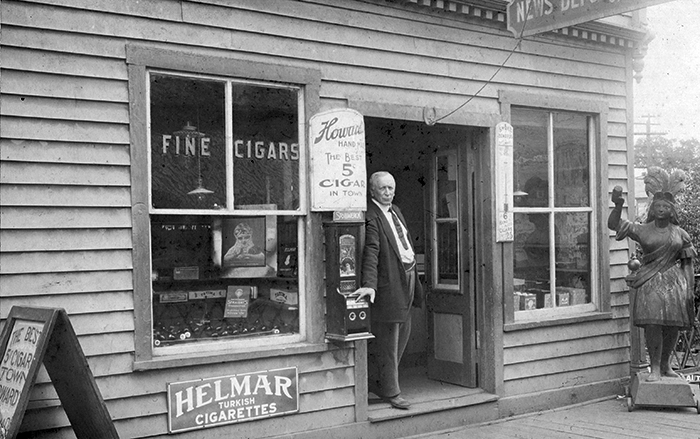
Tobacco store on the Pawcatuck Bridge.

He came to the U.S. when he was five and had a good public school education. As a grown man he wrote doggerel and fancied himself a naturalist. His intellectual aspirations included learning the Latin names of plants and being able to identify specimen trees that grew in the park or on the estates of the wealthy. He passed that interest on to his daughter, who in turn passed it on to my mother. My mother knew the names of a lot of New England plants and flowers, and some of her names were peculiar. My brothers and I call Evening Primrose, “June Flower,” even though I’ve never heard anyone else call it that.

On the other side of my family, my paternal great-grandfather grew up on a “farm” in what is now Hyde Park, Boston. His father was a milkman. During the Depression my grandfather, who was a stockbroker in Boston, bought a farm in New Hampshire, and that place, which was sold in the 70s, was very important to my father.
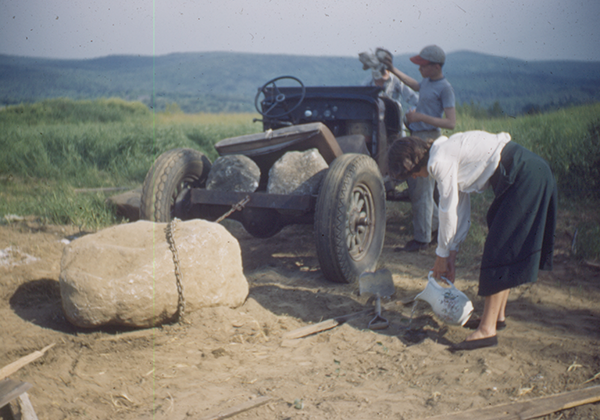
The gentleman farm in New Hampshire

When he was 15 my father worked for a summer on a dairy farm. The men in the bunkhouse woke up at 5:00 am for the morning milking. The way they roused themselves was by smoking a cigarette in their bunk. My father started smoking that summer, and to this day the first thing he does upon waking up is reach for his cigarettes. He then takes a smoke in bed while staring at the ceiling. He just turned 87.

I tell you all this so that you know that the seeds of my current contentment were in me, planted, no doubt, by my parents and ancestors to some degree, but still unknown to me.

The Boss and I escaped the city. We live in rural New Hampshire. The towns around where I live bear more resemblance to the Hastings of my youth than the Hastings of today does. My move to the country was really an attempt to approximate the place where I was born.

While I take Robert Frost poems seriously, I don’t want you to think that I see myself as a farmer. My relationship to the land is still suburban. That said, the following inspires:

The Pasture

I’m going out to clean the pasture spring; I’ll only stop to rake the leaves away (And wait to watch the water clear, I may): I sha’n’t be gone long. — You come too.

I’m going out to fetch the little calf That’s standing by the mother. It’s so young, It totters when she licks it with her tongue. I sha’n’t be gone long. — You come too.

In that poem is the invitation that has brought much happiness to my adult life. The invitation to both the natural world and the poetry that expresses a connection to it.

I refer to the six acres we own as “the property”, but you know that it is a yard. A large suburban yard. None of the land is “working”. A yard exists to be managed, and in that management we suburbanites find some pleasure.

Whether that pleasure comes from creating, imposing, or struggling to control nature, I cannot say. All I know is that there is some satisfaction in the ordering of living things.

I am a bulked-up suburbanite. I have a pickup truck. I have a 16" chainsaw. I fell, buck, split, and stack about four cords of wood for each winter. I have been keeping bees for over a decade, and sometimes keep a flock of 10 to 12 chickens. I have built sheds, repaired stone walls, for good fences make good neighbors, and most summers I grow sunflowers, roses, tomatoes, raspberries, and herbs. I get the Johnny Seed catalog, but it doesn’t take much to remind me that I don’t know what I’m doing. Last summer I got a large birch hung up in a stand of white pines. It reminded me that delusions can get you killed.

More often than not, great happiness comes from this, my most unanticipated pleasure. I never imagined I would find such joy in puttering around the yard.

Happiness comes from walking across the lawn, dumping the old wood in the swamp, and getting rid of the buckthorn that threatens to take over a spot where lady slippers grow.

Sometimes, covered in sweat and scratches, I stand in the middle of my yard and remember that small circumstances could change everything. There is no guarantee I will ever see a decent crop of apples from the apple tree planted last year. The whole lot could turn back to forest a decade after I die. It doesn’t matter. Doing these things… cutting out a clearing, splitting wood, rearranging the stones at the edge of a garden… touches something deep and lyrical inside of me.

We have a deck, but the Boss and I often sit on the concrete steps in the front of house. She calls it the stoop. She is from Brooklyn. All of what we do is new to her. When we first moved to New Hampshire she was confused by red squirrels. She likes to say that to her, all of the garden tools just looked like props from a horror movie. She is Mrs. New England now. If you would like some tips on how to prevent powdery mildew on phlox, or the best way to make war on Japanese beetles, she could help you.

We sit on the stoop, talk about planting more daffodils, and wonder why the mountain laurels still won’t grow. There is joy in taking in the air at your door. Cultivating this small piece of land keeps us from idleness and vice.

I have no idea if my recipe for happiness can be shared. I certainly never guessed that it would be made of this, but both Frost and Voltaire pointed the way. At the end of Candide, the main character says, “but let us cultivate our garden.” The seed was there. It just had to germinate and grow.

Happiness Weekly is a glimpse into what makes each of us happy. To share your story of happiness contact Happiness Weekly or respond below.

Read Lisa Renee’s story of Happiness: Mister Crunch.

Life
Happiness
Season2
Recommended from ReadMedium