
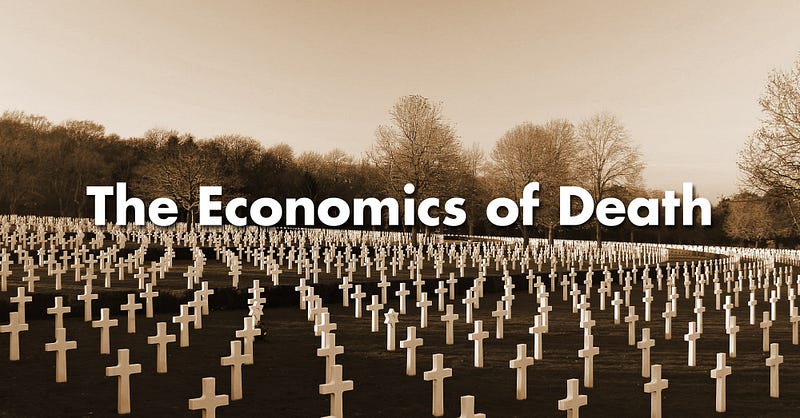
The Economics of Death
A multi-cultural perspective on property rights
When my mom died a few years ago, I wanted to honor her final wishes and make a statement about the person she had been while alive. The first part was simple; she wanted to be cremated and we complied. The second part was my decision to sell the burial plot my grandparents had bought and reserved for my mom and give the proceeds to the younger sister she had helped througout her life. When they bought the plot at Forest Lawn (a Jewish cemetery in Los Angeles) in the 1960’s, it probably cost less than $100.
When I started to inquire about sell those property rights, I found that the cost to buy a plot near her parents had skyrocketed to $8000–9000. Depending on the “view” and prestige of the location, memorial property can start at $14,000. And because money invades every aspect of our lives, there is an after-market for that property.
If you think that’s bad, consider this Smithsonian article about Shanghai:
One prime spot in Shanghai sold for $3.5 billion earlier this year, Quartz writes, while the average burial real estate goes for around $15,000… one company that owns and manages graveyards has decided to go public, with a rumored IPO of $200 million to be announced immanently… On the other hand, Want China Times reports that another company was caught selling $48 million’s worth of grave plots on the black-market.
Putting aside our discomfort with contemplating our own mortality, or the distaste we might feel about the prospect of disinterring a body to make a quick real estate score (the listings indicated unused plots, but who knows?), the subject raises some interesting questions.
#1. Los Angeles only became a top 10 U.S. city by population in 1920. What about other places, where large numbers of people have lived and died in the same town for hundreds of years?
China’s 3000 cemeteries will run out of space by 2019. The English are worried about the same thing. Considering the age of the country, population and the fact that they have 38% more population density than Great Britain, Japan has a cremation rate of 99.85%. However, as often seems to be the case, they have some bizarre customs related to their burial method of choice (hint: don’t ever hold something with chopsticks at the same time as someone else).
#2 When the space runs out, what happens?
About 15 years ago, I visited the gravesite of my wife’s grandmother, located about 10 miles south of Paris, and learned that cemetery plots are leased. After 50 years, if no family members come to renew the lease, the plot is “freed” up. (I had no idea what happens to the disinterred bodies). It was completely bizarre, given my American perspective on property rights.
But the practice is not uncommon. Countries like Germany simply reuse the same grave spaces after several years by removing remains from older graves, burying them deeper in the same grave and then reusing the space on top for a new body.
Families in Spain and Greece rent a “niche”, an above-ground crypt where bodies lie for several years until they have decomposed. At the point, the bodies are moved to a communal burial ground, so the niche can be used again.
Guatemala City, with its population growth and unusally higher murder rate, has seen a much more aggressive policy for disinterment, “with a harried, free market exchange of death for more death, of one body for another.”
Even those crowded parts of the world where cremation is the norm are finding space for an urn is a challenge:
In Hong Kong, thousands of families store ashes in sacks in funeral homes, while they wait years for a space in either public or private cemeteries. And in Singapore, one private company stores 50,000 urns, which can be automatically retrieved with an electronic card.
#3 The world’s response to this scarcity of burial land will completely change society’s views on death, burial rituals, and how we regard our ancestors.
Also from the Smithsonian article on China:
The Chinese government has even started subsidizing sea burials to compensate, paying Shanghai residents 2,000 yuan each to scatter ashes over Hangzhou Bay. For the past few years, some city governments have also pushed so-called tree burials, in which a person’s ashes are placed in a biodegradable casket and interred next to a tree.
In this case, government incentives will change behavior and wear down the old traditions.
Other factors, such as environmental concerns, are the motivation for completely different burial rituals, like green cremation through resomation, a water-based chemical resolving process that is basically a highly accelerated version of natural decomposition chemistry.
And then we have this:
The mushroom death suit (is soylent green not far behind?).
Deconstructing Death-onomics
It’s interesting when we strip away the particulars of countries and systems, and just look at the meta forces behind different economic behaviors.
Scenario #1: a small country occupies the eastern section of a large continental land mass that is bordered on either side by protective oceans. It shares this land mass with two weak colonial neighbors who end up trying to secure their independence from over-extended empires located on another continent. For the next 100 years, this small country expands westward, buying up large swaths of land claimed by the colonial powers, displacing and destroying less technologically advanced indigenous populations and annexing territory through war with the weaker neighbors. People flock to this land mass from all over the world, claiming the vast majority of farmable land. For the following 100 years, technological innovation will create large cities and factories. As the cities fill up, people move farther and farther away from central concentrations of business and manufacturing, spurring the building of sprawling communities that can be as large as small old world countries. (Fun Fact: the continuous suburb known as San Diego-Orange-Los Angeles-Ventura county contains 11,009 square miles; Belgium has 11,787 square miles.)
After 200 years of expansion and opportunity, is it any wonder we believe personal property is inviolable and that everyone has the chance to succeed?
Scenario #2: a small country is bordered on one side by ocean and the other three sides by similar sized countries. A large empire with superior technology conquers the native population and creates a vessel state that sends wealth and resources back to the capitol (instead of exterminating the people to make room for the empire’s settlers). Over the next 400 years, the empire slowly deteriorates and finally breaks up. For 1000 years after that, a succession of kings and emperors rule over parts of this vessel state, until one king successfully unifies all the parts to create a single, centralized country. Following is a 200 year period of stability and growth, as the country fills up its farms and towns and then turns toward colonizing other areas in the world. Changes in religious thought, advances in science and increasing inequality of income lead to a bloody revolution and a more democratic form of government, while this colonial period continues. After 300 years as a world power, losses from wars, independence movements in former colonies and the rise of new super powers reduce it back to its original size at the time of its unification 500 years before. Because it is still a relatively wealthy country, poor immigrants from its past colonies immigrate in order to enjoy these benefits. The only physical change in the country is the increase in the density of its population. For 100 years, there are no great technological revolutions; economic growth is slow and incremental.
With approximately 250 generations of people living, dying and handing down property rights to their heirs within the same fixed borders, is it any wonder that these people perceive limited opportunities, and far less social mobility? In this scenario, larger societal, collective needs compete with the primacy of personal property rights. And the scarcity of land has forced them to create a system of leased cemetery plots.
Are we as free willed as we think?
The impermanence of dead peoples’ property rights in other countries seems to be influenced by geographical, historical and cultural forces just as much as ours have produced a belief in eternal individual property rights.
Two questions come to mind.
- Have we really discovered the best economic system in the world, or did we just naturally develop a structure that fits, based on our particular culture, resources and geography?
- What new rituals and economic structures will we develop when we are forced to deal with finite resources at some point in the future?
It will be interesting to see whether these factors cause us to use more force to preserve the status quo, or move toward a more egalitarian system in order to avoid political upheaval.
Thanks for reading this far. If you found value in this, please recommend this post (❤) to share this with other people!



