
6 Ways Jokes about Violence Against Men Harms Male Victims
Andrew Smiler, on why we should stop laughing at male victims of violence.
There’s a meme going around these days about a man who buys his wife a mood ring so he’ll know how she’s feeling. When she’s in a good mood, it turns green. When she’s in a bad mood, it leaves a big red mark on his forehead. That’s got to be the most literal punch-line I’ve ever seen.
Maybe you find that funny.
Perhaps you caught Bill Maher’s commentary on a recent study revealing that boys and men are sexually abused at much higher rates than Americans expected. He joked that they weren’t abused, they just “got lucky” and mocked them for not understanding that.
Maybe you find that funny.
You’ve surely heard jokes about male prisoners who smell bad because when they drop the soap in the shower, they can’t bend down to pick it up.
Maybe you find that funny.
Although it’s fiction, Any Dufresne (Tim Robbins In The Shawshank Redemption) may well be the only guy you know who’s been in prison. You probably didn’t find his attempted rape funny.
Many people were shocked when we learned about priests molesting and raping boys. I don’t know anyone who thought that was funny.
When Ivan Lopez opened fire at Fort Hood a few weeks ago, he killed three men: Sergeant First Class Daniel Ferguson, Staff Sergeant Carlos Lazeney-Rodriguez, and Sergeant Timothy Owens. I’m guessing you don’t think that’s funny at all.
The moral of our story seems to be that it’s funny when men are the victims of violence, as long as the victim isn’t innocent and no one gets killed.
I’m sure a meme that joked about a woman ending up with a welt on her forehead from her husband’s ring would be reported as offensive. I know a comedian who joked about a woman getting raped would be damned all over the Internet; just ask Tosh. Violence against women isn’t funny, but violence against men is hilarious. WTH?
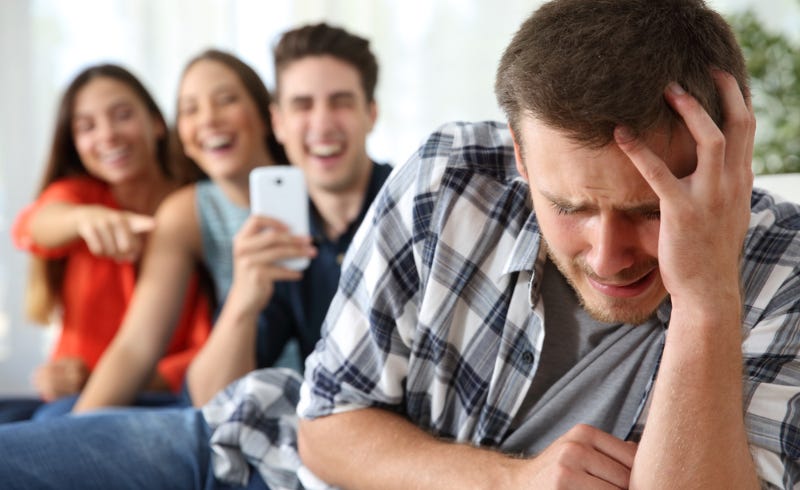
When we publicly laugh at male victims of violence, we’re mocking them for being victims. That sends a pretty clear message, and one that’s a central pillar of the manbox: Don’t be a victim.
Rapper Chris Brown got the message. In an October interview, he revealed that he lost his virginity at age 8 to a girl he thinks was 14 or 15. He talked about this as a conquest and took it as evidence of his sexual prowess — -he was irresistible at age 8. I suppose Maher would agree. But many writers called it rape and rightly pointed out the double standard: no one would dare suggest that an 8 year old girl who had sex with a 14 or 15 year old boy got lucky; they’d call it rape.
The double standards and the jokes hide male violence from view and are part of the reason that the US doesn’t really deal with male victims on a national level. You’ve probably never seen these stats:
- Men and boys make up approximately 75% of the victims of homicide, triple the rate of women and girls, a ratio that has remained fairly constant since 1980 according to the federal Bureau of Justice Statistics.
- The 2010 National Intimate Partner and Sexual Violence Survey revealed that approximately 6% of men — -one in 20 — -has either been raped or forced to penetrate someone else. Christopher Anderson, executive director of Male Survivor, reports that when all forms of sexual violence are combined, the rate is almost 25% of men. (see comments.) The rate of 1 in 6 men is also commonly reported.
- The National Coalition Against Domestic Violence (NCADV) estimates that 835,000 men are physically assaulted by an intimate partner every year. Assaults are committed by gay and straight men, known intimates and strangers.
- In the US Military, men “are an estimated 53% of victims, and yet nobody seems to be paying attention to them,” according to Chris Kilmartin, Distinguished Visiting Professor of Behavioral Science and Leadership at the United States Air Force Academy. Kilmartin notes that the chance of any given man in the military being sexually assaulted is lower than for any given woman, but since men make up more than 85% of the military, the total number of male victims is higher.
- In the study that Maher mocked, Bryana French and her colleagues surveyed nearly 300 high school and college males. More than 40% had been pressured to engage in sex they didn’t want to have; half of them, approximately one-fifth of all the guys who completed surveys, ended up having sex when they didn’t want to. Isn’t that the basic definition of rape: being compelled to have sex when you don’t want to?
So what? Why does it matter that we don’t take violence against boys and men seriously? A few reasons. And let me acknowledge up front that most of the individual effects aren’t unique to men.
- It reinforces our cultural notion that any male should be able to protect himself against any attacker. At this level, it tells us that any male victim is at least partly responsible for what happened. This same logic that says a woman who wears a short skirt is partly responsible for being raped. And if you’re partly responsible for your own victimization, then you don’t really deserve our sympathy or help.
- Despite the numbers, we don’t really devote national resources to solving the problems. All of the attention to sexual assault in the military has been about female victims. Discussions of male-on-male homicide only gets systematic attention as “black on black” or “inner city” violence, limiting the problem to a particular ethnic group or geographical setting. Yet boys and men of all ethnic groups and in all locations are homicide victims.
- Humor is one way we relieve stress. By telling jokes about male victims, we don’t have to deal with something that might be difficult, we can just relieve our anxiety and move on without thought.
- For individual male victims, it reinforces the notion that any male victim is less of a man because he couldn’t defend himself. Many victims are ashamed at having done something stupid that may have contributed to their victimization, but it’s often compounded for guys because they’re ashamed that they were unable to defend themselves.
- For male victims, this all makes it harder to admit they’re victims and get help. That means much less support from friends and family members. It may also mean a shorter lifespan, as Will Courtenay argues in Dying to Be Men.
- For male victims, the unhealed trauma often leads to decreased empathy for others. That’s one piece of the puzzle that’s common among school shooters, family mass murders (or “domestic terrorism” or “household terrorism”), and other acts of mass violence.
When you make a joke or laugh about male victims, you send a message to victims that you’re not entirely trustworthy. You are literally laughing at their pain. So next time you’re contemplating making fun of male victims, or laughing when someone else makes fun of them, ask yourself if that’s really the message you want to send. Maybe it’s not funny after all.
Author’s note: statistics regarding male victims of sexual abuse updated on April 24, 2014.
—
The story was previously published on The Good Men Project.
—
About Andrew Smiler
Andrew Smiler, PhD is a therapist and author residing in Winston-Salem, North Carolina (USA). He is the author of “Dating and Sex: A Guide for the 21st Century Teen Boy” and co-author, with Chris Kilmartin, of “The Masculine Self (5th edition)”. He is a past president of the Society for the Psychological Study of Men and Masculinity and has taught at Wake Forest University and SUNY Oswego. Dr. Smiler’s research focuses on definitions of masculinity. He also studies normative aspects of sexual development, such as age and perception of first kiss, first “serious” relationship, and first intercourse among 15–25 year olds. Follow him @AndrewSmiler.
The Good Men Project gives people the insights, tools, and skills to survive, prosper and thrive in today’s changing world. A world that is changing faster than most people can keep up with that change. A world where jobs are changing, gender roles are changing, and stereotypes are being upended. A world that is growing more diverse and inclusive. A world where working towards equality will become a core competence. We’ve built a community of millions of people from around the globe who believe in this path forward. Thanks for joining The Good Men Project.


