
6 Tips for Building Your Writing Calendar
You know, like actually publishing all your ideas!
Getting anything important done requires discipline & planning.
You have things to say, don’t you? Important things, meaningful ideas to share. If they’re that important, then shouldn’t you spend an hour every month sketching out a plan for how and when you’ll launch “the words” and set the world on fire with your incredible insight?
An hour a month isn’t much time to invest for thirty days of idea creation. How about the bigger picture, though? What about investing a little more time in your writing career with a six-month plan? You’ll give yourself time to build out thematic content — easier to keep going and writing about a single idea (or a few focused ones), don’t you think?
Getting started on your longer-term writing/editorial plan
- Consider all the topics you want to write about -Seasonal topics -Ideas rooted in regular events -Areas of expertise -Passion projects
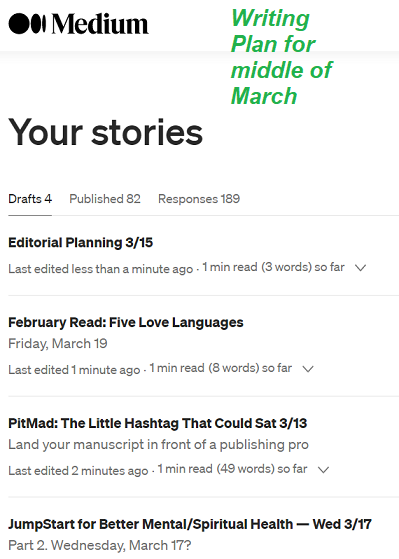
- Brainstorm a list of articles you will write for each content area This may be better explained with examples. I write about faith, writing, and then I write microfiction. a) Faith/spiritual posts might include Advent (4 weeks in December), Lent, Prayer, monthly scripture prompts on the Medium publication called Koinonia. b) My 2021 word of the year is Organize. I’m trying to figure out a plan to feature that word in a monthly post. c) I’m reading a book a month as part of a personal reading plan I built with the Ninja Writers group. I want to write about each of those books. You’ll see in my graphic below that I’m planning to write about the “Love Languages” book. It was my February read. d) Novel writing projects — I participated in Pitch Madness on Twitter on March 4, and I have notes to write up about that experience. I completed a novel during NaNoWriMo in November 2020 and had the presence of mind to write about it before last year ended. Yay me. e) So much more on my planning sheet! I cannot share it all here.
3. Identify when and where you will publish your content -What publications on Medium will accept each topic? (Have a couple in your pocket for each post.) Caution: Know all of the publication’s requirements before you submit. -When will you publish — what day of the week is best for the publication? Or what day/month fits the topic? -Will you cross-publish on your own blog? On another blog? Will you publish there before or after it appears on Medium? (I don’t feature all my Medium content on my website.)
4. Create a publishing calendar -An electronic datebook like a Google calendar may work for you -A spreadsheet may provide a big picture view of your writing plans -A day planner (yes, pen and paper!) is another option -Use both electronic and paper calendars to keep yourself organized (I use both!) -No matter the format, ensure that your calendar is “in your face” every day. Print it or set popup computer calendar reminders.
5. Start writing -Notice in the above graphic, that I planned out four content ideas for the mid-March week. Personally, I need this kind of weekly reminder. Otherwise, I quite literally forget the ideas that pop into my overactive gray matter. -Don’t beat yourself up if you don’t get all your weekly content written. (I haven’t yet this year!) -When overwhelmed by life, writing demands, whatever, focus first on the most timely content. For example, if your plan includes writing about Memorial Day, complete that before writing about a less time-bound project that’s suitable any day of the year.
6. Consider your newsletter subscribers or your social media followers -What content best fits your followers who aren’t on Medium? -What do you want to promote to other interested readers? -What is your goal in sharing certain topics with others? *I confess that I’m behind this year in aligning my newsletter content with my Medium writing calendar. I keep moving that calendar item forward until I can “get around to it.” ~remember that little wooden token?
In 2021, I’ve already nearly doubled my monthly Medium content over what I wrote last year. A low bar, but whatever. And I’ve barely followed this new planning process. Real life with my unwell husband, unfortunately, has interfered with the actual planning process. But this just goes to prove that a solid, workable plan can keep you focused and on track to produce what you must to meet your production and financial goals. Just the cerebral effort of thinking of calendars, generating ideas, and so on has helped me stay slightly on track this year.
The last three quarters of 2021 are going to be fully planned into full glory before March ends. I can’t wait to see what this does for my productivity.
Let me know if this helps you. Or if you think I’ve left something off the content creation process. Let’s learn together!
I’ll be sending out a sneak peek of my debut historical romance set in 1920s New York City. Subscribe to my monthly newsletter today so you don’t miss out.