
6 Things to Capitalize in Your Screenplay
Unlike some of the other rules of traditional screenplay formatting, the rules of capitalization are not written in stone. While each writer’s unique style will influence their individual use of capitalization, there are 6 general things that you should capitalize in your screenplay.
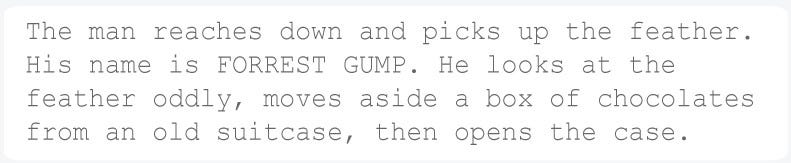
1.) The first time that a character is introduced.
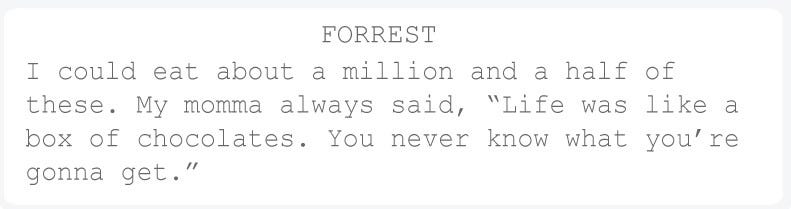
2.) Character names above their dialogue.
3.) Scene headings and slug lines.

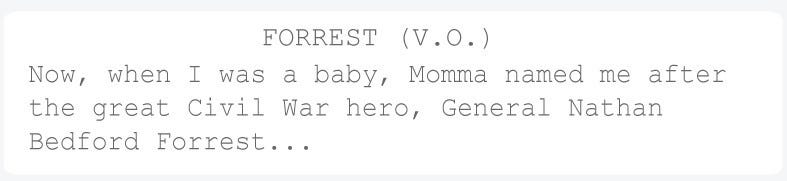
4.) Character extensions for “voice-over” and “off-screen.”
5.) Transitions, including FADE IN, CUT TO, INTERCUT, FADE OUT.
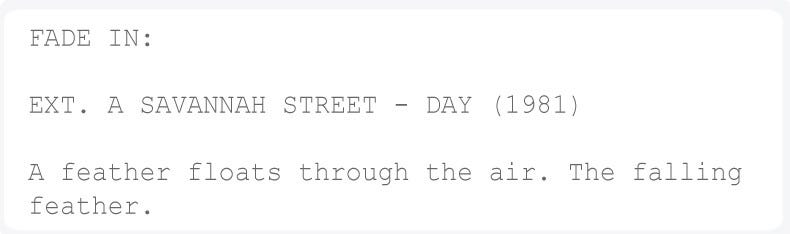
6.) Integral sounds, visual effects, or props that need to be captured in a scene.
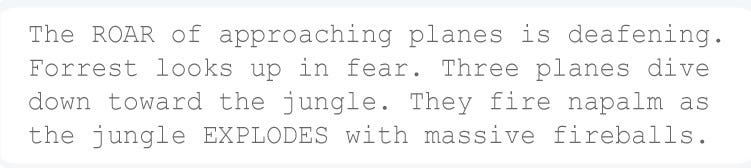
*All examples used are from the Forrest Gump screenplay, written by Eric Roth.*

Of the six uses listed above, #6 (“Integral sounds, visual effects, or props that need to be captured in a scene”) is by far the most disputed. Keep in mind that not every sound, visual effect, and prop needs to be capitalized. The number one priority is that your script is as easy to read as possible.
Ask yourself, “Does capitalizing this word enhance the reader’s experience?” if the answer to that question is a thundering “YES,” then capitalize. However, if your answer is “maybe” or “no,” it its best to not capitalize. Keep your use of capitalization for this scenario to a minimum.
There are a number of great blog posts and forum strings on this topic. Check them out here for more!:
- https://www.reddit.com/r/Screenwriting/comments/oqp5h/rscreenwriting_lets_talk_about_capitalization/#bottom-comments
- https://www.stage32.com/lounge/screenwriting/CAPITALIZATION-in-Screenplays
- https://gointothestory.blcklst.com/question-what-about-capitalizing-sounds-in-spect-scripts-c4e589c5fbeb
- http://thebitterscriptreader.blogspot.com/2009/08/when-to-capitalize-and-underline.html
- https://www.reddit.com/r/Screenwriting/comments/1y5qg4/where_do_you_land_on_capitalization_in_scripts/
What are you thoughts on capitalization? Feel free to share in the comments below!
Like our content? Clap for us and follow us on Twitter, Facebook, and Instagram.
Like our company? Join our Private Beta list to trial our new screenwriting platform next year!
Cheers to writing! -Alli Director of Community Outreach at SoCreate!


