
6 Things Zen Monks Can Teach us About Finding Calm, Focus and Presence
1. . Taming the mental chatter
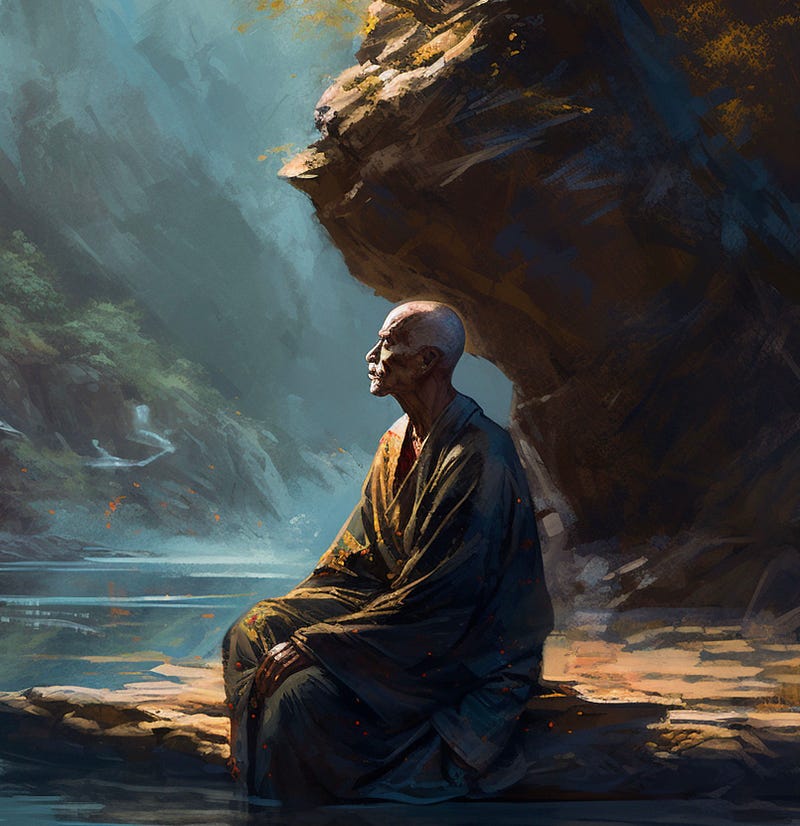
“A monk is simply a traveler, except the journey is inwards.” — Jay Shetty
The mind is like water. When it is disturbed, it reflects nothing. But if it is still, it reflects everything.
Monks understand the mind naturally wanders. Thich Nhat Hanh, a Vietnamese Zen Buddhist teacher, famously called it a “monkey mind” that swings from thought to thought.
The constant mental chatter is the enemy of calmness.
So, what do the monks do?
They train their attention.
And each time their mind wanders (because it will!), they patiently guide it back. Over time, the practice strengthens their ability to focus and reduces the background noise of their thoughts, leaving them feeling calmer and more centred.
1. Taming the mental chatter
Active and uncontrolled thoughts are like mischievous monkeys, forever swinging from branch to branch. Buddhist monk Thich Nhat Hanh says our thoughts jump from one idea to another, often without any clear direction or purpose.
The constant mental chatter is the source of our distracting, stressful, and chaotic lives, making it difficult to focus. These thoughts can be worries, plans, judgments, or simply random ideas.
To achieve monk focus, we must quiet our minds.
To tame their minds and build attention muscle, monks observe their thoughts without judgment and let them pass. To avoid the “swing” they focus on an anchor, like the breath, to gently bring their attention back when it wanders.
The repeated training strengthens their ability to observe thoughts without getting swept away, eventually leading to a calmer and more focused mind.
2. Monks are all about presence
They emphasize living in the present moment, not dwelling on the past or fretting about the future. As Shunryu Suzuki, a Japanese Zen master, said, “Treat every moment as your last. It is not preparation for something else.” He observed the only truly essential thing is this moment.
Simple, right? But how often do we truly experience the richness of the present?
We rush through experiences, never genuinely present. Monks teach us to savour the present moment. Put down your phone, listen deeply, appreciate the taste of your food, and feel the sun on your skin.
Anchor yourself in the now to cultivate a sense of peace and presence that grounds, even when everything around you screams chaos.
3. Letting go of attachment to things
A significant source of our stress is attachment. We cling to desires, possessions, and even outcomes. Attachment breeds anxiety and disappointment.
“Letting go gives us freedom, and freedom is the only condition for happiness. If, in our heart, we still cling to anything — anger, anxiety, or possessions — we cannot be free.”― Thich Nhat Hanh
Monks teach us the power of letting go. Not in a passive, resigned way, but with an active acceptance of what is. The Buddha said, “The secret of happiness lies in the mind’s release from worldly ties.” It doesn’t mean becoming a passive observer of life.
Pursue your goals, but don’t get hung up on the outcome. Enjoy your possessions, but don’t let them possess you. Letting go is how you free yourself from unnecessary burdens and cultivate inner peace.
4. On being here now
“Be where you are; otherwise you will miss your life.”— Buddha
You don’t have to retreat to a monastery to benefit from life-changing monk habits. Start with being present and conscious of wherever you are. Whatever you do, be there with all of yourself: mind, body and soul.
As Vietnamese Zen Buddhist monk Thich Nhat Hanh says, “Life is available only in the present moment.” So, breathe, be present, and find your inner wealth — you have the tools within you.
Shunryu Suzuki, a Zen Roshi, famously said, “We must exist right here, right now!” How often do we rush through life on autopilot, missing the beauty of a sunrise or the warmth of a loved one’s smile?
Pay attention to the details — the ground beneath your feet, the taste of your food. Calm and inner peace are not about emptying your mind; they are about filling it with the richness of the present.
5. Finding gratitude in the simple things
Monks often live with very little. But what they lack in material possessions, they make up for in inner wealth. They teach us to appreciate the simple things — the warmth of the sun, the taste of clean water, the laughter of loved ones.
“Gratitude is the mother of all qualities.” — Jay Shetty
Monks let go of the need for “stuff,” to create space for deeper reflection, spiritual growth, and compassion for others. True wealth is the richness of our inner experience and the depth of our connection to ourselves and our immediate world.
Start a gratitude practice. Every day, list three things you’re grateful for, no matter how small. Shifting your focus to what you have rather than what you lack is a powerful tool for cultivating contentment.
6. On Accepting what is
Release the need to be in total control. Acceptance is life-changing.
Monks understand that suffering and obstacles are inevitable. But they also teach us that suffering needn’t lead to despair.
Acceptance doesn’t mean resignation. It means acknowledging what is and choosing how you respond to it.
“The resistance to the unpleasant situation is the root of suffering.”– Ram Dass
You can’t control the events of your life, but you can control your reaction to them. Rabbi Hyman Schachtel (1954) observed “happiness is not having what you want, but wanting what you have.”
Experiences, especially bitter ones, shall pass. Don’t hold on to them; they will pass like clouds. Picture your mind as a vast, open sky.
Thoughts drift by like clouds, some dark and some light. You, the awareness, are the endless blue, observing them come and go without being carried away. With practice, you’ll find the chatter quiets, replaced by a deep well of calmness.
Monks teach us that suffering isn’t caused by events themselves but by our attachment to how things “should” be. You are not responsible for the weather, but you are responsible for how you dress for it. We can’t control the world, but we can control our reactions.
Let go of the drama of life — your inner peace depends on it.
Join my email list and receive my best essays and free curated tools for growth.


