
STRATEGY
6 Steps to OKR Event Orchestration
Objectives and Key Results can position teams for remarkable results

When teams receive prioritized assignments from leadership, their effectiveness improves. To the high performing team, few scenarios excite them more than having a clear direction and autonomy to act.
How do Objectives and Key Results Help?
Today Objectives and Key Results (OKR) have become an important tool. Developed by Andy Grove, (of Intel), the framework helps teams across all types of organizations focus on the most important. Selected to align teams to strategic goals, properly defined OKRs answer a very important question.
What is the work that matters most?
Teams have the opportunity to achieve more when they focus on the most important. Having fewer priorities bring focus. Along with greater focus comes an increased probability of accomplishing the goal. The key benefit of implementing the OKR framework is understanding work in the context of what brings the most value to the organization. Effectively, it provides a team with a mechanism for evaluating new work. Reducing interruptions and performing fewer low-value tasks allow teams to invest their best energy into high-value activities.
The framework is easy to understand and might be what your team(s) need to establish and maintain alignment. It also can complement the Agile Framework your organization may already be using.
This article explains how to convert organizational goals into achievable quarterly objectives. It also shows a practical method of bringing them to your agile teams. While the approach won’t fit every circumstance, it will help the reader think deeper about the issues they face while using OKRs on a team.
Step 1: Identifying key contributors groups
Identifying key contributors will inform how best to structure pre-planning activities. For simplicity, there are four groupings consisting of leadership, coordinators, team leaders, and team members.
Leadership: Leadership refers to those who possess the authority to set direction and make strategic decisions. These are the people we help to execute the organization’s vision. Sound followership is important to achieve alignment. Our ability to make change relies on how effectively we can deliver results. Think of it this way; achieving results are what we are paid to do.
Coordinator: These are the integrators. Those skilled with getting work accomplished through their network and influencing ability. Nearly anyone can perform this work if they can organize, communicate, and act with integrity. Typically a project manager or agile leader plays this role.
Team Leaders: These are the positional leaders within each group. If the organization has bureaucracy, these will typically be managers. We need them on board and their support. They are responsible for process, procedures, and oversight. All these enable the sustainability of the organization. To receive their best effort, consider having senior leadership send official messages. When they do, their requests are the responsibility of their managers to fulfill.
Anyone who believes they are a leader thinks about how they can give teams the credit they deserve for the work they performed yesterday and for the work they intend to do tomorrow.
Team members: The most important group; people doing the work. These are the individuals the coordinators, leadership, and team leaders are there to serve. Their voice must not be marginalized, but amplified by the coordinators. It is the team that will plot the path to success.
Step 2: Aligning the work to strategic objectives
Strategic objectives typically come from the senior leadership team and may cover up to 5 years.
Strategic objectives are statements that indicate what is critical or important in your organizational strategy. ~ Dan Wolf and Brooke Felger
Some may call them themes, priorities, or initiatives. The strategic team typically owns the process of developing, publishing, and driving understanding across the organization. The objectives are higher-level groupings that might include categories such as talent development, client relationships, financial management, or process improvements.
An example of a strategic objective might be something like,
“Deliver a remarkable experience to our clients.”
Teams within the organization contribute to the success of the objective by defining key results that can be measured. Key results should be focused on what the team has control over and can commit to for the quarter. Examples of areas where a team might find key results include:
- Higher engagement levels with published content
- Increased speed of delivery
- Increase the number of interactions with a client during the period
- An increased overall engagement score
Defining a key result that can be controlled by the team and objectively measured takes time. Let’s explore “increasing the speed of delivery”.
Context: Assuming a team takes 1 full week to produce and ship a product, a 20% increase in delivery speed translates into cutting out 1 day from the existing process. The tracking system recording when the order is placed (start date) and when it has been shipped (fulfilled) can be measured. In real terms, an order placed on Monday morning would go out the door at the end of the day Thursday versus Friday.
- Key Result: Increase the speed of delivery by 20% by the end of the quarter.
- Alternative Key Result 1: Reduce fulfillment time by 20% by the end of the quarter.
- Alternative Key Result 2: Reduce fulfillment time from 5 business days to 4 business days by the end of the quarter.
Objectives are not business as usual (BAU)
Not all important work falls into organizational objectives. This doesn’t mean the work teams do are not important. On the contrary, BAU makes defining and executing objectives possible. Strategic objectives require more focus outside the BAU or they won’t be accomplished. Teams have other mechanisms for tracking results for BAU. They are called key performance indicators (KPIs)and most operations groups follow some industry-standard of measure. KPIs can be radiated on a dashboard.
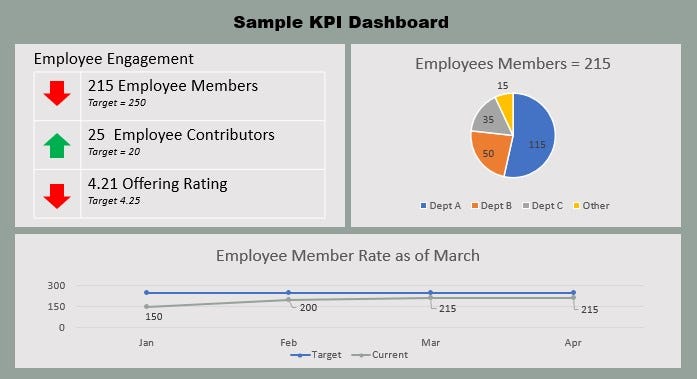
Key Performance Indicator
A word about KPIs. KPIs are important because they monitor progress. Many organizations place their KPIs on a dashboard and have control levels with upper and lower bounds. If a KPI materially changes, some action may be required.
Step 3: Pre-planning is the fulcrum of the quarterly event
After leadership establishes organizational priorities we can engage teams. Many organizations adopt quarterly OKRs and introduce a planning cadence. This frequency provides time for both planning and executing. Success begins with a pre-ceremony period I have termed “pre-planning”.
Any work required to help teams prepare for the quarterly planning ceremony falls into this grouping. Having clear goals articulated and understood by senior leadership and teams prior to the event is crucial.
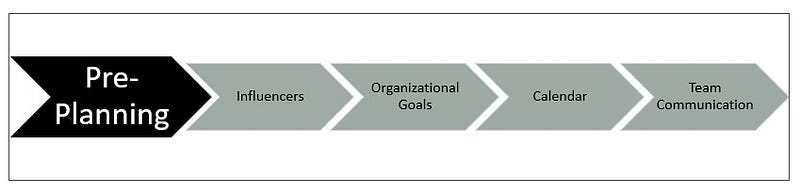
If you believe in the Pareto principle, pre-planning becomes your 20%. Spending a small amount of time on the most important activity will dramatically influence your results. Without preparing the way for your team(s) and key influencers, expect failure. You will need help across the organization prior to performing the planning event. Areas to concentrate on most include influencers, organizational goals, calendar, and communication.
- Meet with influencers: Influencers at every level can make or break any change you seek to make. Learn who they are and meet with them and listen to their concerns. If a positional leader can help, ask for it. For some, helping might be listening to your plan. For others, it might be to get hands-on and actually co-coordinate the event. Knowing you have their support early on will not only give you confidence, but positional leverage needed to move some less inclined to help. For influencers who are less supportive; we should listen to them too as they may provide the helpful insight you need to improve preparations. Potentially you may win them over if you can find common ground. If not, you know the topics to follow-up on with other supportive members or leadership. The goal is to move the team forward and align strategically with the organization. While meeting with influencers, identify who on each team can help you in the orchestration to drive alignment across all participants. Suggestion: Continue to meet informally with your key influencers because they may have new ideas to help increase buy-in across the organization.
- Focus on organizational goals: Work diligently to receive goals from both the leadership and teams separately. Team goals and roadmaps may already be published and easier to retrieve. Teams will expect senior leaders to share their goals too as most have experienced a last-minute change in direction that blows up a great plan. When reviewing various perspectives expect differences. Minor changes can typically be tied up with a discussion and wordsmithing to align teams. Reconciling material variances may take longer. Allow enough time for decision-makers and team leads to agree on what success looks like. The best collaboration results in clear and achievable key results. Suggestion: Pay attention to senior leadership communications; if something is changing bring it to team leadership to ensure planning remains aligned.
- Calendar: Communicating to meet the needs of the team members is our responsibility so they can be successful even if doing so takes more of our time. Develop and publish a calendar of activities; highlighting what teams should expect. Use multiple channels such as team calendar, organizational calendar, e-mail, and collaboration space. The benefit of a public calendar is that it reduces surprising teams. Leaders with full schedules will appreciate reminders. Their teams will need several hours over several weeks to be fully prepared. Providing them a calendar is a key ingredient to their success. Suggestion: Identify the event day and work backward. Begin pre-planning at least 6 weeks prior to the event day.
- Team Communication: More than just the dates; describe what the teams should be doing. For example, you might suggest reconciling their current plans to new leadership objectives. This helps by reducing surprises. When team leaders discuss possible changes coming, team members can help avoid serious problems and delays. Encourage team leaders to frame the work they are performing in terms of how they are achieving the objective. Showing the connection between work and leadership priorities can help people feel they are making a difference. Leading up to the event, begin meeting with an individual of each team that will aid in the orchestration activities during the event (typically a team lead, project manager, or scrum master). Suggestion: send the same messages through multiple channels on a predictable cadence.
Step 4: Planning the quarterly event
When we have the right people helping and clear objectives, orchestrating the event is simplified.
For a 2-day event (in person or virtual) the way we spend time will be similar but the logistics are different. Build a pre-event checklist and walk through the following topics with your key influencers and team leaders.
Quarterly planning checklist topics
- Propose event dates: review dates with the leadership and key influencers. Avoid dates around holidays and if you can avoid Mondays and Fridays.
- Identify participants: ensure decision-makers and key members are all identified.
- Choose a venue: If virtual, most video conferencing now has break-out rooms if needed to facilitate small group sessions. If in-person, select a location that inspires creativity and has room for an all-hands gathering as well as break out areas for teams to meet.
- Publish dates: Do this once dates have been established; at least 3 weeks prior to the event for virtual; longer for an in-person event.
- Duration of the work: These will be full days. Be sensitive to the organizational culture and how teams work together. Remember more time does not equate to more productivity.
- Send invites: Send out invites to the 2-day event. Query your influencers to review the list so you don’t miss key individuals.
- Solicit content: Ask team leaders what they think should be included that will help teams achieve objectives. Work deliberately to bring the right content to the participants. Every minute is precious.
- Secure materials: If in person, having all the necessary materials in the room and test the equipment.
- Organize content: Prioritize content that influences design or thinking about architecture or solutions to be developed.
- Develop a survey: Ensure you have a survey ready to go during the last session of day 2 so feedback is received immediately and can be shared.
This list is not comprehensive but is a good start in developing your logistical checklist to be sure everything is in place. The goal here is to create a safe environment for teams to do the work. Ensuring the logistics are well-managed takes the pressure off of team members. They will thank you when they recognize how smooth the event ran because of the thoughtful planning.
Step 5: Orchestrating the event
The goal for the morning is to ensure clear articulation of the quarterly objectives and the importance of each contributor.
The importance of hearing directly from the organizational leaders cannot be underestimated. Not only does it remove ambiguity, but it also introduces a higher level of accountability to both leaders and their teams. You may even choose to record the session if some key individuals are unable to attend so they can hear the conversation for themselves.
Following the morning session, teams break out. For self-organizing teams, this will be easier though some guidance may still be required. During pre-planning time, we identified event coordinators on each team. This is when they can shine and use their influence in helping their teams complete the event goals.
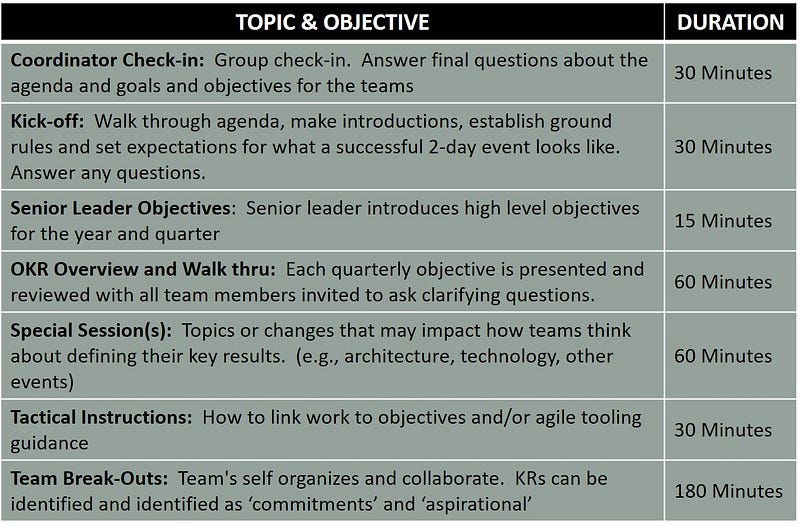
For organizations requiring more help, additional planning can be performed before the event. Specific sessions, times, topics, and agendas can be developed. If needed, a facilitator can help at the team level to time-box topics and ensure they are successful. What follows is my day 1 agenda with topics and descriptions.
Day 1 agenda
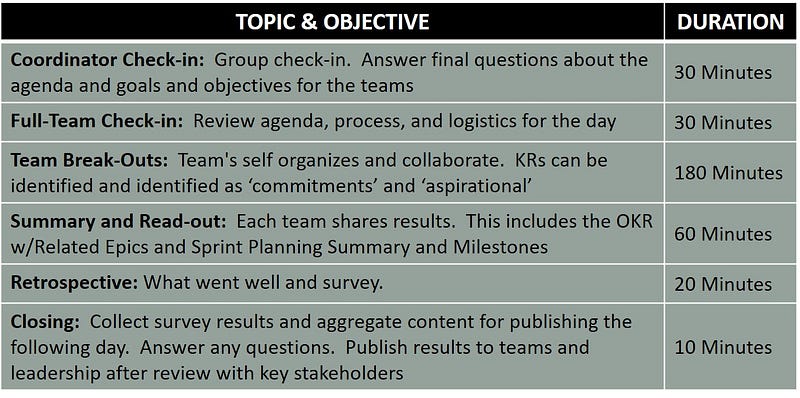
Day 2 continues with teams continuing to work together; on their terms. Experience shows teams know best how to achieve results. Giving them as much time as possible to do their work is important. A short meeting to align and ask questions starts the day to maintain alignment.
After lunch, the teams will be expected to share their outcomes. The summary will include the key results and how they will measure them. They may also identify important milestones that will occur throughout the quarter. These are especially important to senior leaders who want to have a sense of how the team is doing along the way. Having publishable milestones and a way to measure progress demonstrates the team did their job. When a team has developed their own plan and mechanism to measure they are more likely to achieve it.
After each team presents how they intend to deliver on the quarterly objectives, we begin evaluating the event. Conducting a survey during the presentation time so results are compiled within a 2-hour period works best. Then a summary and aggregation of the results can be shared with the teams and leadership right away. See the day 2 agenda below.
Day 2
Step 6: Closing and evaluating the event
Closing the event deserves attention too. It bookends work performed over the past 6–8 weeks leading up to the event. What follows will give you a good start on ending your event on a positive note while maximizing the work teams have accomplished. When done right, this ritual will make the subsequent event easier!
Considerations to end the event well
- Ask for verbal feedback: Do this throughout the event, but afterward too. As much as you can listen, listen, listen.
- Conduct a survey or poll: This will provide you with objective data that is sharable with teams and senior leadership. Use the same format each time and now you have a powerful time-series.
- Establish regular check-in meetings with key team members. Keep your key influencers informed on progress. If you have a tool to refect how teams are executing all the better. If not, have each team walk through how they are progressing using the measure they identified during the event.
- Publish dates for the next event to aid in team planning.
- Incorporate lessons learned into the next event.
- Write a summary and include survey results and share with leadership. Writing this can be a good aid to teach newer members of the team what was accomplished and how the team is working.
- Send recognition to those who helped you most. If your firm has a formal way of doing this, use it. If not, an e-mail to them with a cc to their manager can show your appreciation. Highlight what they specifically did that helped.
- Schedule follow-ups with teams that need your help. Some will.
- Share what you learn with other teams and organizations in your firm or even outside if you have an opportunity. We can all get better. Sharing also brings new ideas and partners.
Last thoughts
Performing quarterly planning offers many benefits to the organization including increased focus leading to better results. Teams are energized when they understand how the work they do contribute to the success of the firm. A well-orchestrated quarterly planning session provides the organization a pathway to superior results.
Shepherding: The art of becoming the leader others want to follow
Additional resources


