
6 Steps to Improve Your Decision Making Skills
Combining the rational and emotional to reach better decisions
In a leadership position, some decisions should be hard. Firing an employee should be hard. Restructuring your team should be hard or pivoting your business in a new direction should not be taken lightly.
Similarly, in your personal life, some decisions are naturally hard. It can have a great impact whether or not you buy a new house or choose to have a kid. It matters and it impacts others.
In business, as a leader, or in life in general you have to make decisions. Some decisions are easy to make while others will have a great impact on your life and potentially the lives of others.
Decisions should not be so hard that they stress you out or that you fear making the wrong decision. Decisions are about moving forward in life and moving forward with purpose.
With the right process and the right tools, you can greatly improve your decision-making capabilities and the results of your decisions. It’s all about having the right decision-making process, for the tough decisions especially.
Decision Making Styles
In a study on decision-making styles, El Othman et al describes five core decision-making styles we use to varying degrees. The Rational, Intuitive, Dependent, avoidant, and Spontaneous styles.
Which one do you use the most?
It is impacted by your personality traits and what is dominant for you.
The most widely used method of assessing personality traits is the Five-factor model, also known as the big five. The model refers to extroversion, openness to experience, agreeableness, conscientiousness, neuroticism. How you score on the five personality traits, will have an impact on how you make decisions.
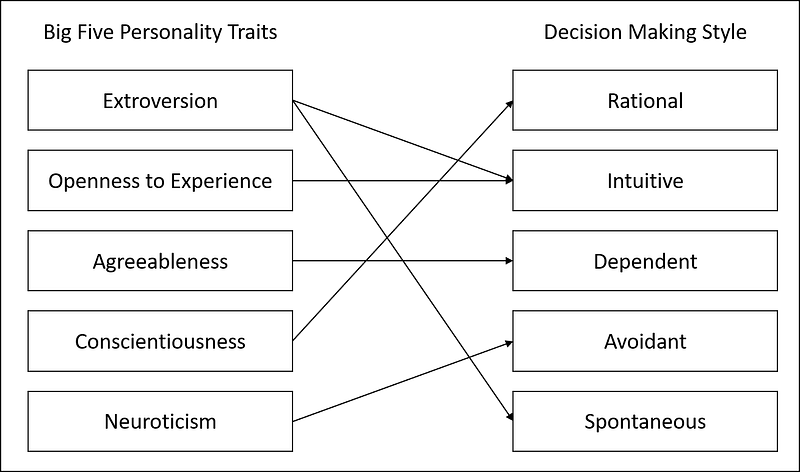
“The degree of emotional involvement in a decision may influence our choices. Especially that emotions serve as a motivational process for decision-making” El Othman et al. BMC Psychology
You can easily find free tests on the big five and get a feel for your personality and how that impacts your decision style. The key is to understand what is your go-to style and decide whether or not that is how you want to make particular hard decisions.
Decision-making process — Using Rationality
“Intuition is okay, but you don’t want to have it too early” Daniel Kahnemann
Having a good process for the harder decisions can make everything much easier. Become a master decision-maker
How to make decisions
- Set Time aside to process your decision making
- Define the problems
- Specify the parameters of your decision
- Choose your decision aid
- Test your decision or get advice
- Decide and don’t look back
Let’s dig into the details!
#1 Set Time aside to process your decision making
“Great decision-making comes from the ability to create the time and space to think rationally and intelligently about the issue at hand.” Graham Allcot
Too often we stress the decision even if it is an important one, or even worse we keep ruminating and pondering the decision at every waking moment without setting time aside to do it properly.
Choose what is an appropriate amount of time to spend on a decision and schedule that in your calendar. Make sure the time is uninterrupted and that you use it on the following steps.
#2 Define the problem
Define the decision clearly to yourself, why is this decision important to you? What will be the benefits of making the right decision? What is the decision actually about?
When we were looking to buy our first house, we did not have an unlimited budget (Surprise) so we had to agree on the most important parameters of the decision. What would be most important to my wife and what would be most important to me? We each created a list with 7–10 items and found that we had great overlap. We both wanted to be near the city center, but at the same time have some nature close by too.
We did not want to buy to the maximum of our funds, as that would put too much stress on making money. We had a 5-month-old at the time, so we also wanted a garden.
We also agreed that as those were the most important factors, then we would be willing to compromise on the size of the house and the garden.
#3 Specify your decision
Define the central factors in the decision. What are the different elements in the decision? Is this a yes/no decision or is it a decision where you have multiple scenarios?
“There are very few examples of people outperforming algorithms in making predictive judgments. So when there’s the possibility of using an algorithm, people should use it. We have the idea that it is very complicated to design an algorithm. An algorithm is a rule. You can just construct rules.” Daniel Kahnemann
Sketch out clearly what the scenarios are or what the yes or no would look like. With Yes and no decisions, what will you not be able to do if it is a yes, or what potential benefits will you lose if you choose no?
If you have multiple scenarios, like different career paths, you should put as much detail into the scenarios as possible. Potentially go back and reevaluate your parameters if they don’t fit all scenarios.
Back to the example of buying our first house. We had the parameters defined and could easily classify our decision as a yes/no decision for every house we would look at. For each house, we could easily sketch the yes or no scenario using the defined parameters and create an “algorithm” that would score the decision for us.
#4 Choose your decision aid
“Decision-making is the process of identifying and choosing alternatives based on the values and preferences of the decision-maker where the ‘decision makers’ may be a team or an individual.” Catherine Pulsifer
For yes/no decisions the easiest tool to choose is the You can use a simple Pro and Cons list and then score each of the items on both sides. See which will score the highest and reflect on how this matches your gut feeling. Identify the most important factors in the decision, rank them if possible and score them. (Example of buying our house, distance to the city is more important than the size of the house. Distance to nature. Distance to family) Make sure you don’t have the opposites on the con side and vice versa.
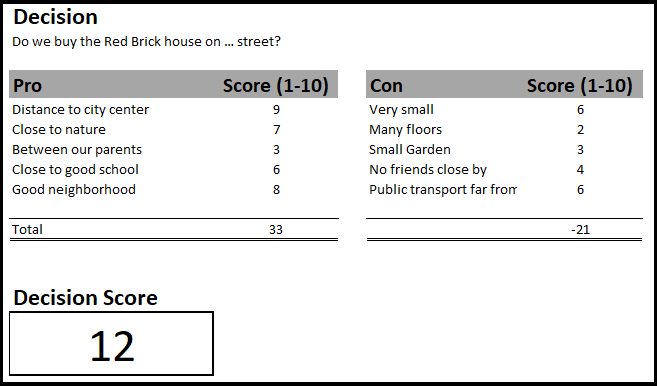
Or use a tool like a decision tree to better structure the elements of your decision to support you in making the decision.
#5 Test your decision or get advice
“Truly successful decision-making relies on a balance between deliberate and instinctive thinking.” ― Malcolm Gladwell
Test the result of the decision, before you make it final
- Pretotype your decision: https://readmedium.com/what-is-pretotyping-c0968c6ca37d
- If possible test out the decision. Try to live like you already made the decision and see how it feels.
- Use your gut feeling. Close your eyes and test it with your stomach. Does this feel right? If it doesn’t feel right, you should consider looking at your parameters again. Sleep on it and check in on the decision again in the morning. How does it feel now?
Testing out a decision may sound difficult. But back to our house example. We thought it would be great to move to the countryside. To a small village with a great community feeling and more nature. So we found a house on Air B&B and spend a couple of days living there. That was enough to tell us, that it wasn’t for us.
Seek advice from someone knowledgeable of the subject or you. Someone who can ask you the tough questions and help you reflect on the parameters of your decision.
“When you have a tough, almost unsolvable decision to make, you don’t just want people to tell you what you want to hear.” Barack Obama
#6 Decide and Don’t look back
“All my life, whenever it comes time to make a decision, I make it and forget about it.” Harry S. Truman
You have made your decision on a rational foundation. You checked it against your gut feeling. You have tested it with an advisor. You are either ready to make your decision or you need to start again.
If you are, then make the decision and feel good about it.