avatarNeeramitra Reddy

Free AI web copilot to create summaries, insights and extended knowledge, download it at here

5756

Abstract

eadmedium.com/v2/resize:fit:800/1*OyS87l6iK8PLuzqiX_jGpQ.jpeg"><figcaption>Image by <a href="https://pixabay.com/users/gene1970-7336744/?utm_source=link-attribution&amp;utm_medium=referral&amp;utm_campaign=image&amp;utm_content=5203722">gene1970</a> from <a href="https://pixabay.com/?utm_source=link-attribution&amp;utm_medium=referral&amp;utm_campaign=image&amp;utm_content=5203722">Pixabay</a></figcaption></figure><h1 id="7bba">The More We Know, the Less We Know</h1><p id="6812"><a href="https://www.goodreads.com/quotes/526642-the-more-you-know-the-more-you-know-you-don-t">Aristotle discovered</a> thousands of years ago what is now scientifically known as the <a href="https://en.wikipedia.org/wiki/Dunning%E2%80%93Kruger_effect">Dunning Kruger effect</a> — you overestimate what you know when you don’t know a lot and underestimate when you actually do.</p><p id="6466" type="7">“The more you know, the more you know you don’t know.” — Aristotle</p><p id="c9c8">When I got serious about fitness the first time and achieved a body transformation, I hoisted myself onto a fitness expert high horse.</p><p id="9365">Over the years, as I’ve learned more and more, I’ve climbed down from Mt. Stupid and now consider myself to be much less of a fitness expert than I did back then.</p><figure id="48fc"><img src="https://cdn-images-1.readmedium.com/v2/resize:fit:800/0*6OkwxZsKYW0fgvfK.png"><figcaption><a href="https://www.google.com/url?sa=i&amp;url=https%3A%2F%2Fcommons.wikimedia.org%2Fwiki%2FFile%3ADunning-Kruger-Effect.png&amp;psig=AOvVaw03gd9alwLQqzRmn4l06MsS&amp;ust=1620477349944000&amp;source=images&amp;cd=vfe&amp;ved=0CA0QjhxqFwoTCJiAv9nKt_ACFQAAAAAdAAAAABAD">Wikimedia Commons</a></figcaption></figure><p id="df5c"><b>Knowledge is infinite</b> and the more we learn about something, the more we tend to grasp this fact. It’s like standing in a dark room with a torch and the brighter it glows, the larger we realize the room is.</p><p id="48e3">We could dedicate our entire lives to one topic yet not learn everything about it. Even in the fields that we think we have expertise in, we’ve actually barely scratched the surface. It’s humbling when you think about it.</p><p id="642a">Moreover, humanity as a whole knows very little. Questions like <i>“Does God exist?”, “Is there extra-terrestrial life?”, “What is the meaning of life?”, </i>and <i>“What happens after death?”</i> still baffle us.</p><p id="a309">Maybe <a href="https://en.wikipedia.org/wiki/I_know_that_I_know_nothing">what Socrates has said is</a> the highest wisdom — <b>“I know that I know nothing.”</b></p><p id="becf">This is exactly why we need to be humble and remember that there’s <i>always</i> more to know. We don’t want to be stuck on Mount Stupid, do we?</p><h1 id="7c3f">A Baffling Logical Conundrum</h1><p id="4595">At the <a href="https://undsci.berkeley.edu/article/whatisscience_01#:~:text=Science%20is%20both%20a%20body%20of%20knowledge%20and%20a%20process.&amp;text=Just%20as%20importantly%2C%20science%20is,understandings%20of%20the%20natural%20world.">core of scientific research</a> is the attempt to make better sense of ourselves and the universe. But trying to understand ourselves <a href="https://quoteinvestigator.com/2016/03/05/brain/#:~:text=As%20it%20was%20succinctly%20put,that%20we%20couldn't.%E2%80%9D">poses a baffling logical conundrum</a>:</p><p id="2ad0" type="7">“If the human brain were so simple that we could understand it, we would be so simple that we couldn’t.”</p><p id="d771" type="7">— Emerson Pugh</p><p id="cd98">The <b>brain is trying to understand itself using itself. </b>But this is an endless and futile pursuit — as the <a href="https://en.wikipedia.org/wiki/Ouroboros">Ouroboros</a> or the serpent that dines on itself for existence depicts.</p><figure id="4739"><img src="https://cdn-images-1.readmedium.com/v2/resize:fit:800/0*_cwZXFCgHL6eqXaf.jpg"><figcaption><a href="https://pixy.org/813392/">Pixy.org</a></figcaption></figure><p id="f781">This leads to the scary insight that <b>we’ll <i>never </i>be able to understand ourselves completely</b>. No matter how much we try, we’ll only get closer and closer to the truth but never reach it. But this is great news at the same time!</p><p id="052f">It solved an internal conflict I used to have— not being able to understand myself completely. Every time I thought I understood myself, I’d do, say or think something that would leave me at a loss.</p><p id="9624">The realization that I’ll never be able to understand myself completely gave me internal peace. Now, I only strive to improve my understanding of myself.</p><p id="24dc">When you happen to do, say or think things that don’t align with who you think you are, don’t beat yourself up. Rather use it to further your understanding of yourself.</p><p id="19b1">And in that sense self-improvement is all about self-learning.</p><h1 id="53dd">What Being Insane Could Really Be</h1><p id="286f">Growing up, I used to think that being insane was the result of something going wrong with the brain’s circuitry. But ever since I went down the thinker rabbit hole, my perception of it has <i>drastically</i> changed.</p><p id="09af"><b>Our worlds <a href="https://en.wikiversity.org/wiki/Does_objective_reality_exist%3F">are our individual perceptions of objective reality</a></b>, so things like truth, right, wrong, etc. are subjective. So it’s natural for us to have different worldviews, opinions, and beliefs.</p><p id="c802">Then isn’t sanity nothing but holding a worldview and beliefs that <i>many</i> others share?</p><p id="526d" type="7">“Perhaps a lunatic is simply a minority of one.”</p><p id="d403" type="7">— George Orwell</p><p id="1176">If only a few people in the world held a particular wor

Options

ldview and set of beliefs, we’d term them pagan or queer. What if only one person did?</p><p id="6122">We’d term him insane.</p><p id="b091">Many famous thinkers like <a href="https://en.wikipedia.org/wiki/Nikola_Tesla">Nikola Tesla</a>, <a href="https://www.vangoghmuseum.nl/en/stories/on-the-verge-of-insanity">Vincent Van Gogh</a>, <a href="https://en.wikipedia.org/wiki/Later_life_of_Isaac_Newton#:~:text=During%20the%20period%201692%E2%80%931693,friends%20showing%20signs%20of%20irrationality.">Newton</a>, and <a href="https://mindhacks.com/2006/12/01/what-caused-nietzsches-insanity-and-death/">Nietzsche</a> to name a few are said to have gone insane at some point in their lives. But could it mean that they happened to come up with some insight that no one else in the world could comprehend?</p><p id="ba9c">So, <b>insanity might not only be not being sane enough but also<i> too</i> sane</b>. This gave me a newfound respect and appreciation for everyone’s beliefs and perspectives, irrespective of how queer they may seem to be.</p><p id="f9e1"><b>None of us know anything</b>, we’re all trying to make sense of the world, each in our own way. So hold your own truth, beliefs, and opinions, but respect ones of others.</p><figure id="bf02"><img src="https://cdn-images-1.readmedium.com/v2/resize:fit:800/1*J1E6HkHJqTGwW1b10iB7_w.jpeg"><figcaption>Image by <a href="https://pixabay.com/users/kellepics-4893063/?utm_source=link-attribution&amp;utm_medium=referral&amp;utm_campaign=image&amp;utm_content=3186483">Stefan Keller</a> from <a href="https://pixabay.com/?utm_source=link-attribution&amp;utm_medium=referral&amp;utm_campaign=image&amp;utm_content=3186483">Pixabay</a></figcaption></figure><h1 id="7d6a">A Millenia-Old Puzzle</h1><p id="1fe5">Since the beginning, the existence of God has puzzled humankind. Back when we were primitive, it was widely accepted that God(s) existed but as we’ve progressed, <a href="https://en.wikipedia.org/wiki/Atheism#:~:text=Atheism%2C%20in%20the%20broadest%20sense,that%20there%20are%20no%20deities.">Atheism</a> has also steadily risen.</p><p id="6bdd">I’m an Atheist myself but it’s <i>not </i>out of a certainty that God doesn’t exist. It’s that to me, the evidence favoring science seems more than that favoring the existence of God. <a href="https://www.goodreads.com/quotes/63480-is-man-merely-a-mistake-of-god-s-or-god-merely">This quote</a> brilliantly encapsulates the God vs Science question.</p><p id="040a" type="7">“Is man merely a mistake of God’s? Or God merely a mistake of man?”</p><p id="f82a" type="7">― Friedrich Nietzsche</p><p id="dd1d">If God exists, wouldn’t he view humankind as a sore mistake? — Ever since we’ve existed, we’ve driven thousands of species to extinction, destroyed nature, and made a <i>complete </i>mess of the planet. I’m sure we can all agree that <b>the planet would be much better off without us</b>.</p><p id="e901">So, why would God who is infallible and omnipotent make such a mistake? On the other hand, if God doesn’t exist, wouldn’t the existence of religions be holding us back from making maximal scientific progress?</p><p id="faaf">As of now, we can neither prove the existence of God nor disprove it so this is a question that’ll continue to baffle us. Either way, we need to be more responsible and realize that the other species are as much part of the earth as we are.</p><p id="6a01">The Earth is our only home and it can take care of us only as long as we take care of it.</p><h1 id="aeb7">Final Thoughts</h1><p id="9041">In the cesspool of cliche and overused generic quotes, the mindblowing ones are rare as diamonds. When you do come across such ones, I urge you to look beyond the quotes— a mind-blowing quote is often the door to a goldmine of mind-blowing wisdom.</p><p id="48ec">Look up the person that said it, their other quotes, their works if any, and so on. It’s thanks <a href="https://www.goodreads.com/quotes/1219460-choose-not-to-be-harmed-and-you-won-t-feel-harmed-don-t">to a stray quote</a> that I discovered <a href="https://en.wikipedia.org/wiki/Stoicism#:~:text=Stoicism%20teaches%20the%20development%20of,the%20universal%20reason%20(logos).">Stoicism</a> which has completely changed my life.</p><p id="a446">So don’t knock on the door but push it open as well — you never know what treasures you might find.</p><h2 id="fdb4">Want to Start Each Day with Peak Energy, Motivation, and Focus? Grab Your Free Copy of God-Mode Mornings</h2><div id="dc8f" class="link-block"> <a href="https://readmedium.com/7-quotes-that-have-actually-changed-my-life-bfece8b68d3f"> <div> <div> <h2>7 Quotes That Have Actually Changed My Life</h2> <div><h3>And can hopefully change yours.</h3></div> <div><p>medium.com</p></div> </div> <div> <div style="background-image: url(https://miro.readmedium.com/v2/resize:fit:320/1*se8AQUY5G0wgm5BXR_r34Q.jpeg)"></div> </div> </div> </a> </div><div id="467f" class="link-block"> <a href="https://readmedium.com/6-teachings-from-4-philosophies-that-have-changed-my-life-f63ac4419b48"> <div> <div> <h2>6 Teachings from 4 Philosophies that Have Changed My Life</h2> <div><h3>From dealing with suffering to understanding the meaning of life.</h3></div> <div><p>medium.com</p></div> </div> <div> <div style="background-image: url(https://miro.readmedium.com/v2/resize:fit:320/1*c6pllIVpdGEsqnJwELuQ_Q.jpeg)"></div> </div> </div> </a> </div></article></body>

6 Quotes That Absolutely Blew My Mind When I Came Across Them

Worlds of wisdom packed in just a few words

Image by Billy A from Pixabay

Quotes are everywhere — on the internet, in our social media feeds, as wallpapers, and as wall posters. Most are cliche “feel-good” nuggets, some offer good life advice, and few, very few are outright mindblowing.

You know the quotes that make you pause, suck in your breath, and just go “WOWWWWWWW!”. In a few words, they challenge your worldview, drastically widen your perspective, or deliver a mind-numbing insight.

They burn themselves into your memory and even years later, you’ll be able to recall them with the same awe. Here are 6 such quotes.

Every Human Being Has Two Lives

“We have two lives and the second begins when we realize we only have one”

— Confucius

Such profound wisdom in such a treacherously simple quote. We have only one life but how many of us truly realize it?

Most of us just run the hamster wheel of society — Get good grades in school. Get into a good university. Get good grades again. Land a well-paying job. Slave away. Live paycheck to paycheck. Get married. Hate your job but continue to slave away. Finally, get rid of the student loan. Have kids. The paycheck is increasing but so are your expenses. Continue to slave away. Pay for your kids’ education. Pull them into the wheel as well. Then retire as they start to slave away at jobs they hate.

It’s a fine plan, isn’t it? — Burn away the prime years and most of our life. Only to spend a decade or less sitting on the porch reading a newspaper and hobbling around with creaking joints.

There’s only one life. Only one to do the things we love, to tick things off our bucket lists, to meet amazing people, to do goofy shit, to get our hormones racing, to forge unforgettable memories.

And to be able to say with a wistful smile, “It was one heck of a life!” when our grandchildren ask.

Earlier, to me, success used to mean hustling hard, climbing up the rungs of the professional ladder, racking in millions, and buying fancy cars. But now, I’d say my present “normal” life is perfect — a “9 to 5” I enjoy, clinking dumbbells at the gym, weaving my thoughts into words, wholesome conversations with my buddies, losing track of time with my girlfriend, laughing my ass off with my family, sinking into the couch with a book, and catching at least 8+ hours of z’s every night.

It’s not all rosy, no life is. But with ample time for the things that really matter, it’s a great life.

Making the shift from the path society has laid out for us to laying one for ourselves involves choosing risk over stability, self-contentment over social validation, and meaning over money.

It isn’t easy but it’s extremely rewarding.

What Suffering Really Is

Factors outside our control dictate more than 90% of our lives. This means that adversity can strike when we least expect it. But how we choose to react to and perceive any situation is completely up to us.

In other words, adversity is inevitable but suffering is a choice. And this beautiful quote says just this,

“Choose not to be harmed — and you won’t feel harmed. Don’t feel harmed — and you haven’t been.” — Marcus Aurelius

When I recently developed a severe migraine, this thought greatly alleviated my suffering. Instead of clutching my head and writhing in pain, I managed to calmly sit in my chair and largely ignore the pain.

Similarly, my first brush with insomnia had driven me to the brink of sanity but when the second one hit, I persevered easily.

Not only physical pain but this thought can also make it easy to deal with any scale of adversity — from the small stinging remark of a work colleague to the heavy demise of a loved one.

The key thing to understand here is that you aren’t trying to endure suffering but choosing not to suffer at all in the first place.

Instead of being a soldier in the heat of battle, you take on the role of a distant observer. Initially, it takes fervent reaffirmation but over time, as it gets programmed into your subconscious brain, it gets easier.
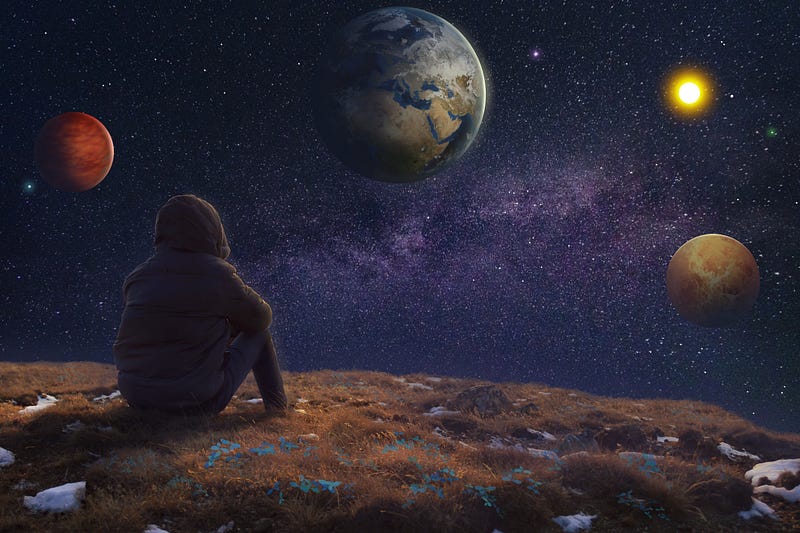
Image by gene1970 from Pixabay

The More We Know, the Less We Know

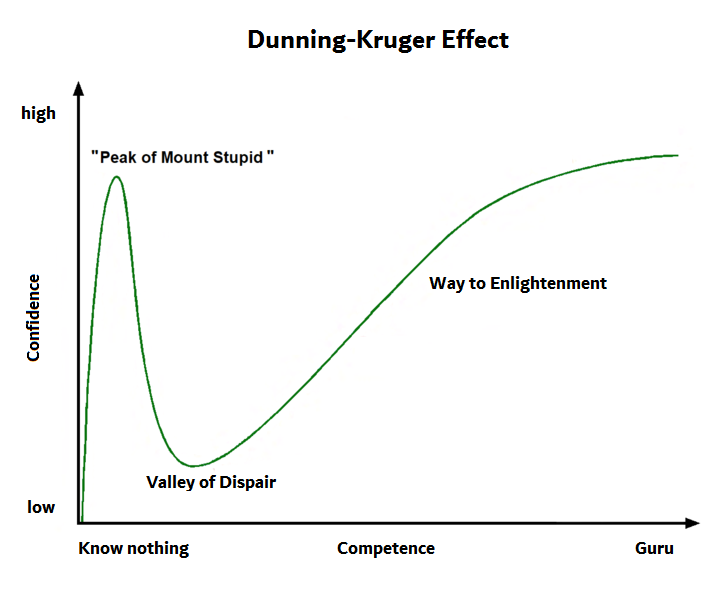
Aristotle discovered thousands of years ago what is now scientifically known as the Dunning Kruger effect — you overestimate what you know when you don’t know a lot and underestimate when you actually do.

“The more you know, the more you know you don’t know.” — Aristotle

When I got serious about fitness the first time and achieved a body transformation, I hoisted myself onto a fitness expert high horse.

Over the years, as I’ve learned more and more, I’ve climbed down from Mt. Stupid and now consider myself to be much less of a fitness expert than I did back then.
Wikimedia Commons

Knowledge is infinite and the more we learn about something, the more we tend to grasp this fact. It’s like standing in a dark room with a torch and the brighter it glows, the larger we realize the room is.

We could dedicate our entire lives to one topic yet not learn everything about it. Even in the fields that we think we have expertise in, we’ve actually barely scratched the surface. It’s humbling when you think about it.

Moreover, humanity as a whole knows very little. Questions like “Does God exist?”, “Is there extra-terrestrial life?”, “What is the meaning of life?”, and “What happens after death?” still baffle us.

Maybe what Socrates has said is the highest wisdom — “I know that I know nothing.”

This is exactly why we need to be humble and remember that there’s always more to know. We don’t want to be stuck on Mount Stupid, do we?

A Baffling Logical Conundrum

At the core of scientific research is the attempt to make better sense of ourselves and the universe. But trying to understand ourselves poses a baffling logical conundrum:

“If the human brain were so simple that we could understand it, we would be so simple that we couldn’t.”

— Emerson Pugh

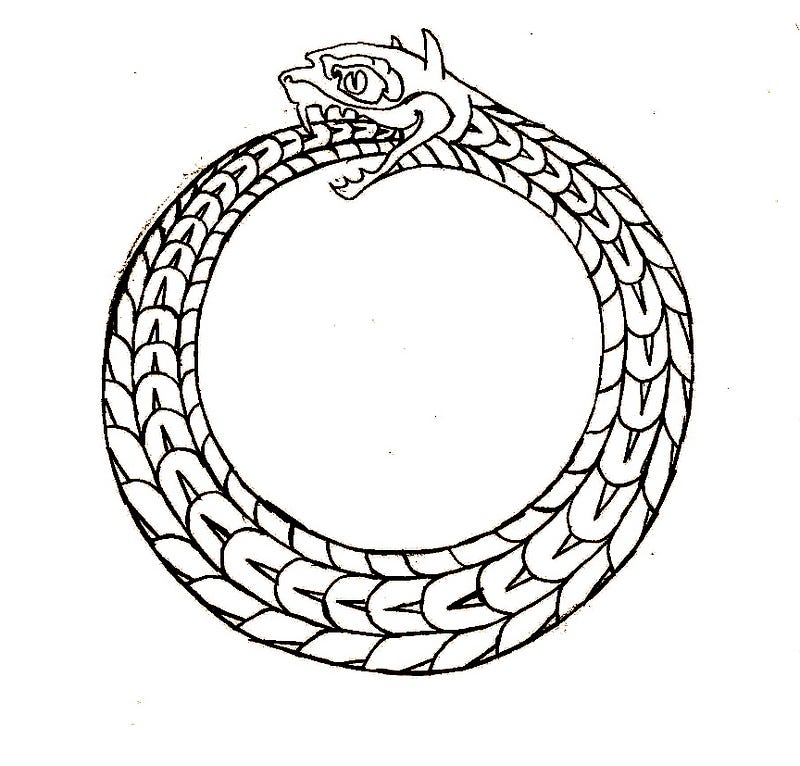
The brain is trying to understand itself using itself. But this is an endless and futile pursuit — as the Ouroboros or the serpent that dines on itself for existence depicts.
Pixy.org

This leads to the scary insight that we’ll never be able to understand ourselves completely. No matter how much we try, we’ll only get closer and closer to the truth but never reach it. But this is great news at the same time!

It solved an internal conflict I used to have— not being able to understand myself completely. Every time I thought I understood myself, I’d do, say or think something that would leave me at a loss.

The realization that I’ll never be able to understand myself completely gave me internal peace. Now, I only strive to improve my understanding of myself.

When you happen to do, say or think things that don’t align with who you think you are, don’t beat yourself up. Rather use it to further your understanding of yourself.

And in that sense self-improvement is all about self-learning.

What Being Insane Could Really Be

Growing up, I used to think that being insane was the result of something going wrong with the brain’s circuitry. But ever since I went down the thinker rabbit hole, my perception of it has drastically changed.

Our worlds are our individual perceptions of objective reality, so things like truth, right, wrong, etc. are subjective. So it’s natural for us to have different worldviews, opinions, and beliefs.

Then isn’t sanity nothing but holding a worldview and beliefs that many others share?

“Perhaps a lunatic is simply a minority of one.”

— George Orwell

If only a few people in the world held a particular worldview and set of beliefs, we’d term them pagan or queer. What if only one person did?

We’d term him insane.

Many famous thinkers like Nikola Tesla, Vincent Van Gogh, Newton, and Nietzsche to name a few are said to have gone insane at some point in their lives. But could it mean that they happened to come up with some insight that no one else in the world could comprehend?

So, insanity might not only be not being sane enough but also too sane. This gave me a newfound respect and appreciation for everyone’s beliefs and perspectives, irrespective of how queer they may seem to be.

None of us know anything, we’re all trying to make sense of the world, each in our own way. So hold your own truth, beliefs, and opinions, but respect ones of others.
Image by Stefan Keller from Pixabay

A Millenia-Old Puzzle

Since the beginning, the existence of God has puzzled humankind. Back when we were primitive, it was widely accepted that God(s) existed but as we’ve progressed, Atheism has also steadily risen.

I’m an Atheist myself but it’s not out of a certainty that God doesn’t exist. It’s that to me, the evidence favoring science seems more than that favoring the existence of God. This quote brilliantly encapsulates the God vs Science question.

“Is man merely a mistake of God’s? Or God merely a mistake of man?”

― Friedrich Nietzsche

If God exists, wouldn’t he view humankind as a sore mistake? — Ever since we’ve existed, we’ve driven thousands of species to extinction, destroyed nature, and made a complete mess of the planet. I’m sure we can all agree that the planet would be much better off without us.

So, why would God who is infallible and omnipotent make such a mistake? On the other hand, if God doesn’t exist, wouldn’t the existence of religions be holding us back from making maximal scientific progress?

As of now, we can neither prove the existence of God nor disprove it so this is a question that’ll continue to baffle us. Either way, we need to be more responsible and realize that the other species are as much part of the earth as we are.

The Earth is our only home and it can take care of us only as long as we take care of it.

Final Thoughts

In the cesspool of cliche and overused generic quotes, the mindblowing ones are rare as diamonds. When you do come across such ones, I urge you to look beyond the quotes— a mind-blowing quote is often the door to a goldmine of mind-blowing wisdom.

Look up the person that said it, their other quotes, their works if any, and so on. It’s thanks to a stray quote that I discovered Stoicism which has completely changed my life.

So don’t knock on the door but push it open as well — you never know what treasures you might find.

Want to Start Each Day with Peak Energy, Motivation, and Focus? Grab Your Free Copy of God-Mode Mornings

Philosophy
Self Improvement
Life Lessons
Quotes
Inspiration
Recommended from ReadMedium